Social influence
 Call Kai
 Learn
 Practice Test
 Spaced Repetition
 Match
 Flashcards
 Knowt Play
1/41

There's no tags or description
Looks like no tags are added yet.
42 Terms
Obedience situational explanations
Agentic state
Milgram's initial interest in obedience bc→trial of Adolf Eichmann in 1961 for war crimes.
Eichmann had been in charge of the Nazi death camps and his defence was that he was only obeying orders.
So Milgram proposed that obedience to destructive authority occurs because a person does not take responsibility.
Instead they believe they are acting for someone else, i.e. that they are an 'agent’
Agent:
someone who acts for or in place of another.
not an unfeeling puppet - they experience high anxiety (moral strain) when they realise that what they are doing is wrong, but feel powerless to disobey

Autonomous state
opposite of being in an agentic state
Autonomy-independent/free.
So a person in an autonomous state is free to behave according to their own principles and feels a sense of responsibility for their own actions

Agentic shift
Agentic shift- shift from autonomy→agency
Milgram (1974) suggested that this occurs when a person perceives someone else as an authority figure:
The authority figure- greater power bc higher position in a social hierarchy.
In most social groups, when one person is in charge others defer to the legitimate authority of this person and shift from autonomy to agency.
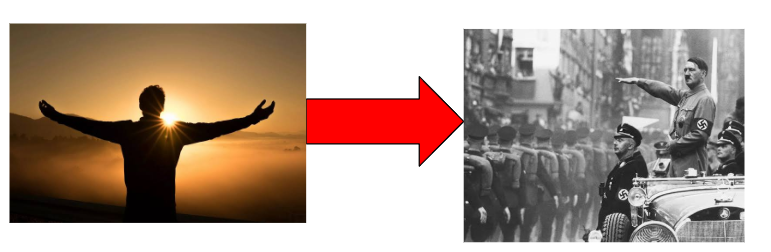
Binding factors
Milgram observed that many of his participants said they wanted to stop but seemed powerless to do so.
Remained in an agentic state bc of binding factors
Binding factors-aspects of the situation that allow the person to ignore or minimise the damaging effect of their behaviour and thus reduce the 'moral strain they are feeling.
Milgram proposed a number of strategies that the individual uses, eg:
shifting the responsibility to the victim (he was foolish to volunteer)
denying the damage they were doing to the victims.
Agentic state evaluation:
Research support
One strength is that Migram's own studies support the role of the agentic state in obedience
Most participants resisted giving the shocks at some point:
often asked the Experimenter questions about the procedure.
One of these was Who is responsible if Mr Wallace (the Learner) is harmed? When the Experimenter replied I’m responsible, the participants often went through the procedure quickly with no further objections.
This shows that once participants perceived they were no longer responsible for their own behaviour they acted more easily as the Experimenter's agent
Supporting agentic state as Milgram suggested

Agentic state evaluation:
A limited explanation
Limitation- agentic shift doesn't explain many research findings about obedience
Eg. doesn’t explain the findings of Steven Rank and Cardell Jacobson's (1977) study:
They found that 16 out of 18 hospital nurses disobeyed orders from a doctor to administer an excessive drug dose to a patient.
The doctor was an obvious authority figure. But almost all the nurses remained autonomous, as did many of Milgram’s paricipants.
Practical implication of this:
individuals retain personal moral agency even in hierarchical settings.
Factors eg. training, expertise, and ethical awareness can actively prevent people from entering an agentic state, highlighting that blind obedience to authority is not an inevitable outcome in real-world environments like healthcare.
This suggests that, at best, the agentic shift can only account for some situations of obedience and other factors than agentic state also influences obedience

Agentic state evaluation:
Obedience alibi revisited
Limitation-challenged by real-world historical events.
Mandel (1998) analysed the actions of German Reserve Police Battalion 101 during WWII, who executed civilians in Poland despite explicitly being offered alternative duties by their commander if they chose not to shoot.
This directly contradicts Milgram’s theory, as these men acted autonomously rather than shifting responsibility to a commanding officer. Since they were not coerced or ordered under threat, their behavior cannot be explained by an agentic shift.
This implies that the agentic state is an oversimplified explanation for destructive obedience. Destructive obedience also driven by dispositional factors
Legitimacy of authority
Societies are structured in a hierarchical way:
Means people in certain positions hold authority over the rest of us.
eg. parents/teachers/police officers/nightclub bouncers have authority over us at times.
Authority they wield is legitimate bc agreed by society.
Most accept that authority figures have to be allowed to exercise social power over others because this allows society to function smoothly.
Consequence of legit authority:
some people are granted the power to punish others.
Agree police and courts have the power to punish wrongdoers→ willing to give up some of our independence and to hand control of our behaviour over to people we trust to exercise their authority appropriately.
We learn acceptance of legitimate authority from childhood, from parents initially and then teachers and adults generally.

Destructive authority
Problems arise when legitimate authority becomes destructive.
eg. charismatic and powerful leaders (such as Hitler, Stalin and Pol Pot) can use their legitimate powers for destructive purposes→ ordering people to behave in ways that are cruel and dangerous
Destructive authority was obvious in Milgram's study, when the Experimenter used prods to order participants to behave in ways that went against their consciences.

Legtimacy of authority evaluation:
Explains cultural differences
Strength- it’s a useful account of cultural differences in obedience.
Many studies show that countries differ in the degree to which people are obedient to authority. eg.Kilham and Mann (1974) found that only 16% of Australian women went all the way up to 450 volts in a Milgram-style study. However, David Mantell (1971) found a very different figure for German participants - 85%.
This shows that, in some cultures, authority is more likely to be accepted as legitimate and entitled to demand obedience from individuals.
This reflects the ways that different societies are structured and how children are raised to perceive authority figures.

Legtimacy of authority evaluation:
Cannot explain all (dis)obedience
Limitation is that legitimacy cannot explain instances of disobedience in a hierarchy where the legitimacy of authority is dear and accepted.
Nurses in Rank and Jacobson's study:
Most disobedient despite working in a rigidly hierarchical authority structure.
Also, a significant minority of Milgram's participants disobeyed despite decognising the Experimenter's scientific authority.
This suggests that some people in general may just be more (or less) obedient than others
It is possible that innate tendencies to obey or disobey have a greater influence on behaviour than the legitimacy of an authority figure.
Legitimacy of authority evaluation:
Real-world crimes of obedience
Strength- high external validity, as it successfully accounts for real-world crimes of obedience.
Kelman and Hamilton (1989) argued that real-world atrocities, such as the My Lai massacre during the Vietnam War, can be understood through the US Army's rigid hierarchy. Soldiers obeyed orders to murder innocent civilians because their commanding officers held recognised authority and had severe power to punish.
Supports legit authority explanation →shows when an authority figure is perceived as legitimate within a clear hierarchy, individuals yield their personal moral agency to that authority.
Through this understanding, authority structures (eg. armies/ healthcare) can use mechanisms to encourage individuals to question destructive orders and not blindly follow them as they believe the authority is legitimate
-
My Lai massacre- additional info
Milgrams findings used to explain horrors of My Lai massacre (war crime)
504 unarmed civillians killed
Women gang raped
Soldiers burned villages to ground
Only Lft. Calley faced charges+found guity
Defence was that he only followed orders

Nurses and obedience- additional info
Hoffing et al. (1966):
unknown doctor to telephone 22 nurses and ask each of them (alone) to administer an overdose of a drug that was not on their ward list (Astroten').
21/22 started to administer the drug (they were prevented from continuing). The nurses obeyed without question.
Rank and Jacobson (1977):
replicated Hofling et al. 's study but altered some aspects of the original procedure that might have maximised obedience, instead:
told by a doctor to administer an overdose of valium, a real drug that the nurses would have been familiar with.
Doctor's name was also known to the nurses and they all had the chance to discuss the order with each other.
More realistic circumstances= 2/18 nurses obeyed the doctor's order (before they were prevented from carrying it out).

Dispositional explanations for obedience
Dispositional explanations
Any explanation of behaviour that highlights the importance of the individual's personality (i.e. their disposition). Such explanations are often contrasted with situational explanations.
The Authoritarian Personality
Like Milgram, Adorno wanted to understand the anti-Semitism of the Holocaust.
Research→draw very different conclusions from M
High level of obedience was basically a psychological disorder (pathological).
Causes of such a disorder lie in the personality of the individual rather than in the situation, ie. it is a dispositional explanation

Authoritarian Personality (AP) and obedience
Adorno argued, all ppl with AP:
show an extreme respect for (and submissiveness to) authority.
view society as 'weaker' than it once was, so believe we need strong and powerful leaders to enforce traditional values such as love of country and family.
Both of these characteristics make people with an Authoritarian Personality more likely to obey orders from a source of authority.
show contempt for those of inferior social status→fuelled by their inflexible outlook on the world - for them there are no grey areas.
Everything is either right or wrong and they are very uncomfortable with uncertainty.
Therefore people who are 'other' (e.g. belong to a different ethnic group) are responsible for the ills of society.
'Other' people are a convenient target for authoritarians who are likely to obey orders from authority figures even when such orders are destructive (eg. Nazi Germany).
Origins of the Authoritarian Personality
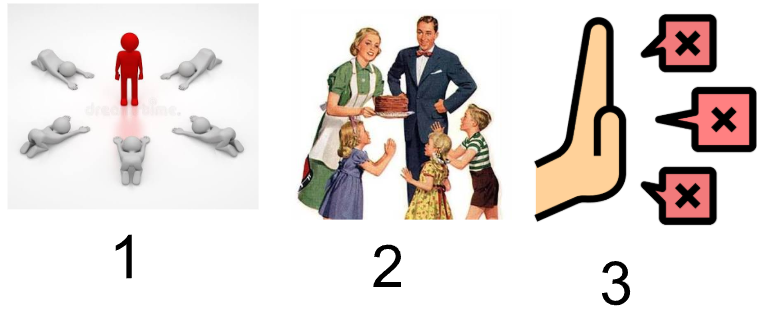
Psychodynamic explanation- Adorno believed it forms in childhood, mostly as a result of harsh parenting:
extremely strict discipline
expectation of absolute loyalty
impossibly high standards
severe criticism of perceived failings.
Parents give conditional love - love and affection for their child depends entirely on how he or she behaves (I will love you if...).
Adorno et al. argued that these childhood experiences create resentment and hostility in a child.
But the child cannot express these feelings directly against their parents because they fear punishment.
→ Scapegoating- fears are displaced onto others who they perceive to be weaker
Explains the hatred towards people considered to be socially inferior or who belong to other social groups, a central feature of obedience to a higher authority.
Adorno et al.'s research
Procedure:
Adorno et al. (1950)
studied 2000+ middle-class, white Americans and their unconscious attitudes towards other ethnic groups.
Researchers developed several measurement scales, including F-scale (potential-for-fascism scale).
F-scale:
used to measure Authoritarian Personality.
Had to rate items 1 (strongly disagree)→6 (strongly disagree)
2 egs. of items from F-scale:
Obedience and respect for authority are the most important virtues for children to learn
There is hardly anything lower than a person who does not feel great love, gratitude and respect for his parents!
Adorno et al’s authoritarian personality findings
People with authoritarian leanings (scored high on the F-scale+other measures) showed traits which are the basis of obedience:
identified with 'strong' people
contemptuous of the weak
very conscious of status (their own and others)
showed extreme respect, deference and servility to those of higher status
Authoritarian ppl- certain cognitive style (way of perceiving others)- black and white thinking (no similarities between diff types of ppl), fixed and distinctive stereotypes about other groups.
Strong positive correlation between authoritarianism and prejudice
Evaluation of authoritarian personality as an explanation for obedience:
Research support
Strength-evidence from Milgram supporting the Authoritarian Personality
Elms and Milgram (1966), interviewed a small sample of people who had participated in the original obedience studies and were fully obedient. All completed the F-scale (and other measures) as part of the interview. These 20 obedient participants scored significantly higher on the overall F-scale than a comparison group of 20 disobedient participants.The two groups were clearly quite different in terms of authoritarianism.
However, when individual subscales of the F-scale analysed, obedient participants had unusual characteristics for authoritarians eg. obedient participants generally did not glorify their fathers+didn’t experience unusual levels of punishment in childhood
Therefore, link between personality and obedience but lack of typical authoritarian background traits means the Authoritarian Personality cannot fully account for their obedience. (correlation not causation)
Evaluation of authoritarian personality as an explanation for obedience:
Limited explanation
Limitation- authoritarianism can’t explain obedient behaviour in the majority of a country's population.
Eg. pre-war Germany, millions of individuals displayed obedient and anti-Semitic behaviour. Despite differences in their personalities in all sorts of ways. Extremely unlikely that they could all possess an Authoritarian Personality.
Alternative view is that the majority of the German people identified with the anti-Semitic Nazi state, and scapegoated the 'outgroup' of Jews, a social identity theory approach.
Therefore Adorno's theory is limited because an alternative explanation is much more realistic
Evaluation of authoritarian personality as an explanation for obedience:
Political bias
Limitation- F-scale only measures the tendency towards an extreme form of right-wing ideology.
Christie and Jahoda (1954) argued that the F-scale is a politically-biased interpretation of Authoritarian Personality. They point out the reality of left-wing authoritarianism in the shape of Russian Bolshevism or Chinese Maoism.
In fact, extreme right-wing and left-wing ideologies have a lot in common. eg. emphasise the importance of complete obedience to political authority.
Adorno's theory is not a comprehensive dispositional explanation that accounts for obedience to authority across the whole political spectrum
Evaluation of authoritarian personality as an explantion for obedience:
Flawed evidence
Limitation- F-scale suffers from severe methodological flaws.
Greenstein (1969) described the F-scale as a "comedy of methodological errors" because every single item on the questionnaire is worded in the same direction. eg. can achieve a high authoritarian score simply by agreeing with every statement.
scale measures acquiescence bias (tendency to agree with statements regardless of content) rather than a genuine authoritarian personality. As a result, individuals who routinely select "agree" are incorrectly categorized as having an authoritarian disposition.
reduces the usefulness of the F-scale in explaining obedience. lacks construct validity, any support derived from it—eg. Elms and Milgram's research—may reflect measurement error rather than a true psychological explanation for obedient behavior.
Resistance to social influence
Resistance to social influence
ability of people to withstand the social pressure to conform to the majority or to obey authority.
influenced by both situational and dispositional factors.
Social support
presence of people who resist pressures to conform or obey can help others to do the same.
These people act as models to show others that resistance to social influence is possible.
Other ppl who aren’t confroming→pressure to conform can be resisted
Asch's research:
the confederate who is not conforming may not be giving the right answer.
But bc someone else is not following the majority is social support.
Enables the naive participant to be free to follow their own conscience.
confederate acts as a 'model of independent behaviour.
Their dissent gives rise to more dissent because it shows that the majority is no longer unanimous.;
pressure to obey can be resisted if there is another person who is seen to disobey.
one of Milgram's variations, rate of obedience dropped from 65% →10% when the genuine participant was joined by a disobedient confederate.
participant may not follow the disobedient person's behaviour
but other person's disobedience acts as a 'model of dissent for the participant to copy and this frees him to act from his own conscience.
disobedient model challenges the legitimacy of the authority figure, making it easier for others to disobey.;
Evaluation of social support on resisting social influence:
Real-world research support
Strength is research evidence for the positive effects of social support.
Eg. Albrecht et al. (2006) evaluated Teen Fresh Start USA, programme to help pregnant adolescents aged 14-19 resist peer pressure to smoke.:
Social support was provided by a slightly older mentor or "buddy.
At end of the programme adolescents who had a buddy' were significantly less likely to smoke than a control group of participants who did not have a buddy.
This shows that social support can help young people resist social influence as part of an intervention in the real world.
Evaluation of social support on resisting social influence:
Research support for dissenting peers
Strength-research evidence to support the role of dissenting peers in resisting obedience.
Gamson et al's (1982) participants, told to produce evidence that would be used to help an oil company run a smear campaign. ↑ resistance in their study than Milgram’s.
Probably because the participants were in groups so could discuss what they were told to do.(88%) rebelled against their orders.
shows that peer support can lead to disobedience by undermining the legitimacy of an authority figure
Evaluation of social support on resisting social influence-
Social support explanation
Limitation- resistance depends heavily on the quality and perceived competence of the supporter, rather than just their presence.
Allen and Levine (1971) conducted an Asch-type line-judging task and found that when a dissenting supporter had "good eyesight," resistance to group pressure reached 64% (compared to just 3% with no supporter). However, when the dissenter wore thick glasses and had obviously poor eyesight, resistance dropped significantly to 36%.
having a dissenter increases resistance, the effectiveness of that social support is substantially reduced if the ally is perceived as unreliable or lacking credibility in the task.
reduces the overall validity of the social support explanation. Extent to which it enables resistance heavily depends on specific situational factors like the supporter's perceived capability.
Rotter (1966) proposed locus of control (LOC)- sense we each have about what directs events in our lives.
concept concerned with internal control versus external control.
Internals-they are mostly responsible for what happens to them (internal locus of control).
Externals- mainly a matter of luck or other outside forces (external locus of control).
Some people have an internal LOC (internals) - they believe that the things that happen to them are largely controlled by themselves.
eg. do well in an exam it is because you worked hard, if you don't do well it is because you didn't work hard.
externals
tend to believe the things that happen are outside their control.
eg. did well in an exam because they used an excellent textbook vs if failed they might blame it on the textbook/ bad luck because the questions were hard.
Locus of control (LOC) continuum
People are not just either internal or external.
LOC is a scale and individuals vary in their position on it.
high internal LOC is at one end and high external at the other. Low internal and low external lie in-between
high internal LOC are more able to resist pressures to conform or obey.
if takes personal responsibility for their actions and experiences (as internals do), they tend to base their decisions on their own beliefs rather than depending on the opinions of others.
Another explanation is that people with a high internal LOC tend to be more self-confident, more achievement-oriented and have higher intelligence. traits→greater resistance to social influence.
Also characteristics of leaders, who have much less need for social approval than followers.
Evaluation of Locus of control as an explanation for resistance to social influence-
Research support
strength is research evidence to support the link between LOC and resistance to obedience.
Holland (1967) repeated Milgram's baseline study and measured whether participants were internals or externals. He found that 37% of internals did not continue to the highest shock level (l.e. they showed some resistance), whereas only 23% of externals did not continue, In other words, internals showed greater resistance to authority in a Milgram-type situation.
This shows that resistance is at least partly related to LOC, which increases the validity of LOC as an explanation of disobedience.
Evaluation of Locus of control as an explanation for resistance to social influence-2. Contradictory research