astron midterm no. 2単語カード
 Call Kai
 Learn
 Practice Test
 Spaced Repetition
 Match
 Flashcards
 Knowt Play
1/141

There's no tags or description
Looks like no tags are added yet.
142 Terms
biosphere
sum of all living and dead organisms on earth
land or ocean: which is more biologically rich
land has more kg of carbon (mostly alive), ocean has less (has a lot of dead things that washed in), underground has likely more than ocean but unknown
biome
geographical region w/ a distinct climate and set of organisms
six biomes
freshwater: water but low salt ex. ponds/lakes/streams/wetlands
marine: 75% of Earth's surface ex. oceans/reefs/estuaries
desert: hot or cold low rainfall
forest: tropical, temperate, and boreal (taiga)
grassland: land dominated by grasses ex. savannahs/temperate grasslands
tundra: coldest biome, treeless
symbiosis vs endosymbiosis
when 2 organisms interact w/ each other
when 2 organisms interact from each other and one lives inside the other
ex. microbes in the human gut that help us digest and we feed them
*does not have to be beneficial
which two things are believed to have descended from endosymbiotic bacteria
endosymbiosis is important for eukaryotic cells
both mitochondria and chloroplasts are believed to have descended from endosymbiotic bacteria
--> endosymbiosis is why eukarya contain organelles originally in bacteria
three domains of life
archaea: mostly prokaryotic; single DNA strand; more likely than bacteria to exist in extreme conditions
bacteria: prokaryotic; single DNA strand
eukarya: multiple DNA strands; cells 10x bigger than prokaryotic cells; most multiple cells
archaea are __
hardy, they are stickier and harder to separate, and stronger/more durable; which explains why some are extremephiles
which 2 domains of life are most related
archaea are more closely related to eukarya than bacteria
valence electron
electron in outermost shell of atom; farthest from nucleus and participates in reactions w/ other atoms
covalent bonds
two atoms or ions share an electron
ionic bonds
electron donor transfers an electron to the electron acceptor
gaining electrons vs losing electrons vs oxidizing agent
atom that experiences gain of electrons = reduction
atom that experiences loss of electrons = oxidation
atom that causes the oxidized atom to lose electrons = oxidizing agent
atom that is oxidized = reducing agent
equation to find how many electrons fit in each shell
2(period or row)^2
main grup elements, transition elements, inner transition elements
main group = s or p
transition = d
inner transition elements: f orbital

water is __ bond
covalent
positive, negative charged ions
cation, anion
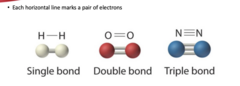
horizontal lines represent
single bond, double bond, triple bond
peptides
chain of amino acids
dipeptide = chain of 2 amino acids, tripeptide = chain of 3 amino acids, protein = chain of >=50 amino acids
amino acids
buildings blocks of proteins;
molecules with a central carbon, amino group, carboxyl group, hydrogen atom, side group
functions of proteins
- catalyzing chemical reactions (enzymes)
- transporting materials
- building cell structure
- controlling gene expression
- defending against pathogens (antibodies)
- binding/storing ions
- signaling organism to do something (hormone)

chirality, homochriality
arrangement of atoms in a molecule; homochirality = one-handedness & life uses exclusively left-handed amino acids and right-handed sugars
structure of dna
double-helix (twisted ladder shape) with bases attached to a sugar-phosphate backbone
sugar properties
a carbohydrate, hydrophillic (they like water), don't pack as efficiently as fats, good for short-term energy
dna and rna are both sugars
lipid properties
composed of fatty acids, hydrophobic and b/c of this they pack efficiently + are dense, good for long-term energy
main component of cell membranes
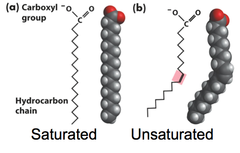
saturated vs unsaturated fatty acids
saturated: carbons are bonded to as many hydrogens as possible --> straight chains packed tightly, tend to be solid at room temp
unsaturated acids: not all carbon bonds --> bent chains, tend to be liquid at room temp
proteins are chains of
amino acids
how many detected amino acids? how many primarily used?
over 500 known; only uses 20
chirality + life uses which acids & sugars
arrangement of atoms in a molecule
- life uses left-handed amino acids
- life uses right-handed sugars
homochirality
one-handedness
hydrophilic head group
choline, phosphate, and glycerol
hydrophobic tail
fatty acid chains

RNA three letter sequences
- rna contains instructions for buidling proteins
- 3 letter sequence = codon, represents a diff amino acid

hemoglobin
folded and twisted chains
iron-rich molecule that carries oxygen * carbon dioxide in the bloodstream

why do some amino acids have more than one sequence
b/c there are more 3-base sequences than commonly used amino acids
polar amino acids
side chains include oxygen and nitrogen that easily form bonds w/ water
hydrophilic
non-polar amino acids
side chains mostly made of carbon and hydrogen
hydrophobic
evolution
gradual change in populations of living organisms
evolutionary adaptation
inherited trait that enhances organisms' ability to survive & reproduce
heredity
passage of genetic info from one generation to the next
gene
sequence of DNA/RNA that give instructions for single cell function
genome
complete sequence of DNA/RNA
mutation
random change in DNA/RNA
*doesn't have to change the function of the gene, it just has to change a letter
asexual reproduction
cell splits to make two identical cells
- full set of chromosomes on both
prokaryotes and eukaryotes use ___ to reproduce
prokaryotes perform binary fission to reproduce
eukaryotes perform mitosis to replicate cells
meiosis
genetic material from 2 diff parents combines to make new organism;
recombination
during sexual reproduction where genetic material from each parent is mixed
diploid
two sets of chromosomes
sexual reproduction is
- less efficient bc two organisms are needed
- faster large-scale genetic combinations not possible w/ asexual reproduction --> prob why cambrian explosion happened after sexual reproduction came to be
mutations can be a molecular clock!
the number of mutations can be used as a proxy for the time elapsed since two species shared a common ancestor
phylogenetic tree
- time goes from bottom to up
- length of branches = amt of genetic difference
- joints connecting = most recent common ancestor

viruses
TINY, contain DNA or RNA and protein, and cannot reproduce on their own w/o a host
bacteriophages
viruses that infect bacteria
vertical gene transfer
transfer of genetic material from parent to offspring
• one-way transfer of genes from older --> younger
generations
horizontal gene transfer (aka lateral)
transfer of genetic material from one organism to non-descendant (not parent to offspring)
• very important for evolution and spreading mutations
• more common for prokaryotes
conjugation, transformation, transduction
cell-to-cell transfer (inserting genetic material)
environment-to-cell transfer (goes through the environment and cell picks it up)
virus-mediated transfer (blasts out of og cell into new cell)

plasmids
small DNA molecules
- can reproduce independently
- small, circular, double-stranded
most extremophiles are
- bacteria or archaea, sometimes eukarya
- most are anaerobic (don't require oxygen)
mesophiles, thermophiles, and hyperthermophiles ideal heat
mesophiles (15C-45C) --> thermophiles --> (45-80C) hyperthermophiles (80C+)
humans are
mesophiles
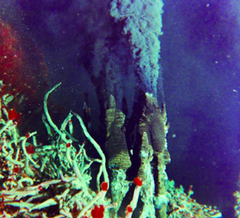
hyperthermophiles can be found
in black smoker hydrothermal vents, bottom of ocean
- organisms tend to not use oxygen
- tend to be autotroph (no sunlight to be phototrophs)
why are high temps challenging for normal organisms
biomolecules and membranes are likely to break down at high temps, proteins unravel
how have hyperthermophiles + thermophiles adapted to high heat
- use thermostable proteins and enzymes
- make proteins faster
- use heat-shock proteins to stabilize and refold other proteins
polymerase chain reaction (PCR)
technique that allows molecular biologists to make many copies of a particular gene using thermostable enzyme
psychrophilic vs psychotolerant
psychrophilc = organisms grow best at temps sub 15C
psychotolerant = prefer warmer temps but can grow below 15C
snow algae
eukaryotic organisms that look pink, algae that handles high UV radiaiton

why is coldness a problem for organissm
- become brittle, cells can freeze
- membranes can solidy --> harder to transport nutrients
how have psychrophilic and psychotolerant organisms adapted
- incorporating unsaturated fatty acids into membrances --> can't pack as tightly --> more fluid and less rigid
- ice-structuring proteins --> shuffle ice crystals so they don't get too big
- chaotropic compounds --> makes molecules harder to freeze
brine pockets in ice sheets
can be liquid in rly cold temps --> bacterium can photosynthesize under thin layer of ice
halopihlic organisms
need high salt concentrations, found in evaporites (salty crusts)

to combat dehydration from salty environments, halophilic/halotolerant organisms:
salt-in: organisms pump ions to cells to match high salt concentration out of cell, more ions to proteins = incr salt tolerance, typically halophile
salt-out: organisms pump out salt/ions, make sure toe qualize inside/outside pressure, typically halotolerant
pH is a measure of
the concentration of protons (H+)
acidophiles, alkaliphiles
grow in acidic pH environments, grow in very salty, highly basic (pH=11) conditions
barophile
grow best under pressure, bad at repairing cellular damage from UV
obligate barophiles: cannot survive w/o high pressure
barotolerant: can grow at high pressure, but also survives in lower pressure
do viruses or mammalas handle more radiation
viruses
polyextremophiles
adatped to two or more extremes
ex. live near deep-sea vents & have to handle high temp and pressure
fungi
eukaryotic extremophiles that can handle high radiation/acid
ex. brine shrimp and wood frog
habitable/uninhabitable
inhabited/uninhabited
life COULD exist/ life could NOT exist
life DOES exist/life DOES NOT exist
phase transitions that require vs release heat
require: melting, evaporating, sublimating (solid -->gas)
release: freezing, condensation, deposition (gas --> solid)

when the sun becomes a red giant what happens to habitable zone
earth + mars will be too hot to have surface water, and jupiter/saturn will be within the habitable zone
mercury pros/cons for life
pro: rocky
con: no atmosphere, too hot/cold, high UV, no water, no volcanic
uninhabitable & uninhabited
venus pros/cons for life
pro: rocky, earth size & gravity, has atmosphere
con: extremely hot, surface conditions are toxic
uninhabitable & uninhabited
why is venus so much hotter than earth
spins much more slowly, so coriolis effect is weak
equililbrium temperature
temp a planet would have if it received the same amt of energy as it sends out
Ein vs Eout
Ein > Eout , planet gets hotter
Ein < Eout, planet gets colder
Ein = Eout, planet stays constant = thermal equilibrium
Ein equation
(flux of star at planet's distance) * (cross-section of planet) *(fraction absorbed)
Ein = (L/4pi*d^2)(pi*planet radius^2)(1-albedo)
Eout = (flux from planet)(surface area of planet)
weather vs climate
weather: short-term chance in winds/clouds/temp/pressure
climate: long-term avg of weather at given location
global win patterns are driven primarily by (2)
atmospheric heating and planetary rotation
evidence for loss of water from venus's atm
venus has much less H, lighter isotopes escape easily --> venus lost its H
conservative vs optimistic habitable zone
conservative: inner limit = runaway greenhouse, outer = maximum greenhouse
optimistic:
mars pros/cons for life
pros: terrestrial (rocky), has atmosphere, evidence for past liquid water
cons: very hot in day & frigid at night, no liquid water (perm ice), no/little volcanic and tectonic activity
habitable (past maybe now too) & uninhabited
mars features (color, seasons, surface)
- iron oxide (rust) = red
- color variations
- dark regions
- mars has seasons
- polar ice caps
mars has __ days
slightly longer
how did we find mars's rotation speed
identify surface features, track how features move as it rotates, take observations over long time
Northern vs Southern Hemisphere on Mars
Northern Lowlands
- lower elevation
- thinner crust
- 1/3 of surface
Southern Highlands
- higher elevation
- thicker crust
- 2/3 of surface
seasons on earth are caused by, seasons on mars are caused by
earth: axial tilt
mars: tilt & eccentricity!
seasons on mars are
the same intensity as on Earth but approximately twice the length of time
seasons on mars northern vs southern hemisphere
northern hemisphere
- winter at perihelion: brief & mild
- summer at aphelion: long & cool
southern hemisphere
- winter at aphelion: long & cold
- summer perihelion: brief & hot
olympus mons
largest volcano is solar system; no plate motion like earth (eruptions kept occuring in same place) and gravity is reduced on mars (mountains can be taller w/ less rock strength)
why is mars hard to live on
- atmospheric pressure