PPP Glavy IRAT questions
 Call Kai
 Learn
 Practice Test
 Spaced Repetition
 Match
 Flashcards
 Knowt Play
1/17

There's no tags or description
Looks like no tags are added yet.
18 Terms
What does Glomerular Filtration Rate (GFR) measure?
A. The total amount of glucose reabsorbed by the body.
B. The percentage of red blood cells removed by the spleen.
C. The amount of urine stored in the bladder.
D. The volume of fluid filtered by the kidneys' glomeruli per unit of time
D. The volume of fluid filtered by the kidneys' glomeruli per unit of time
Which statement best defines an "acute" condition or disease?
A. A condition that develops slowly over years and persists for a lifetime.
B. A genetic defect that is inherited in an autosomal dominant manner.
C. An asymptomatic state that never causes structural or functional
tissue damage.
D. A condition characterized by sudden onset and a relatively short course
D. A condition characterized by sudden onset and a relatively short course
What is renal agenesis?
A. Being born with only one kidney.
B. Being born with two kidneys, but only one works.
C. Surgical removal of one kidney due to injury, disease, or cancer
A. Being born with only one kidney.
Which organ is the main producer of erythropoietin (EPO) in adults?
A. Heart
B. Kidneys
C. Spleen
D. Liver
B. Kidneys
What is calcitriol?
A. The active, hormonal form of Vitamin D
B. A form of Vitamin C
C. A synthetic thyroid hormone
A. The active, hormonal form of Vitamin D
Which of the following best defines a chemical buffer?
A. A solution that completely prevents any chemical reaction from
occurring
B. A solution that resists changes in pH upon the addition of acidic or
basic components
C. A strong acid that rapidly decreases the pH of water.
B. A solution that resists changes in pH upon the addition of acidic or
basic components
Renin:
A. is an aspartyl protease.
B. acts to cleave angiotensin I to generate angiotensin II.
C. is produced and secreted by the proximal tubule.
A. is an aspartyl protease.
SIADH (Syndrome of Inappropriate Antidiuretic Hormone) is characterized
by:
A. Increased release of ANP or an increased sensitivity to ANP of its
receptor
B. Decreased release of ADH or a decreased sensitivity to ADH of its
receptor
C. High blood sodium level
D. Increased release of ADH or an increased sensitivity to ADH of its
receptor
D. Increased release of ADH or an increased sensitivity to ADH of its
receptor
An acid is a substance that can ________hydrogen (protons) ions and a base is a
substance that can ________ hydrogen (protons) ions.
A. donate, accept
B. accept, donate
C. donate, donate
D. accept, accept
A. donate, accept
Kidney Damage with severe loss in GFR below 15% is classified as ____ of chronic
kidney disease.
A. Stage 1
B. Stage 2
C. Stage 3
D. Stage 4
E. Stage 5
E. Stage 5
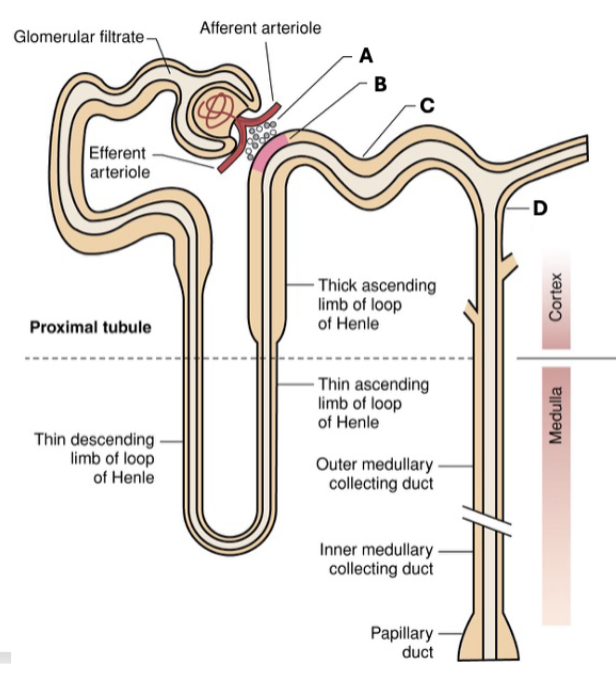
Which letter labels the Cortical collecting duct?
A. A
B. B
C. C
D. D
D. D

Which letter labels the distal convoluted tubule?
A. A
B. B
C. C
D. D
C. C

Which letter labels the Macula densa?
A. A
B. B
C. C
D. D
B. B

Which letter labels the Juxtaglomerular Apparatus (JGA)?
A. A
B. B
C. C
D. D
A. A
What is the primary function of Erythropoietin (EPO)?
A. Increases bone density
B. Decreases blood sugar levels
C. Stimulates white blood cells to fight infections
D. Stimulates red blood cell production
D. Stimulates red blood cell production
Which of the following medical terms describes a high plasma sodium concentration (typically above 145 mEq/L)?
A. Hyponatremia
B. Hypernatremia
C. Hypokalemia
D. Hypocalcemia
B. Hypernatremia
Which of the following medical terms describes a low plasma sodium concentration (typically below 135 mEq/L)?
A. Hyponatremia
B. Hypernatremia
C. Hypokalemia
D. Hypocalcemia
A. Hyponatremia
Antidiuretic hormone (ADH, arginine vasopressin, or vasopressin):
A. secreted by the posterior pituitary gland.
B. secreted in response to decreased plasma osmolality or severe hypervolemia.
C. secreted by the liver.
A. secreted by the posterior pituitary gland.