Child Growth and Development
 Call Kai
 Learn
Learn Practice Test
 Spaced Repetition
 Match
Match Flashcards
 Knowt Play
1/83

There's no tags or description
Looks like no tags are added yet.
Name | Mastery | Learn | Test | Matching | Spaced | Call with Kai | Chat |
|---|
No analytics yet
Send a link to your students to track their progress
84 Terms
Growth
specific body changes and increases in the child’s size, such as a child’s height, weight, head circumference, and body mass index.
Development
increase in complexity, a change from relatively simple to more complicated
five principles related to the progression of general development
Principle 1 – Developmental Sequence is Similar for All
Principle 2 – Development Proceeds from General to Specific
Principle 3 – Development is Continuous
Principle 4 – Development Proceeds at Different Rates
Principal 5 – All Areas of Development are Interrelated
Abraham Maslow and the Hierarchy of Needs
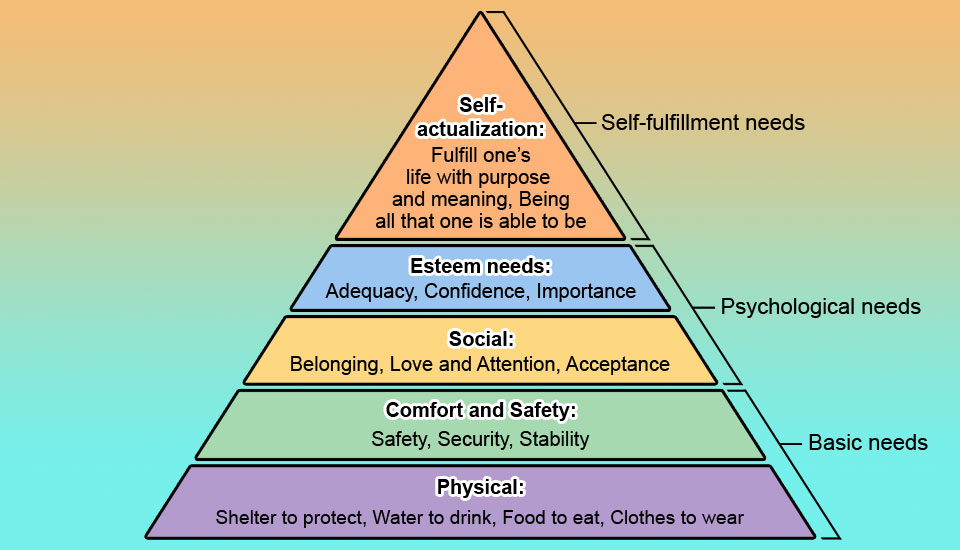
The first level of need is the physical, followed by comfort and safety, social, self-esteem and self-actualization.
Erik Erikson and the Eight Conflicts in Emotional Development
Age | Conflict | Meaning |
|---|---|---|
Infant | Trust vs. Mistrust |
|
Toddler | Autonomy vs. Shame and Doubt |
|
Preschool | Initiative vs. Guilt |
|
Grade School | Industry vs. Inferiority |
|
High School | Identity vs. Role Confusion |
|
Early Adult | Intimacy vs. Isolation |
|
Middle Adult | Generativity vs. Stagnation |
|
Late Adult | Integrity vs. Despair |
|
Jean Piaget and the Four Stages of Cognitive Development
Sensorimotor | Birth to approximately 2 years | Children learn through sensory perception and motor activity. |
Preoperational | 2 years to 7 years | Children are bound by what they experience directly and not by what they think. Children begin to use symbols (one thing that represents another). For example, using sand to make a cake. Children are egocentric; their thinking centers on themselves. They can’t see things from another point of view or from another perspective. For example, they do not realize that when they stand in front of the TV, no one else can see it. |
Concrete-Operational | 7 years to 11 years | Children become more rational in their thinking. For example, realizing that Santa Claus probably doesn't exist. |
Formal Operations | 11 years and beyond | The final stage of cognitive development, in which thinking becomes very abstract. Children think beyond the present and think about ideal situations. |
Lev Vygotsky and the Theory of Cognitive Development
Some of the major ideas in Vygotsky’s theory include:
Children acquire knowledge through culture.
Culture teaches children what to think and how to think.
Children learn through problem-solving experiences shared with a knowledgeable adult or peer. Initially, the person interacting with the child assumes more responsibility for guiding the learning. As the child learns, the responsibility is gradually transferred to him/her. This is an instructional technique called scaffolding.
A difference exists between what a child can do on his/her own and what he/she can do with the help of a knowledgeable adult or peer. A child can perform a task under adult guidance, or with peer collaboration, that he/she could not achieve alone. Vygotsky called this the Zone of Proximal Development and claimed that learning occurred in this zone. In summary, Vygotsky focused on the connections between people and the culture in which they interact.
Maria Montessori and Child-Centered Learning Environments
A few of the key ideas of Maria Montessori’s theories:
Emphasis is placed on the preparation of the learning environment. This includes the space children use; and the furnishings, materials, children, and adults who occupy the environment.
The learning environment should be beautiful and orderly. This allows children to learn about order from the learning environment.
Furniture, tools, materials, and toys should be child-sized.
Children learn best by having sensory experiences.
Children should be provided with tools that work.
Materials should be organized and accessible to children. They should be allowed to find what they need and return it when finished.
Heredity
passing down of genetic characteristics from parents to their children. It influences a child through the inheritance of physical characteristics and temperament from birth parents at the time of conception
Temperament
describes the emotional response of a child, and heredity imparts temperament in a child. Children experiencing the same situation may react completely differently from one another
Temperament and Personality
prevailing or dominant quality that characterizes a person, such as emotional or fussy. Personality is the totality of a person’s attitudes, interests, behavioral patterns, emotional responses, social roles, and individual traits that endure over a long time
Health and Wellness Factors
Nutrition and Physical Activity
Social Influence on Child Development
social interactions, promoting Social Interaction, children with disabilities may sometimes have an increased difficulty engaging in social interactions with their peers. Because of a perceived difference
Prevention
strategy that stops challenging behaviors before they begin, and it is the primary method child care professionals use to encourage children to discard these behaviors.
Redirection
strategy that is used to guide children’s behavior by recognizing challenging behavior at its earliest stages and taking steps to stop it from escalating
Positive reinforcement
strategy in which desired behaviors are rewarded so that the child is encouraged to repeat them.
Importance of Routines
Security and self-esteem (“My needs will be met.” “I am worthy of this person’s attention.”)
Time and space (“Toys go here.” “This is when we have a snack.”)
Independence and competence (“I can do this by myself.”)
physical development
health, wellbeing, motor development
Birth – 8 Month Physical Development
Transferring an object from one hand to the other hand
Reaching for and grasping an adult’s fingers
Turning head side to side
Rolling over
8 – 18 Months Physical Development
Crawling on hands and knees
Sitting on a chair without support
Grasping a smaller item with a thumb and forefinger
Physical Development 18 – 24 Months
Putting objects into a shape sorter
Improving hand-eye coordination
Pushing and pulling large objects
Standing on tiptoes to reach for an object
Physical Development 2 – 3 Years
Stringing beads on yarn
Walking up and down stairs independently
Riding a tricycle using pedals
Physical Development 3 – 4 Years
Throwing a ball overhand
Balancing on one foot
Begins to use scissors
Physical Development 4 Years – Kindergarten
Jumping and skipping
Throwing, catching, and kicking a ball
Stringing beads together
Zips and snaps clothing
Physical Development 5 – 12 Years
Continuing to act more independently each year
Assuming responsibility for personal care and hygiene most of the time
Understanding of safety, and the use of helmets and protective sports gear
Writing sentences
Approaches to Learning
Eagerness and Curiosity: children’s desire to engage with objects and people in their immediate environments
Persistence: capacity to continue working on tasks that appear difficult or unsolvable
Creativity and Inventiveness: ability to use familiar materials in new ways; trying out old solutions to solve new problems, experimenting with new solutions
Planning and Reflection: ability to attempt different approaches to learning, think through the steps, and plan solutions
Approaches to Learning Birth – 8 Months
Turning toward and tracking voices, people, or objects
Inspecting own hands, fingers, feet, and toes
Gazing at the adult feeding them or changing their diaper
Approaches to Learning 8 – 18 Months
Imitating familiar activities like stirring, cooking, or using a phone
Playing in a sand box with tools
Going up and down a step
Approaches to Learning 18 – 24 Months
Finding and pointing to objects in books
Jumping in place or running farther
Approaches to Learning 2 – 3 Years
Scribbling on a piece of paper
Repeating activities or games over and over
Preferring to feed themselves
Approaches to Learning 3 – 4 Years
Noticing new things and asking questions about them
Pretending to be an animal and acting out mannerisms
Approaches to Learning 4 Years – Kindergarten
Asking for additional information
Investigating and experimenting with new things
Responding to open-ended questions
Approaches to Learning 5 – 12 Years
Enjoying and learning from sensory experiences, such as those created using building blocks, art supplies, puzzles, and musical instruments
Showing increasing attention spans, and can concentrate for longer periods of time without becoming distracted
Can tell time and make plans in advance
Social and Emotional Development Birth – 8 Months
Cooing or babbling when being talked to or sung to
Turning toward a familiar voice
Mirroring the facial expressions of others, such as smiling or frowning
Social and Emotional Development 8 – 18 Months
Reacting to an adult’s expression, such as crying when an adult yells
Clapping hands to express joy
Social and Emotional Development 18 – 24 Months
Increasing verbal and physical comprehension
Displaying early forms of empathy for others
Social and Emotional Development 2 – 3 Years
Asking how a friend is feeling
Using words to express emotions
Social and Emotional Development 3 – 4 Years
Noticing a friend is feeling frustrated
Reacting to their anger by stomping their feet
Social and Emotional Development 4 Years – Kindergarten
Identifying accurately their own emotions and those of their peers
Comforting a classmate when they are upset
Social and Emotional Development 5 – 12 Years
Forming more friendships
Enjoying more organized play activities, such as board games and card games
Beginning to disagree with peers
Preferring to be part of a group or team, rather than engaging in solitary play
Children demonstrate language and literacy in the following seven components:
Listening and Understanding: verbal and behavioral response to oral communication
Speaking: children’s ability to clearly express themselves in words
Vocabulary: vast expansion in words children understand
Sentences and Structure: ability to use an increasing number of words, phrases, and complete sentences to communicate
Conversation: initiate and participate in conversations
Emergent Reading: increased motivation for reading and understanding words
Emergent Writing: increased motivation for written expression and learning the meaning of printed concepts
Language and Literacy Birth – 8 Months
Turning and smiling when own name is spoken
Using a variety of nonverbal communications with caregivers
Kicking legs in excitement when bottle is being prepared
Wiggling to music
Language and Literacy 8 – 18 Months
Saying simple words, such as “Yes,” to show understanding
Pointing to things when asked questions
Staring at an adult when they are speaking
Language and Literacy 18 – 24 Months
Answering questions
Following a one-step direction, such as “Pick a book.”
Language and Literacy 2 – 3 Years
Listening to books being read aloud
Talking to peers using simple words
Repeating overheard words
Language and Literacy 3 – 4 Years
Listening and responding attentively to simple conversations
Identifying characters from a story when prompted
Using four- to five-word sentences
Language and Literacy 4 Years – Kindergarten
Responding to questions with appropriate answers
Expressing likes/dislikes and opinions
Language and Literacy 5 – 12 Years
Showing an increased understanding of grammar in their speech
Enjoying telling and writing stories
Beginning to engage in more discussions and conversations with adults
Exhibiting more imagination and expression when they speak
Children demonstrate mathematical thinking skills in the following six components:
Number Sense: the ability to recognize quantity; count and construct sets; identify relationships between numbers; and understand how to use numbers in a variety of ways, such as measuring, comparing or estimating
Number and Operations: exploring quantities and understanding that joining and separating changes the size of sets
Patterns: the arrangement of things that are in order and repeated
Geometry: a natural and intuitive part of mathematics
Spatial Relations: awareness of objects or people in relation to oneself
Measurement and Data: ability to compare things and make judgments about the characteristics of an object
Mathematical Thinking Birth – 8 Months
Watching the eyes, mouth, and hands of an adult as they sing and do finger plays
Reaching for a favorite toy
Gazing at an object in one hand, then looking at another object in the other hand
Mathematical Thinking 8 – 18 Months
Gathering favorite items and giving them to an adult
Noticing a piece of a puzzle is missing and looking for it
Picking up one object and then looking around to find another one that matches
Mathematical Thinking 18 – 24 Months
Holding up two fingers when asked “How old are you?”
Asking for more cookies when given one or two
Mathematical Thinking 2 – 3 Years
Counting items in a counting book with assistance
Singing songs such as “5 Green, Speckled Frogs” and “The Ants Go Marching”
Noticing a pattern on a shirt
Mathematical Thinking 3 – 4 Years
Counting in order
Duplicating an auditory pattern modeled by an adult
Mathematical Thinking 4 Years – Kindergarten
Counting aloud through at least 31 with assistance
Throwing a number cube or dice during a board game and moving the correct number of spaces
Mathematical Thinking 5 – 12 Years
Are interested in a growing variety of subjects, including computers, games, jokes, riddles, maps, globes, and graphs
Are able to measure in terms of inches and centimeters; and enjoy measuring with rulers, measuring tape, and yardsticks
Children demonstrate scientific inquiry in the following six components:
Scientific Inquiry Through Exploration and Discovery: use of senses to observe and collect information about the world
Life Science: exploring the growth and change of living things, such as plants and animals, in their natural environments
Physical Science: exploring the characteristics and movement of objects
Earth and Space Science: knowledge based on the dynamic properties of earth and sky
Environmental: awareness of their own relationship to people, objects and living/non-living things in their environment
Engineering and Technology: thinking, exploring, problem solving, and creating through designing and building
Scientific Inquiry Birth – 8 Months
Closing eyes when a light is turned on
Banging utensils, blocks, and toys on the floor or table
Following an object or person in view
Scientific Inquiry 8 – 18 Months
Crawling to explore the environment
Filling and dumping toys
Developing stronger preferences for tastes and textures
Scientific Inquiry 18 – 24 Months
Sticking fingers in ears, nose, and mouth
Pointing to body parts, such as nose, when asked
Participating in or refusing activities that involve senses
Scientific Inquiry 2 – 3 Years
Shaking a toy, such as a maraca, to hear a noise
Experimenting with stacking blocks
Playing with natural materials such as sand, water, leaves, etc.
Scientific Inquiry 3 – 4 Years
Noticing when something tastes sweet
Taking objects apart and trying to put them back together
Exploring a tree using a plastic magnifying glass
Scientific Inquiry 4 Years – Kindergarten
Taking things apart and using parts to invent new structures
Discussing favorite colors or foods
Scientific Inquiry 5 – 12 Years
Increasing awareness of the season and the type of weather that each season brings
Using reasoning to understand why things happen
Children demonstrate social studies in the following eight components:
Culture: participating in family practices and identifying self as a member of a culture
Individual Development and Identity: recognizing characteristics of self as an individual, while noting similarities to peers and others
Individuals and Groups: responding to the needs of others and following family, classroom, school, and community routines
Spaces, Places and Environments: identifying own personal space in relation to surroundings and other places
Time, Continuity and Change: recognizing time, events, routines, and changes that take place over time
Governance, Civic Ideals and Practices: recognizing and following rules in a variety of settings and meeting varying expectations
Economics and Resources: recognizing the difference between wants and needs
Technology and Our World: exploring and showing awareness of and using technology as a tool when appropriate (e.g., writing utensils, electronic toys, computers, or tablets)
Social Studies Birth – 8 Months
Recognizing voices of Mom and Dad
Responding with smiles to loved ones
Social Studies 8 – 18 Months
Responding positively and negatively to adults and other children
Offering toys or objects to others but wanting them back
Social Studies 18 – 24 Months
Speaking the language heard in their home
Participating in family rituals
Social Studies 2 – 3 Years
Talking about events and people associated with cultural celebrations
Trying things on their own
Recognizing self in pictures
Social Studies 3 – 4 Years
Talk about food, objects, and customs from their own family or culture
Asking questions about differences they have with their peers such as skin, hair, etc.
Social Studies 4 Years – Kindergarten
Talking about family traditions during story time
Playing games or instruments from other countries
Social Studies 5 – 12 Years
Becoming less dependent on parents but expanding friendship circle
Increasingly interested in visiting new places and making new friends
Children demonstrate creative expression through the arts in the following five components:
Sensory Art Experience: use of imagination and creativity to express feelings and understanding using a variety of diverse materials (e.g., paint, clay, markers on paper, watercolor painting, and photography)
Music: recognizing and creating patterns through group musical activities
Creative Movement: dancing and exploring different ways to move to express and represent thoughts, observations, imagination, feelings, experiences, and knowledge
Imaginative and Creative Play: experiences that help children develop fluency of language, movement, originality, elaborations of ideas, vocabulary, imitation, and self-expression
Appreciation of the Arts: children responding to their own art and to a variety of artistic expressions of others
Creative Expression Through the Arts Birth – 8 Months
Finger-painting with homemade, natural, edible paint
Moving their bodies to music with some intent and control
Cooing when being sung to
Creative Expression
Through the Arts 8 – 18 Months
Painting with squeeze bottles on sidewalk or tarp
Imitating an adult making animal sounds
Using an object to make a sound to get attention
Creative Expression
Through the Arts 18 – 24 Months
Painting on an easel with a variety of brushes
Repeating the same song over and over
Creative Expression
Through the Arts 2 – 3 Years
Singing and clapping during group time
Watching and copying other children’s play activities
Using imaginative play as a vehicle to express their own life experiences
Creative Expression
Through the Arts 3 – 4 Years
Creating a collage with various fabrics
Exploring musical instruments
Using ribbons, scarves, and other props while spinning and moving to music
Creative Expression
Through the Arts 4 Years – Kindergarten
Creating a three-dimensional collage using one or a variety of materials
Playing various instruments and discovering different types of sounds that each instrument can make
Imitating animal movements
Creative Expression
Through the Arts 5 – 12 Years
Having a good sense of rhythm and beat
Becoming more interested in receiving recognition for their creative efforts
Writing stories and scripts, and creating plays
Prosocial behavior
Acts of kindness—such as helping, sharing, sympathizing, cooperating, and comforting—benefit all persons, the givers and the receivers
As described by Maslow through his hierarchy of needs, once the higher levels of the pyramid are achieved, individuals attain self-actualization, or the realization of their potential
“In group settings, the atmosphere most likely to promote nurturing, sharing, cooperating, and rescuing has the following characteristics:
Participants anticipate that everyone will do his or her best to support one another.
Both adults and children contribute to decisions made, practices, and procedures.
Communication is direct, clear, and mutual.
Individual differences are respected.
Expectations are reasonable.
People like one another and feel a sense of belonging to the group.
There is an emphasis on group as well as individual accomplishments.”
Self-Discipline
Without this guidance from adults, children do not learn appropriate behaviors or a sense of morality. For this reason, it is extremely important to clearly define expectations and behaviors to influence a child’s growing sense of right and wrong, and to help them establish a sense of self-discipline.
People who are self-disciplined are aware of appropriate behaviors and their effect on others.
Developmentally Appropriate Practice
Active learning: Children learn during the activity by doing.
Meaningful experiences: Children have a fun and memorable time during an activity to which they can relate on a developmental level. The experience relates to their developmental level, cultural background, and individual interest. For example, a toddler activity on pets would have more meaning than one on endangered species. Using water for cooking, cleaning, and playing has more meaning than doing a lesson on “Great Waterways of the World.” Likewise, the topics on endangered species and waterways of the world are more appropriate for older children.
Nurturing relationships: The child builds a positive relationship with his/her peers and classmates during the activity. It is also okay for children to work by themselves.