BIOL1500 Intro to Organismal & Evolutionary Biology Midterm 1: Chapter 51-56 (26-27)
 Call Kai
 Learn
Learn Practice Test
 Spaced Repetition
 Match
Match Flashcards
 Knowt Play
1/113

Earn XP
Description and Tags
ecology and biosphere, population ecology, species interactions, community ecology, ecosystems, biodiversity and conservation biology, animal behavior
Name | Mastery | Learn | Test | Matching | Spaced | Call with Kai | Chat |
|---|
No analytics yet
Send a link to your students to track their progress
114 Terms
Ecology
the scientific study of the interaction between organisms and their environment (where species live in numbers
Biosphere
abiotic variable across the planet, determines where species can exist`
adiabatic cooling
(caused by the presence of mountains) warmer air expands, loses pressure and rises -→ gets cooler, releasing energy, fewer interactions between molecules that would create heat!
explains why rain falls on windward side of mountain range: air must over mountain for this process, water will be released (cool air holds less water)
main biomes of continental usa
temperate seasonal forest, temperate grassland, cold desert, subtropical desert

climate diagrams
allow us to view precipitation and temperature over the year
subtropical desert characteristics
low density, scattered vegetation
desert plan adaptations include reduced leaf surface area physical defenses, and tolerance to desiccation (losing all moisture)
temperate seasonal forest characteristics
distinct vertical layers (closed canopy, understory trees, shrubs, herbs)
deciduous trees dominant (lose their leaves)
temperate grassland (great plans)
very dry winters
very low productivity during winter
many animals graze
salinity
(characterizes aquatic habitats)
primary production
the amount of light energy converted to chemical energy by autotrophs
autotrophs
(ex. plants, phytoplankton, macroalgae): organisms that perform photosynthesis
nutrient upwelling
winds push warmer surface water away, pulls colder nutrient-rich matter in
streams and rivers characteristics
flowing, fresh water
ponds and lakes characteristics
nonflowing fresh water
freshwater wetlands characteristics
nonflowing fresh water, shallow enough to have emergent vegetation throughout (swamps have emergent trees, bogs have acidic adapted plants)
salt marshes and mangrove swamps characteristics
are characterized by intertidal, estuarine waters with emergent vegetation
estuaries characterized
coastal regions where seawater mixes with fresh water (lower salinity)
rocjy intertidal zone characteristics
intertidal, marine waters on a steep rocky coastline
coral reef, seagrass beds, and kelp forest characteristics
found in neritic zone → shallow region of ocean overlying continental shelf
benthic zone characteristics
the bottom surface of an aquatic environment, contains larger/microorganism q/ a food source of mainly detritus
geographic range
the area a population occupies
population size
the number of individuals in a population at a specific area
density of a population
the # of individuals in a certain area or volume
populations near the center of a species range will be more abundant than the edges
larger species tend to have lower densities
require more resources to survive
dispersion
the pattern of spacing among individuals within the boundaries of the population (NOT the same as dispersal)
clumped dispersion
Individuals are aggregated → why? Social groups, low dispersal, mating behavior, spotty resources, predation/defense
uniform distribution
example - territoriality → the defense of a bounded physical space against erncroachment by other individuals
random distribution
high, passive dispersal (wind-pollination), constant environmental resources cross space
demography
the statistical study of the processes that change a population’s size and density over time
life histories
the schedule of an individual’s life
there are trade-offs in life history traits
K-selected populations
long life/low # of offpsring: high parental investment, ex. whales
r-slected populations
short life/high # of offspring: low parental investment, ex. rabbits
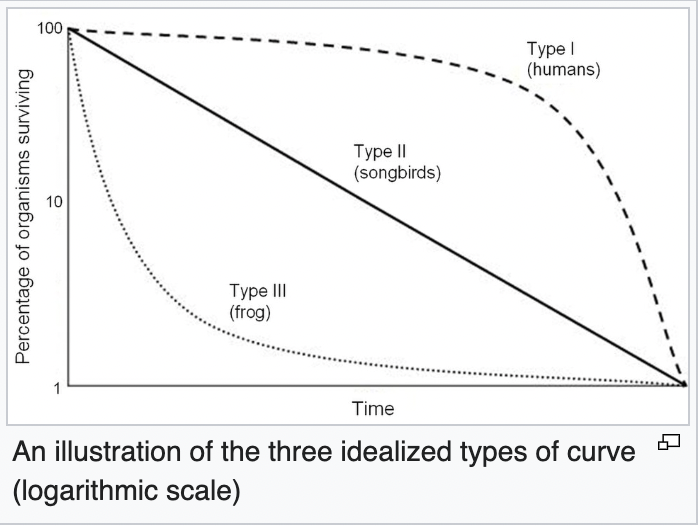
survivorship curves
the probability of surviving changes with age/stage (when are individuals more likely to die)
y-axis represents the proportion of the initial cohort surviving over time

age structure/pyramids
can tell us if a population is growing, shrinking or static
exponential growth
population has unlimited growth, assumes infinite food/space/mates → reality has constraints, leads to carrying capacity (K) = max population sustainable, will transition to logistiv growth
general: ∆N/∆t = B-D
per capita rates: dN/dt = rN
r: per capita growth rate
r > 0: population grows, r < 0: population declines
ideal conditions r = rmax = intrinsic rate of increase
graph: J shaped curve
logistic growth model
dN/dt = rmaxN(K-N)/K
incorporates resource limitation
produces s-shaped (sigmoidal) curve
growth fastest n = k/2
low density in logistic growth model
slow growth (few breeders)
intermediate density in logistic growth model
fastest growth - many breeders, enough resources
populations fluctuate around K
density dependent factors (factors that limit populaiton growth)
resource limitation, parasitism (disease), predation
incorporated into logistic population growth model
density independent factors (factors that limit populaiton growth)
generally climate and abiotic factors
interspecific interactions betwen two species
occurs between 2 species that live in the same area (community) → usually fighting for access to resources
classified by how they affect the fitness of the 2 species
types of interspecific interactions
+/+: mutualism
±: exploitation
+/0: commensalism
-/-: competition
-/0: amensalism
explotation ±
low lethality and host specificity: grazers
high lethality and host specificity: parasitoids
low lethality and high host specificity: parasite
high lethality and low host specificity: predators
predators
predators limit prey abundances via consumption → there are numerical effects of predators or prey
predation is a density-dependent population control factor
same goes for herbivores and parasites
anti-predator adaptation
prey have evolved diverse strategies to defend themselves from predators
active/passive camouflage, behavorial modifications, structural/chemical defenses
Lotka-Voltera Model
(predator prey cycling in nature) → predator population will slightly lag behind prey
ex. oscillations of snakes were caused by lynx predation (density-dependent factors rather than by overshooting carrying capacity)
predators can evolve counter adaptations
parasite
organism that feeds on cell contents/tissues/body fluids of another species (the host) while in or on the host organism
usually harm but do not kill their host
direct transmission of parasites
directly between host with no intermediary (cold/flu)
can complete life cycle between one host
vector transmissionof parasites
where (generally) an insect carries pathogen (generally bloodborne) and transmits it, may not get sick → just a carrier
ex. malaria
vertical transmission of parasites
parent to offspring disease transmission
complex life cycle of parasites (horizontal transmission through life stages)
require 2-3 hosts in a specific order to complete life cycle
trophic transmissionL secondary hosts are usually eaten by final host for parasites to complete life cycle
exploitative competition
species compete over limiting resources, deplete its resources, and the resource limits their growth
nonrenewable vs. renewable
no physical interaction required
interference competition
direct competitive interactions between organisms
territoriality, chemical warfare
competitive exclusion principle
2 species cannot coexist indefinitely if they are limited by same resource
one species will inevitability be more successful
fundamental niche
conditions where a species could exist
realized niche
the conditions a species does exist (smaller due to competition)
types of mutualism
generalists, specialists, obligate mutualists, facultative mutualists
generalists
one species interacts with many species
specialists
one species interacts with one other species or only a small # of closely related species
obligate mutualists
species that provide benefits to each and need that interaction to persist
facultative mutualists
species that provide benefits to each other that do not need interaction to persist
most organisms are mircobes (bacteria, fungi, protists) in their gut to help digest dood
mutualism for protection and defense
mutualism can aid reproduction and dispersal (bee pollen)
community
assmeblage of populations of different species in a particular area or habitat
species richness
number of species in a sample/size/community
species evenness
distribution of relative abundances for species in a sample/site/community
5 species each represented by 2 individuals EACH
species diversity
metric incorporating rich/evenness
shannon-weiner’s diversity index H’
a mathematical measure that quantifies biodiversity by balancing both species richness (the total number of different species) and species evenness (how evenly individuals are distributed among those species) (diversity metrics)
species interactions between many species in a community
(created by compounded 2-species interactions) species eating another, food chains with trophic levels
producer → primary consumer → secondary consumer
there is also possibility for negative predation (ex primary consumer eats secondary consumer)
indirect effects in species interactions
involving an intermediate species between 2
initiated by predators: trophic cascade (primary consumers excluded bc they eat plants)
direct effects in species interactions
2 species interaction w/o involving another species (parasitism)
can be positive or negative (arrows in trophic diagram can show effects or flow of energy)
keystone species
a species that has a disproportionate effect (though not necessarily on the community)
test by removing species and seeing what happens to population
ex. some apex predators (though some keystone species may still have predators)
ecological sucession
predictable change in species composition over time (easily observable after natural disaster (ex. volcanic eruption)
seral stage: each stage of community change in succession
primary sucession
developmental of communities in habitats that are initially devoid of plants and organic soils
mountain slopes, ex. volcano → ZERO LIFE
secondary succession
development of communities that contain no plants but do have organic soil
treefall gaps → some level of organic material
terrestial: pioneer species (grasses/weeds) → climax community
pioneer species characteristics
Good dispersers at new/disturbed sites: rapid growth/ reproduction, tolerant of harsh, abiotic conditions
poor competitors, shade intolerant (for plants)
climax community characteristics
bad dispersers, slow growing (below-ground biomass), intolerant harsh abiotic conditions, large size as adults, shade tolerant for plants
theory of island biogeography
explains how island species richness results from a balance between immigration and extinction, shaped by island (patch) size and isolation
demographic and environment stochasticity
demographic stochasticity
random variation in birth and death rates due to differences between individuals
environmental stochasticity
random variation in birth and death rates due to changes in environmental conditions
drought/flood
gross primary prodcution
all the solar/chemical energy that is captured and converted into chemical bonds by photosynthesis
after producers use energy for their own cellular respiration, what is left is net primary productivity
chemiosynthesis (chemoautotrophs)
an organism’s energy that doesn’t ultimately come from the sun, using the energy derived from the oxidation of inorganic chemical compounds rather than sunlight to convert carbon molecules and nutrients into organic matter (food)
carbon cycle
photosynthesis (conversion to glucose) and respiration (atp)
net primary production
the amount of energy that matters ecologically, can be transferred to next trophic levels (energy is lost at each trophic step)
NPP = GPP - producer respiration (plant)
gross secondary production
the total amount of energy consumed by herbivores in a given area that is used for respiration, gorwith and reproduction (analogous to GPP for consumers)
net secondary production
the total of energy consumed by herbivores in a given area that is used for growth and reprodcution(nalogous to NPP for consumers)
GPP → (- respiration for plants) NPP → ( - detritus) GSP → ( - respiration for mammals) NSP
ecological (Food Chain) Efficiency % net production from one trophic level to the next lower trophic level
net production energy (J)/ net production energy of the next lower trophic level (J)
typically range from 5%-20%
being purely carnivorous is a relatively inefficient way to get energy from photosynthetic production
limits to trophic levels
there isn’t enough energy in the system to support more than 4/5 trophic levels
longest chain will probably be marine
nutrient cycling
described by compartment models - the 4 compartments where nutrients accumulate
nutrients are recycled through the ecosystem
4 compartments in nutrient cycling
available organic (consumers, dead organic matter), unavailable organic (coal, oil), available inorganic (soil, water, sediments), unavailable inorganic (rocks, minerals)
nutrients circulate in biogeochemical cycles between living organisms and nonliving reservoirs (atmosphere/sedimentary
biogeochemical cycles
nutrients recycled between abiotic and biotic components of ecosystems
greenhouse gases
CO2 acts like a window pane in a greenhouse trapping energy in the lower atmosphere, creating a warm earth
downstream effect is ocean acidification (decreasing pH in ocean, ruining integrity and durability of marine life, altering availability of key ions, affecting physiological processes, like reproduction or respiration)
phosphorus cycle
Animals cannot directly use inorganic phosphorus (ex. in rocks)
no phosphorus in the atmosphere
Comes from soil and plants (fixed by plants) eaten by animals or wind/rain erodes phosphate-rich rocks; runoff goes to the ocean
nitrogen cycle
neither animals or plants can fix inorganic nitrogen → only bacteria can fix nitrogen that come from the atmosphere
instrumental value
the value biodiversity has because of the benefits it provides to humans: 4 categories
cultural, provisional, regulation, and supporting values
intrinsic value
the value biodiversity has in itself, regardless of human user or benefit
ecosystem services (biodiversity can increase ecosystem services)
a function performed by an ecosystem that directly or indirectly benefits humans
pollinations services, water filtration, storm mitigation, prevention of invasive species, erosion mitigation
helped a lot by dunes
provisioning services
material things used (almost directly) for our own use
ex: lumber fur, meat, crops, fiber, cotton
many of these plants have been artificially selected for human benefit
pharmaceutical chemicals, aspirin (willow bark), taxol (pacific yew bark), quinine
regulating and supporting services
allows an ecosystem to exist w/o suffering too many fluctuations
regulating: biodiversity benefits regulation processes that reduce environmental fluctuations
supporting: benefits of biodiversity that allow ecosystems to exist, such as primary production, soil formation, nutrient cycling
cultural services
aesthetic, spiritual, cultural value; ecotourism
principle sof regenerative agriculture (how a healthy ecosystem sustainsn itself)
diversity is key
incorporate livestock
keep it organic
leveraging ecosystem services
biodiversity loss
extinction has been happening for a long time → historical mass extinction
main causes of biodiversity loss today
overharvesting, introduced species, pollution, global climate change, habitat loss ≠ fragmentation (Mass extinction event: extinction value is 1000x higher than extinction of 75% in a 2 million year period)