Class Mech HW 4
 Call Kai
 Learn
 Practice Test
 Spaced Repetition
 Match
 Flashcards
 Knowt Play
1/69

There's no tags or description
Looks like no tags are added yet.
70 Terms
What method do I use for a linear homogeneous differential equation with constant coefficients?
Using the trail function y = e^rx, deriving twice, and substituting into the DE!

What is this initial condition?
y’(0) = 4
When does using the trial function y = e^rx apply?
When my DE has constant coefficients. Only numbers, no polynomials.
Checklist for solving DE’s:
select trial function, derive and place into DE.
Solve for characteristic eq, potentially use a quadratic to find roots.
Using roots, find the general solution FORM and plug them in.
plug in each IC one at a time and solve for the constants A and B etc etc.
Why does the factor e^rx = 0 end up dropping, and not giving a root?
Exponentials can get extremely close to zero, but they never actually equal zero. So the function does not equal 0, and therefore cannot give us a root.
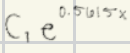
Derivative of

If we have a factor of re^rx = 0, why does this leave us with a genuine root?
While the exponential factor e^rx cannot equal 0, there is a factor of r that can. So, we call r=0, and use it as a definitive root.
The general solution for 2 Unique Roots is…

The general solution for 2 Equal Roots is…

The general solution for 2 Complex Conjugate Roots is…
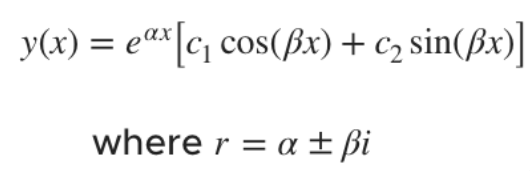
The general solution for 3 Unique Roots is…

Chain rule reminder!


When considering the Work Energy Theorem, when can be said about forces that are acting perpendicularly to the surface of a horizontal?
Their Work will be 0.
When working with normal force N, what is it likely that I will end up replacing it with?
Its parallel opposite pointing force; typically, this ends up being mgcos theta.
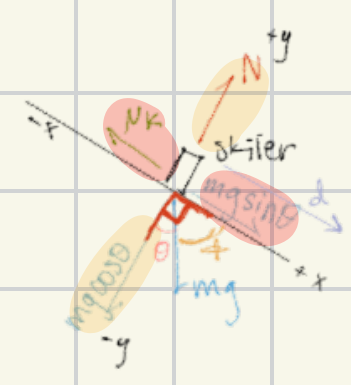
What angle does the angle between mgcos theta and mg end up being?
it ends up being theta, the same angle above the horizontal.

Formula for Frictional Force is…

What is the difference between static friction and kinetic friction?
Static friction is the resistive force that keeps a stationary object from moving. Kinetic friction is the resistive force that slows down or opposes an object that is already sliding across a surface.
When using the Work Energy Theorem, what is the usual approach to starting a problem?
Find the Work contribution of all forces, add them, then set equal to Delta K. Delta K = Kf-Ki, where K=1/2 mv².

Define the formula for Work, W.
Where F is the force on the object, d is the distance moved, and cos theta is the angle BETWEEN the FORCE and the DISPLACEMENT.

Note on solving gravity’s Work function.

Trig functions for cos to sin?
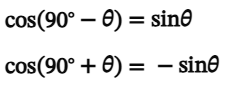
Trig functions for sin to cos?

What is different between the kinetic energies on a slope vs off the slope?
Their velocities! Make sure to separate up Vslope and Vstraight.
What does it mean when we’re told to assume that “the external impulse on the projectile is negligible compared with the internal impulse”?
It means that during the very short time the projectile explodes, forces from outside the projectile fragment system (especially gravity) do not have enough time to change the system’s total momentum by an important amount. We can say confidently that total momentum of the whole exploding system is conserved during the explosion.
When a problem asks me to find vectors, ie velocity vectors and express them in vector notation, what is the best way to proceed?
Write the velocity in component form BASED ON MY COORDS!!! Velocityposition/momentum get x y and z!!!
Use the diagram/wording to identify known horizontal and vertical components.
Use relevant physics, such as Momentum Conservation, to find other x and y.

Trigonometric Horizontal motion is?
cos theta
Trigonometric Vertical motion is?
sin theta
If I’m using vector notation to describe the motion of an object, how would I describe an object moving upward at a speed Vo/2?
Vo/2 sin (90 deg) y hat.

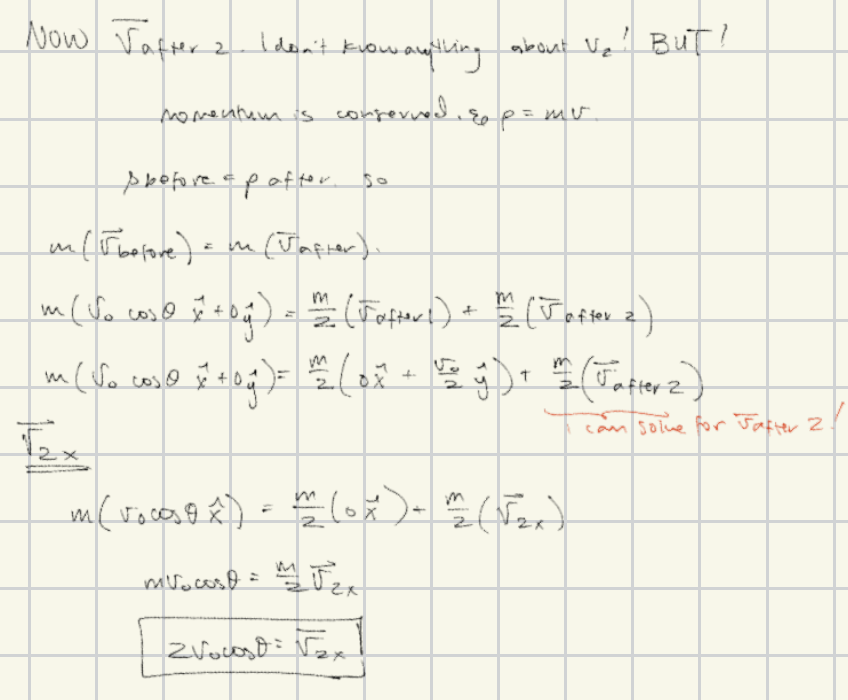
IMPORTANT Conservation of Momentum Problem:
Reminder this is ONLY the Vx solving. I will also need to repeat this for Vy!!!!!
What is the equation for momentum?
p=mv
How can I express momentum as a vector?

How do I write momentum in vector notation?
Multiply the velocity vector by mass.

If I’m told momentum is conserved in a kinematics problem, what assumption can I make?
that momentum before = momentum after.
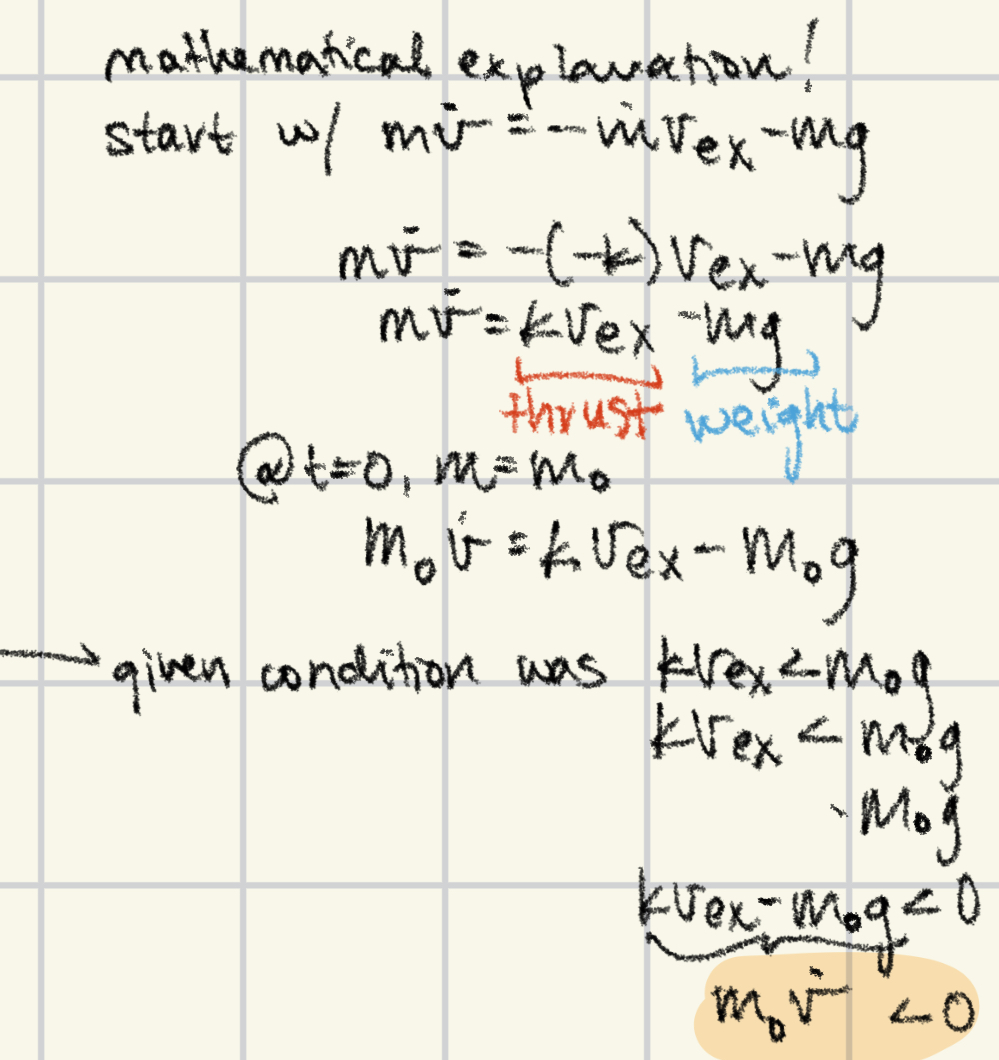
If I’m told to note that m dot < 0 in a problem, what does that mean?
it means that mass is decreasing with time, or with respect to time. ie the subject is getting lighter as time passes.
In Problem 5, I’m told m(t) = mo-kt. Where should I plug this in?
Into any ‘m’ value I see. Context clues tell me that any m is m(t), since the rocket is losing fuel all the time.
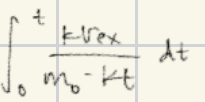
What is a good way to solve this?
u-sub!
What is m dot?
It is mass over time. Other ways of describing it are dm/dt, or mf-mi.
What happens to a rocket when its initial thrust is smaller than its initial mass?
It just doesn’t launch.

If a component depends on itself, such as Vx, what is the best way to approach the problem?
Try separation and integrating to find the variable I want :))
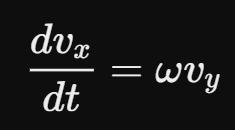
If a component depends on another component not alike itself, such as ______, what is the best way to approach the problem?
The system is coupled; the best way to go is the eliminate the variable via substitution, AND THEN SOLVE FOR A DE FORM!!!! If I’m given initial conditions, that’s also a good indicator that I need to find a DE to put them into. Solve the general solution, which gives me the velocity term if I’m solving using Vx.


What is the magnetic force on a charged particle?
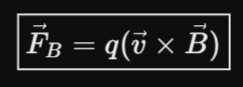

Does magnetic force always affect every component of velocity?
No. The velocity component PARALLEL to B feels no magnetic force. Only the velocity components PERPENDICULAR to B are affected and can couple to one another.


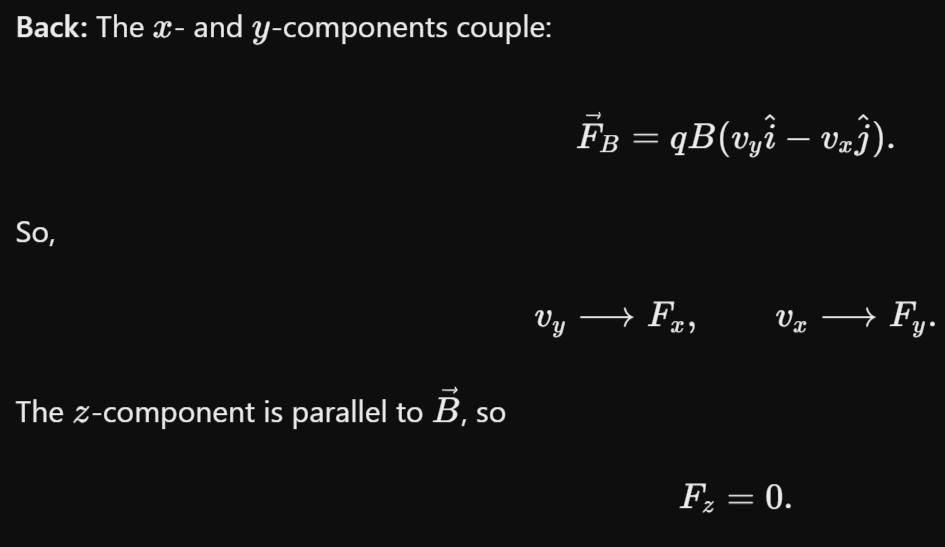
Why are the x and y equations coupled when B = B z hat?
Because each component’s acceleration depends on the other component’s velocity.

What happens if v || B?
Fb = 0. A charged particle moving exactly parallel to a magnetic field experiences no magnetic force.

If the magnetic field points along a different coordinate axis, which velocity components couple?
The two velocity components perpendicular to the magnetic field couple. ie, if Fb points down x, then z and y couple.

What information can be derived from this initial condition?
The x, y and z initial positions.


What information can be derived from this initial condition?
The x, y and z initial velocities.

When dealing with a DE problem that asks for the scalar equations of motion and I’m not given any vector forces with dots, what do I do?
Start with calling F=ma, and then replace a with its respective dotted equation.
What is the vector dotted equation for v?

What is the vector dotted equation for a?


If I need to solve v x B, how do I do it? What is my output?
VECTOR! For a cross product, multiply matching components and match them in vector notation.

If i need to solve v dot B, how do I do it? What is my output?
SCALAR! For a dot product, multiply matching components and add them together.



How are velocity and speed related?
Speed is just the magnitude of velocity.

When searching for the scalar differential equations and I don’t know how to start, where do I begin?
Change my F equation into ma, and then change a into my x../y../z.. . Then, once I’ve formed my entire F equation, dot everything with x hat/y hat/z hat.
When working with coupled equations, I will usually end up with one uncoupled equation that is as it is. How do I solve this uncoupled scalar differential equation?
As normal. For double dots, integrate once to get a single dot, velocity. Integrate once more to get no dots, position.
When I’m told that r=R-ut, when is it suitable to replace R-ut in the problem for r?
When the problem asks for a result that is in terms of r. That’s when I should replace R-ut for r, and use r as the variable I’m integrating/deriving.
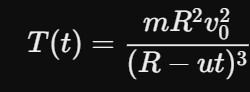
This is in terms of t…
This is the same thing in terms of r!

What does r(t) mean?
It gives the particle’s radial distance from the hole as a function of time.


Why does the position vector have no phi hat component?
The position vector points directly from the hole to the particle. That direction is always radial. The phi hat direction is sideways/tangential, so it appears in velocity, not position.
What is the difference between r hat and what is phi hat?
The r hat direction is radial, and the phi hat direction is tangential/sideways.
What is the tangential component of the velocity vector in polar coordinates?


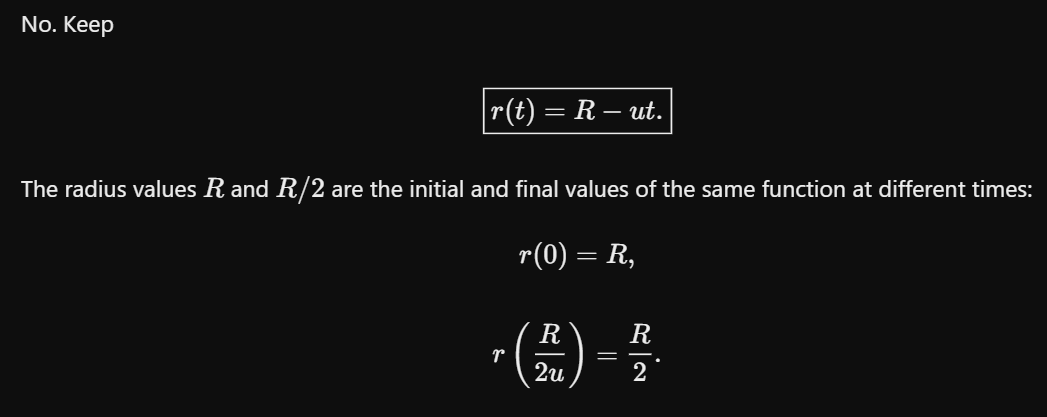
What is the time when the particle reaches r=R/2?

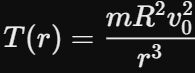
When I’m asked for something like “Tension as a function of radius”, what am I looking for?
T( r ).
When solving for Work using the Work Integral Equation, what do I plug in for the displacement vector ds?

When asked to confirm that the Work Kinetic Energy Theorem is true, how do I find my Delta K?
By finding Delta K = Kf-Ki