AP Biology Chapter 5
 Call Kai
 Learn
Learn Practice Test
 Spaced Repetition
 Match
Match Flashcards
 Knowt Play
1/57

There's no tags or description
Looks like no tags are added yet.
Name | Mastery | Learn | Test | Matching | Spaced | Call with Kai | Chat |
|---|
No analytics yet
Send a link to your students to track their progress
58 Terms

Covalent bond in which electrons are shared equally.
Nonpolar Covalent Bond

Where one atom is bonded to a more electronegative atom and the electrons of the bond are not shared equally.
Polar Covalent Bond
The attraction of cations and anions. The transfer of electrons creates ions which form an ionic bond.
Ionic Bonds
A charged atom.
Ion
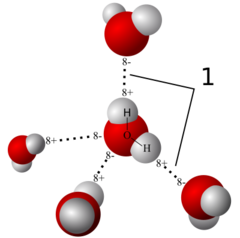
When a hydrogen atom covalently bonded to an electronegative atom is also attracted to another electronegative atom.
Hydrogen Bond

An organic molecule consisting only of carbon and hydrogen.
hydrocarbon
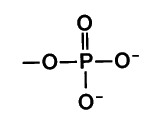
A chemical group consisting of a phosphate atom bonded to four oxygen atoms; important in energy transfer.
phosphate group

Name the 4 types of macromolecules
Carbohydrates, proteins, lipids, and nucleic acids

All the chemical conversions that occur within a cell
Metabolism = anabolism + catabolism
Metabolism
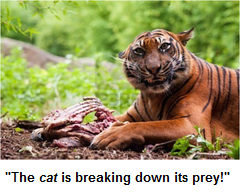
Conversion of complex organic molecules into smaller molecules by breaking chemical bonds
Catabolism

Conversion of small organic molecules by forming chemical bonds between smaller molecules
Anabolism
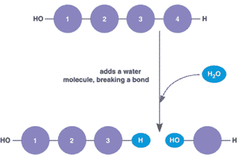
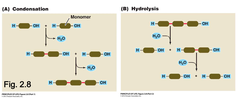
Pocess that is the reverse of dehydration synthesis. In __________, or water breakage, the bond between monomers is broken by the addition of a water molecule.
Hydrolysis

Reaction in which two molecules are covalently bonded, with the loss of a water molecule
Dehydration synthesis

Long molecules consisting of many similar or identical building blocks linked by covalent bonds.
Polymers

The monomer in a carbohydrate is a(n) ______________.
EX: Glucose
Monosaccharide

Two monosaccharides covalently bonded form a ____________.
EX: Sucrose
Disaccharide

Three or more monosaccharides linked together form a ______________.
Polysaccharide
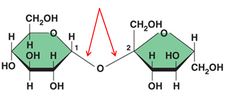
The bond in a carbohydrate is a(n) __________ _______.
Glycosidic linkage
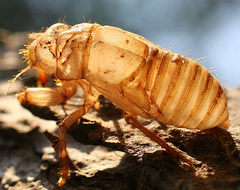
Two examples of structural carbohydrates are ______ and _________.
Chitin; cellulose

Polymer of β glucose monomers that is found in plant cell walls
Cellulose

Stored carbohydrate in an animal is called ________; in a plant, it is ______.
Glycogen; starch

Starch and glycogen are polymers of ________ molecules.
α glucose
Lipids are the only large biological molecules that do not form __________.
Polymers

Cushioning of organs, insulation, and energy storage are three functions of ___________.
Lipids
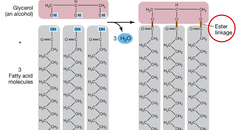
Triglyceride is composed of a ______ and three ____ _____ ______.
Glycerol; fatty acid chains

Fats with one or more double covalent bonds, which is less likely to solidify and more flexible.
Unsaturated fats

Basic structural component of cell membranes, with a polar/hydrophilic head region and a nonpolar/hydrophobic tail region, giving membranes their selective permeability.
Phospholipid
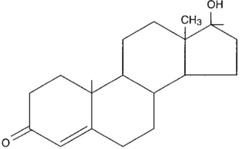
Lipid characterized by a carbon skeleton consisting of hydrogen-fused rings.
Steroid
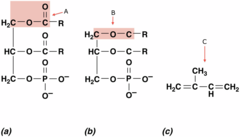
In a triglyceride, the ---OH of glycerol loses a H and the ---COOH of the fatty acid chain loses a ---OH which joins to form water in a(n) _____ _______.
Ester linkage

The monomer in a protein is a(n) _____ ____.
Amino acid
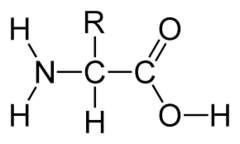
Amino acids are formed of a(n) _____ group with a(n) ________ group and a(n) _ group side chain.
Amino; carboxyl; R
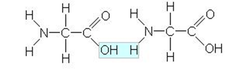
In a _______ bond, the ---COOH group in one amino acid loses an ---OH and the ---NH2 group in another amino acid loses a H.
Peptide

The polymer in a protein is a(n) ___________.
Polypeptide
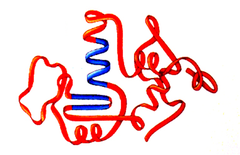
A protein's _________ determines its function.
Structure
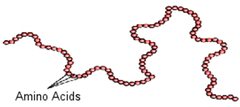
At the _______ level of protein structure, a linear sequence of amino acids is joined by peptide bonds to form a polypeptide.
Primary
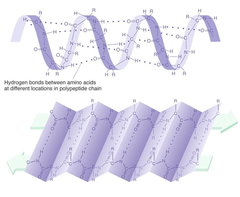
At the _________ level of protein structure, hydrogen bonds form between the partial positive hydrogen atom of amine groups and the partial negative oxygen atom of carboxyl groups.
Secondary
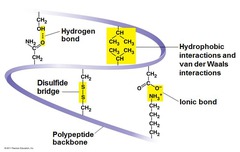
At the ________ level of protein structure, various chemical associations in precise regions of a polypeptide cause it to fold into a 3D shape that will determine its function.
Tertiary

At the __________ level of protein structure, 2 to 4 completely formed polypeptides combine.
Quaternary

In this disease, one amino acid at the primary level (valine) replaces glutamic acid and the result is a distorted shape at the subsequent levels.
Sickle cell anemia
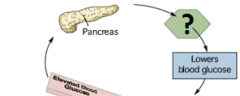
Insulin and glucagon are examples of _________ proteins.
Hormonal

________ proteins are embedded in all membranes and allow cells to interact with molecules and other cells.
Receptor

___________ proteins, such as actin and myosin, are found in muscle cells.
Contractile/Movement
_____________ proteins move molecules into and out of cells.
Transport
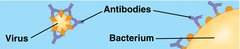
_________ proteins, like antibodies, are produced in response to antigens and bind to them.
Defensive

Excessive heat can cause ____________, in which a protein unravels and loses its native shape.
Denaturation
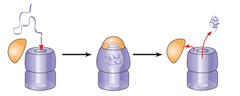
Assist in the proper folding of the protein by keeping the polypeptide segregated from disruptive chemical conditions in the cytoplasmic and create a hydrophilic environment for folding polypeptides
Chaperonins

Nucleic acids are composed of ___________.
Nucleotides
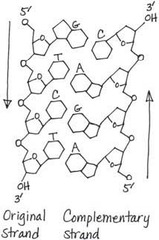
The polymer in a nucleic acid is a(n) ______________.
Polynucleotide

Nucleotides link together via ________ _____ to form nucleic acid.
Phosphodiester bonds
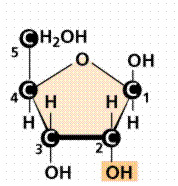
The sugar in RNA is ______.
Ribose

The sugar in DNA is ______.
deoxyribose
The nitrogenous bases in DNA are ____.
A, T, C, G
The nitrogenous bases in RNA are ____.
A, U, C, G
Nitrogenous bases in DNA and RNA form complementary base pairs by forming ____________ bonds.
Hydrogen

The backbone of DNA and RNA molecules is composed of alternating _____________ and ______________.
sugars; phosphate groups

type of bond in water? Oxygen is more electronegative than hydrogen and the electrons of the polar bonds spend more time near oxygen thus, making oxygen more negativity charged and hydrogen more positively charged
polar covalent

water hating substances
hydrophobic
water loving substances
hydrophilic