SAM Exam 6 Oncology Review
 Call Kai
 Learn
 Practice Test
 Spaced Repetition
 Match
 Flashcards
 Knowt Play
1/115

There's no tags or description
Looks like no tags are added yet.
116 Terms
What breed is hereditarily predisposed to Renal cystadenocarcinoma with nodular dermatofibrosis (RCND)?
German Shepards
What breed is hereditarily predisposed to Histiocytic Sarcoma?
Bernese Mtn Dogs
What breed is hereditarily predisposed to Osteosarcoma?
Scottish Deerhound
What breed is hereditarily predisposed to Hemangiosarcoma?
Goldens
What breeds are hereditarily predisposed to Transitional cell carcinoma?
Shelties, Scotties, Westies, Beagles, Yorkies
Pesticides, herbicides, and insecticides cause what cancer in dogs?
TCC
Living environment (urban environment, waste sites) can cause what kind of cancer?
Lymphoma
Sunlight can cause what cancer?
HSA and SCC
Tobacco smoke increases the risk of what cancer in DOGS?
Lymphoma & Nasal carcinomas
Tobacco smoke increases the risk of what cancer in CATS?
Lymphoma & Oral Squamous Cell Carcinoma
The chemical-> 2, 4-D and 4-chloro-2- methylphenoxy acetic acid
(MCPA) can cause what cancer in dogs?
Transitional cell carcinoma of the bladder in dogs

List some infectious causes of cancer.
-FeLV
-FIV
-Spirocerca Lupi
-Schistosomiasis
-FeSA
-Papillomavirus
-Marek's disease
-BLV
Intact female dogs have a _____ increased risk at developing mammary cancer
7x increased risk (26% risk)
How can mammary cancer be prevented in cats?
spay before 6 months of age
What is the best way to control cancer?
Surgery!
What are the 2 exceptions when surgery is NOT the best way to control the cancer?
-Lymphoproliferative diseases
-Metastatic disease
What is the main indication for surgery as a cancer treatment?
solid (localized) tumors
What is the main indication for radiation therapy?
used to treat small amounts of residual tumor cells
*Can also be used to reduce pain symptoms
Indications for chemotherapy?
Treat primary tumors, prevent/treat metastatic lesions, palliate
tumor-related symptoms
What is induction chemotherapy & what is it used for?
using chemotherapy as a sole therapy to treat primary tumors
**LSA, Plasmacytomas, TVT, palliation, intralesional
What is adjuvant chemotherapy?
"Adding" chemotherapy to some other regimen such as following Sx or RT for tumors with high metastatic rates
What are the indications for adjuvant chemotherapy?
Additional local control
What is neoadjuvant chemotherapy?
Using chemotherapy in hopes of "downstaging" tumors (i.e.
shrinking them) prior to surgery or other regimens
Define stable disease.
Define progressive disease.
25% increase in tumor burden and/or the development of new lesions (in spite of therapy)
Measured using performance scale in humans
• Decreased symptom-ology
• Increased "well-being"
• Does not directly equate with improved survival
Palliative responses to therapy
What is responsible for the specificity of drugs for chemotherapy?
Differential growth factor
T/F: Chemotherapy has relatively low specificity for tumor cells
True
*Results in a narrow therapeutic index
Define complete response.
→ Cure-complete disappearance of cancer, patient has normal life-expectancy
→ Complete remission (CR): complete disappearance of cancer for a minimum of 2 dosing intervals.
Define partial response.
Partial remission (PR): 30-50% or greater decrease in tumor burden and no new disease for a minimum of 2 dosing intervals.
What is the MOA of cytotoxic chemotherapy?
Targets actively dividing cells; relies on the differential growth fraction of tumor vs. normal
What is the role of the MDR1 (PgP or ABCB1 transporter protein) with respect to chemotherapy resistance?
→ Activity extrudes substrate drugs
→ Multi-drug resistance (efflux pumps)
→ Predisposes them to toxicity
What breeds are affected by mutations in this gene?
Collies & Aussies
How do the MDR1 mutations affect their sensitivity to chemotherapy?
Toxicity
Define predictable toxicity.
due to the drug's action on rapidly dividing (normal) cells
What are the predictable toxicities of chemotherapy?
"BAG"
→ Bone marrow-leads to cytopenias
→ Skin-can lead to hair loss
→ GI- leads to vomiting/diarrhea
What are the most common "dose-limiting" toxicities of chemotherapy?
NEUTROPENIA IS MOST COMMON and thrombocytopenia
When is cytopenia seen after chemotherapy?
7 days post-treatment
When are GI side effects seen after chemotherapy treatment?
3-5 days post-treatment
WHAT IS CONSIDERED UNACCEPTABLE TOXICITY of chemo?
NEUTROPHILS IT IS

Which chemo drugs cause severe extravasation events?
chemotherapy toxicity; DNA-binding agents cause the most severe toxicity
(Couldn't find where it said a specific drug)
What chemo drugs can cause cystitis?
Cyclophosphamide and acrolein
What side effects are seen with Cisplatin?
renal toxicity, vomiting, AND in cats fatal pulmonary toxicity
What side effects are seen with 5-FU?
neurotoxicity in cats
What side effects are seen with our fav chemo drug (Doxorubicin)?
Cardiotoxicity (dogs i think) and nephrotoxicity in cats
Which common drugs are substrates of the MDR1 protein?
Prednisone, vincristine, vinblastine, doxorubicin, actinomycin, mitoxantrone
T/F: ALKYLATING AGENTS SUCH AS CYCLOPHOSPHAMIDE, CHLORAMBUCIL, LOMUSTINE, CISPLATIN are not substrates of the MDR1 protein
True
What is the MOA of Palladia?
Inhibits tyrosine kinase
What tumor types is Palladia used to treat?
Non-resectable mast cell tumor, anal sac tumors, thyroid tumors, mammary tumors, HSA, GIST
What are the growth patterns and behavior of benign vs. malignant tumors?
Benign grow by expansion vs. malignant grow by invasion
What is a pseudocapsule?
Solid tumors are often surrounded by fibrous tissue in reaction to the growing mass
**Contains benign tumors but does not contain neoplastic cells
**Malignant tumors can spread elsewhere
What information can you obtain from biopsies?
→ Benign vs malignant (significant inflammation can impair this esp for epithelial tumors)
→ Categorizes tumor
→ Surgical biopsy is gold standard if FNA is inconclusive or doesn't fit with the clinical picture
→ Grade of neoplasia → prognosis
What information can you obtain from cytology?
Dominant cell type, tumor diagnosis
What tumor types can be definitively diagnosed (subcategory) with cytology?
Round cell tumors→ MCT, Lymphoma, melanoma, Histiocytic sarcoma
What factors influence the reliability of cytology?
Inflammation can affect the appearance of epithelial
Inflammation can cause mesenchymal proliferation can impair diagnosis of sarcomas
Define Radical excision.
Achieve tumor-free margins → curative. Not possible if metastatic disease is present. Generally a big procedure: general anesthesia, removal of muscle, bone, body wall, digit, tail, or limb amputations
Define marginal excision.
Planned excisional biopsy. If the tumor is benign, this is curative. Microscopic disease may remain; can be curative with radiation therapy
Define debulking.
Palliative surgery. Residual gross disease left behind (rapid regrowth). Remove compressive lesions such as in the CNA, head/neck, pelvic canal, bleeding tumors and necrotic tumors
-Recurrence is grade-dependent (low grade has ~7-30% recurrence )
-In general, curative intent surgery is wide margin
-Desired surgical margin is >3 cm
-Low-grade tumors on distal limb may not require amputation given low recurrence
-Radical excision recommended for recurrent or high-grade tumors
Soft tissue sarcoma margin considerations
-Incomplete ~5%.
-More commonly high grade, metastasis
Feline vaccine site sarcoma margin considerations
-Dogs: 1-cm lateral and no fascial plane ~40- 75% local control. 2-cm lateral and 1 fascial plane ~91- 100% local control
-89-100% Grade II /Low-grade MCT cured with >1 cm margin
-Recurrence at dirty margin is only ~30-40% for low- grade tumors
-Metastatic rate for low-grade tumors is
Mast cell tumor margin considerations
How does radiation kill tumor cells?
The energetic ionizing radiation interacts with tissues and either directly damages tissue or creates secondary charged particles (usually electrons), which then damage tissue
What are the 4 biological factors influencing tumor response to radiation?
Repair→ cellular damage
Redistribution→ within the cell cycle
Repopulation→ of cells
Reoxygenation→ of the tumor
What features of an individual tumor predict its' responsiveness to radiation therapy?
Blood supply (like lots)
Oxygen supply (like lots)
Tumor size (like small tumors)
Tumor histology (epithelial is more responsive than mesenchymal)
What are some acute responding tissues to radiation?
skin, hair, tumor, bone marrow → rapidly dividing tissue → typically reversible
What are some late-responding tissues to radiation?
bone, connective tissue, ligaments → slow-dividing tissues → permanent
What are some acute radiation side effects?
moist desquamation of the skin is an acute toxicity, Mucositis, moist desquamation, erythema
What are some late radiation side effects?
include alopecia, hyperpigmentation, fibrosis, Xerostomia, KCS, soft-tissue necrosis, nerve tissue damage
What is the approximate incidence of unacceptable toxicities with standard radiation protocols?
~5% risk
Identify some unacceptable toxicities of radiation in both the short term and the long term.
~5% risk of bone tumor formation, muscle fibrosis, nerve damage
What are some treatment options for low-grade canine mast cell tumors?
Surgery alone: 60-70%
Surgery and radiation: 90% for low grade
Recurrence at dirty margin is only ~30-40% for low- grade tumors
How is canine mast cell tumor stage diagnosed?
Minimum database, lymph node evaluation, abdominal ultrasound, determine local tumor extent
What are the chemotherapy options for high-grade tumors?
Canine soft tissue sarcoma (MDB, LN evaluation, thoracic radiographs)-these are minimal diagnostics; others may be indicated based on the specific patient
_______________→ improves outcome for tumors with high metastatic rates (common with osteosarcoma post-amputation)
Chemotherapy
___________→ treat residual disease after surgical excision (common with MCT)
Radiation
What is the most common malignant bone tumor of dogs?
Osteosarcoma
**common to see Hematogenous spread to lungs occurs early in disease

What are the common locations for osteosarcoma?
Distal radius
Proximal Humerus
Distal femur
Proximal Tibia

What drugs are used to treat osteosarcoma?
carboplatin,doxorubicin, cisplatin
What is the most common hematopoietic neoplasia in dogs?
Lymphoma
**80-85% of cases are Diffuse large cell lymphoma
What is the common protocol used to treat Lymphoma?
UW-Madison protocol/ CHOP
Doxorubicin, vincristine, cyclophosphamide-based protocol
How is Lymphoma diagnosed based on cytology?
> 50% lymphoblasts from nodal sample
What is the most common malignant tumor of the spleen and heart?
Hemangiosarcoma
What are the common locations for hemangiosarcoma?
skin, heartbase , spleen, liver, kidneys
**Hematogenous spread to lungs, viscera, brain, bone, etc occurs early in course of disease for visceral tumors
What drug is used to treat hemangiosarcomas?
Doxorubicin

Hemorrhagic effusion: pleural, pericardial, peritoneal
BW: Anemia, thrombocytopenia, schistocytosis, DIC
HEMANGIOSARCOMA diagnostic findings
What is the prognosis for hemangiosarcoma?

What is the prognosis for osteosarcoma?
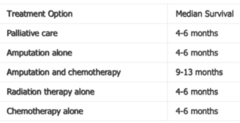

CBC: low grade anemia and thrombocytopenia
Chem: ALP elevated
Cytology: > 50% lymphoblasts from nodal sample
Lymphoma

Presentation: middle-older age, weight loss and anorexia. Cachexia, ocular changes, neurologic changes.
Predisposition. FeLV/ FIV cats at a higher, Tobacco smoke exposure also increases risk Most common gastrointestinal lymphoma
Feline Lymphoma
What is the treatment for feline lymphoma?
chemotherapy→ lymphoma is a systemic disease.
Doxorubicin increases remission duration. CHOP protocol
What is the prognosis for feline lymphoma?
depends on small cell low-grade or large cell high grade, anatomic location, treatment, response to therapy, FeLV status

Presentation: older cat with history of recent vaccination. Associated with rabies and FeLV vaccines
Staging: High grade tumors: rapid growth, inflammation, extremely invasive behavior, 20-25% metastatic rate.
MBD, FeLV/FIV, thoracic rads, CT scan, +/- abdominal u/s
Feline vaccine-induced site sarcoma
What is the treatment for feline vaccine-induced site sarcoma?
Radical resection, adjuvant radiation therapy, chemotherapy
What is the prognosis for feline vaccine-induced site sarcoma?
Still poor despite different treatment modalities and high cost. Early detection is CRITICAL
What is the significance of margins for tumor resection?
Directly correlated with disease free interval for many tumor types
________- attempt radical resection and curative procedure
Surgery
_________recommended due to poor outcome with surgery alone
Radiation
____________reserved for palliative purposes. Doxorubicin is drug of choice
Chemotherapy
What is the most common malignancy found in intact female dogs?
Mammary tumors
What is the incidence of mammary tumors after the 1st heat?
8% risk