RAD 111 Unit 3 x-ray tube
 Call Kai
 Learn
Learn Practice Test
 Spaced Repetition
 Match
Match Flashcards
 Knowt Play
1/58

There's no tags or description
Looks like no tags are added yet.
Name | Mastery | Learn | Test | Matching | Spaced | Call with Kai | Chat |
|---|
No analytics yet
Send a link to your students to track their progress
59 Terms
A x-ray tube has an
anode and cathode
Anode charge?
positive
Cathode charge?
negative
X-ray production requires
an electron stream that is decelerated/stopped
The cathode is a source of what?
electrons/negatively charged
The anode is the location of
rapid deceleration/positvely charges
What creates X-rays and heat?
Rapid deceleration
What is a cathode filament mostly made of?
tungsten, similar to lightbulb
Cathode purpose
thermionic emission
Thermionic emission
filament boost
The release of electrons from the tungsten filament when the electrical current passes through it and heats the filament
Thermionic emission creates
thermionic cloud/space charge or electron cloud
Space charge
A cloud of electrons formed by the focusing cup as electrons are boiled off of the filament.
Cathode dual focus
2 filaments: Small and Large filaments
Cathode: Small Filament
Low mA
Small body parts
Cathode: Big Filament
High mA
Big body parts
Cathode: The focusing cup is mainly made up of what?
nickel
Cathode: focusing cup causes
Electrostatic repulsion
Cathode: Electrostatic repulsion
keeps the electrons together
Anode is mainly made up of what?
molybdenum coated with tungsten (90% is tungsten). Also, may have copper, and graphite in the anode.
Anode acts as a
low thermal conductivity
Low thermal conductivity does what?
slows the migration of heat to the rotor
Anodes function/targets
decelerates electrons
opposite charge
Anode is a
Thermal conductor
Thermal conductor
conducts heat away from the focal spot
Anode: target/focal spot/focal track location
where the electron stream strikes the anode
Anode: target/focal spot/focal track main material
Tungsten, due to its high atomic # and high melting point
Anode: target/focal spot/focal track second material
Rhenium alloy due to its ability to hold tungsten particles together under high heat
What is tungsten's melting point?
3400 °C or 6152° F
Types of Anodes
stationary and rotating
Stationary anodes are used for what?
dental units
Rotating anodes are used for what?
diagnostic
Rotating anodes rotate at what RPMs?
3000-10,000 rpms, needed for heat dispersion
What is the rotating anode angles?
5-20°
Rotating anodes function?
Dissipates heat
Rotating anode: Stator
made of electromagnets located outside the glass tube
Stator function
The electric motor turns the rotor at high speeds
Rotating anode: Rotor
connected to the target through the anode stem
Rotating anode: Ball Bearings
allow free rotation of the rotor
Rotating anode: Rotor + stator + Bearings =
induction motor
Rotating anode: Dielectric Insulating oil
surrounds the tube
Dielectric Insulating oil function
-Additional layer of insulation
-Pulls heat away from the tube
Rotating anode: Fan
blows air over the tube
Tube Housing
Glass envelope
Protective housing
Glass envelope
Pyrex glass or metal envelope
Glass envelope function
-Vacuum allows electrons to travel without encountering air atoms ◦
-This allows the filament to heat up without burning
-Insulates the high voltage (tech will not get shocked)
-Dissipates heat away from tube components
Protective housing materials
Steel lined with lead
Protective housing function
-Absorbs all photons except those directed towards the patient
-Leakage radiation not to exceed 100mR/hr (1 mGya/hour) @ 1 meter using maximum Kv and MaS
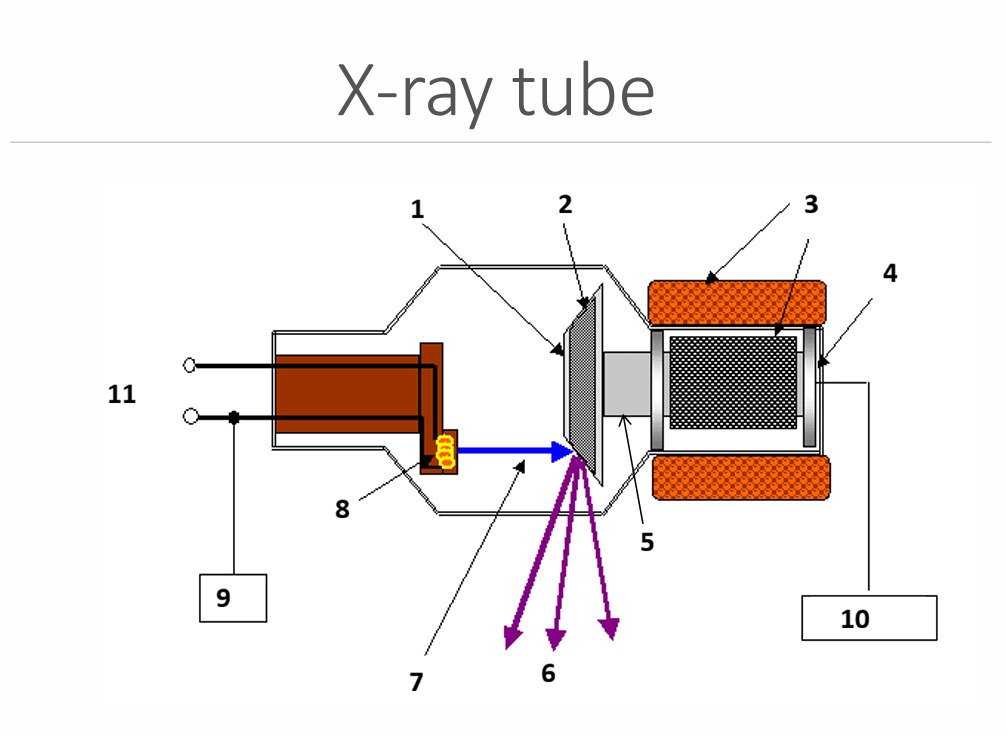
What is 1?
Rotating anode
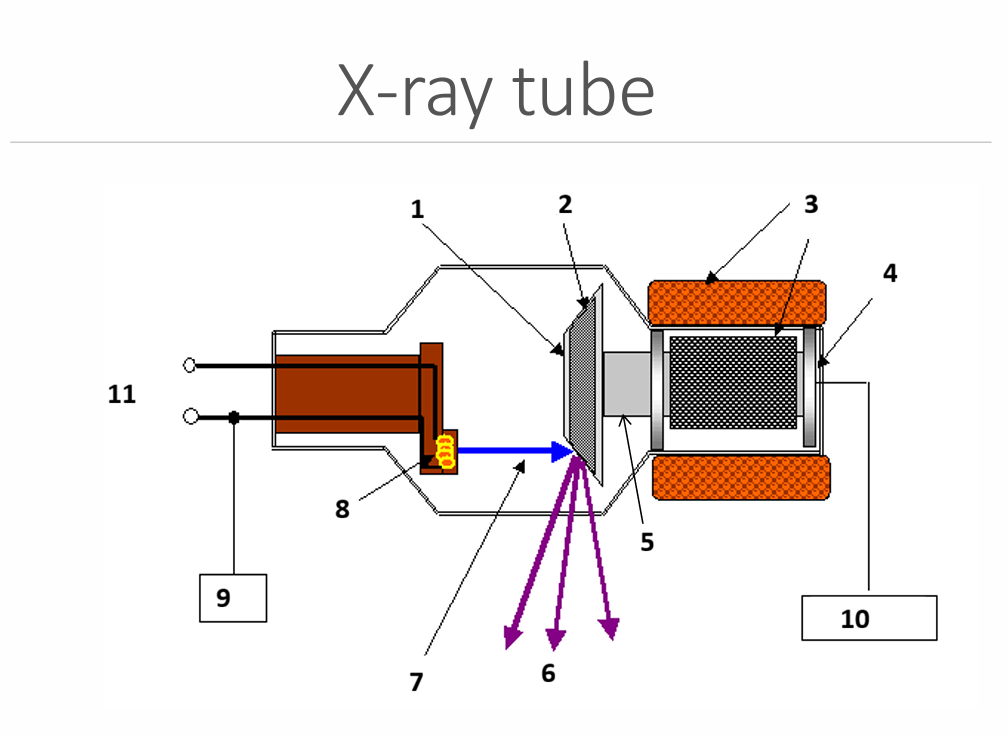
What is 2?
Tungsten target

What is 3?
Stator
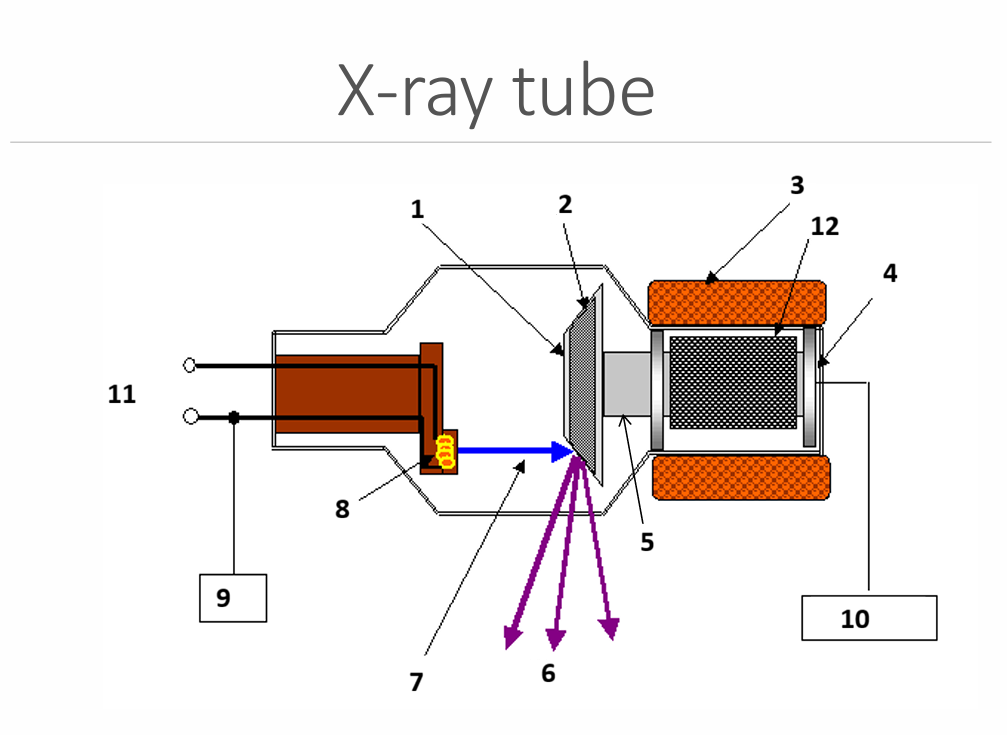
What is 12?
Rotor

What is 4?
Ball races

What is 10?
+100,000 V

What is 5?
Anode stem
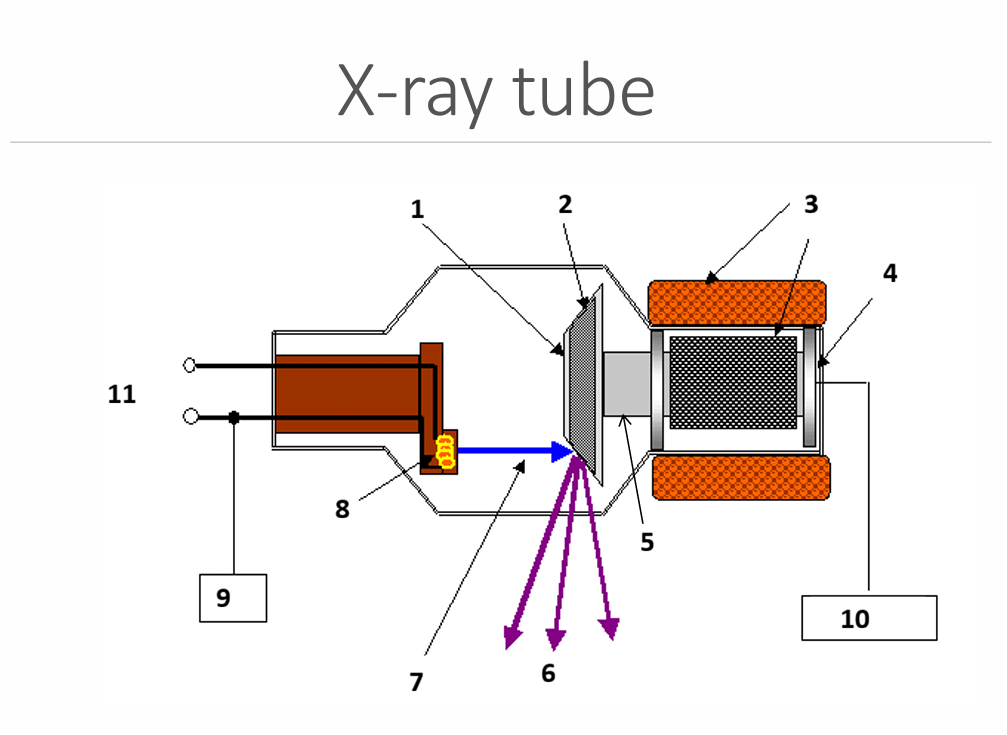
What is 6?
X-ray
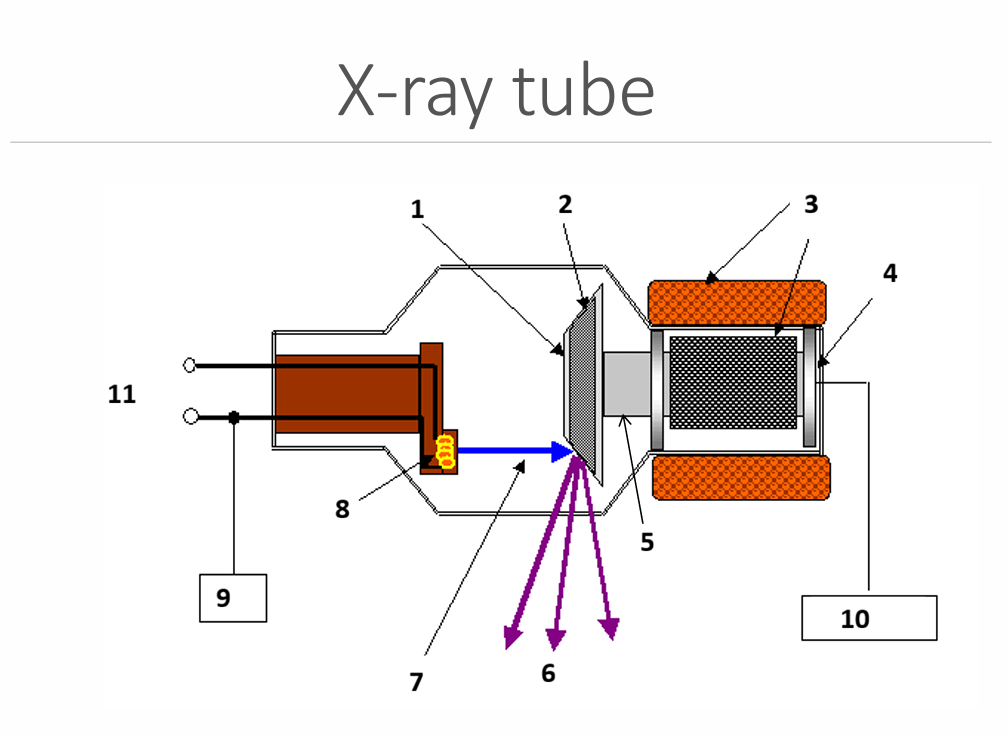
What is 7?
Electron beam

What is 8?
Hot cathode filament
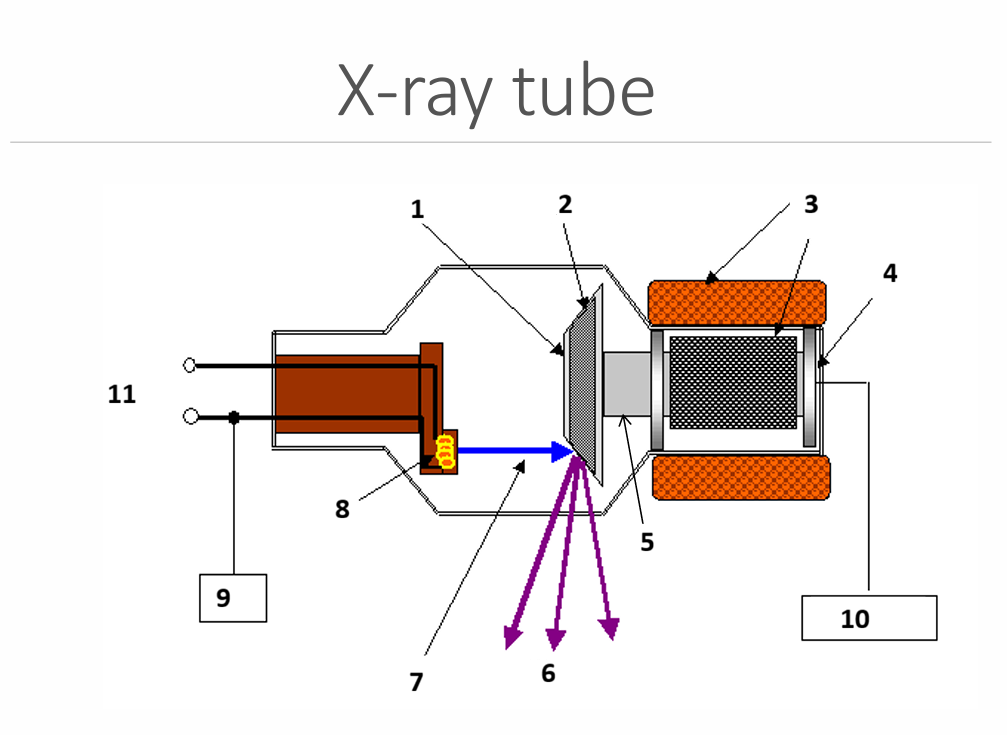
What is 9?
0 V

What is 11?
6.3 V ac