Week 10d — Speech & Language Acquisition
 Call Kai
 Learn
 Practice Test
 Spaced Repetition
 Match
 Flashcards
 Knowt Play
1/22

There's no tags or description
Looks like no tags are added yet.
23 Terms
Who was patient PV in the speech comprehension studies?
A 31-year-old Italian stroke patient with profound STM syndrome (1–2 items) but excellent LTM.

What was PV's sentence verification task (Vallar & Baddeley, 1984)?
Judge sentences true/false: short semantic-mismatch, long semantic-mismatch, long word-order-reversal.
What is a semantic-mismatch false sentence? Give an example.
False by category mismatch, e.g., “plants are people.”
What is a word-order-reversal false sentence? Give an example.
False by reversed word order, e.g., “sailors are often lived on by ships.”
How did PV do on the three sentence types (of 28 each)?
Normal on semantic mismatch (25, 26), impaired on reversal (17 vs. controls’ 26).
What did PV's sentence results show?
Length wasn’t the problem — she failed only when word order had to be tracked.
Why could PV detect semantic mismatch but not word-order reversal?
She relied on LTM’s semantic code — meaning, not verbatim word order.
If STM patients rely on LTM, what should happen when they repeat sentences verbatim?
Fail verbatim repetition but keep the gist.

Who was patient IL, and what was she asked to do (Saffran & Marin, 1975)?
A severe STM patient asked to immediately repeat sentences of varying length/complexity.
What happened to IL's verbatim recall as sentences got longer?
It decreased — but she retained the gist of the sentence.
What word substitutions did IL make, and why?
More familiar words (ancient→old) — frequent words are more strongly activated in LTM.
When did IL substitute a LESS frequent word?
When it fit meaning better — e.g., bottle→vial for sulphur.
What happened to passive constructions in IL's repetitions?
Short passives stayed passive; long ones became active (“pricked by the needle” → “she pricked her finger”).
What happened when subject and object were reversible in IL's repetitions?
Meaning often reversed — “George and Karl were closely watched” → “watched them closely.”
What did IL's performance show about comprehension vs. verbatim repetition?
Comprehension intact, verbatim repetition impaired — she got the meaning, not the words.
What is the role of the short-term store in speech comprehension?
Holds unprocessed info while a later clause is interpreted, or when the first parse fails.
Give the example of a sentence where the first parse fails.
The old train the young” — “train” first reads as noun, then verb.
Why is the STS's role in comprehension only subtle?
Not needed for simple sentences — gist suffices; deficits show only in verbatim tasks.
What did one researcher call the phonological loop?
Little more than a pimple on the face of cognition.”
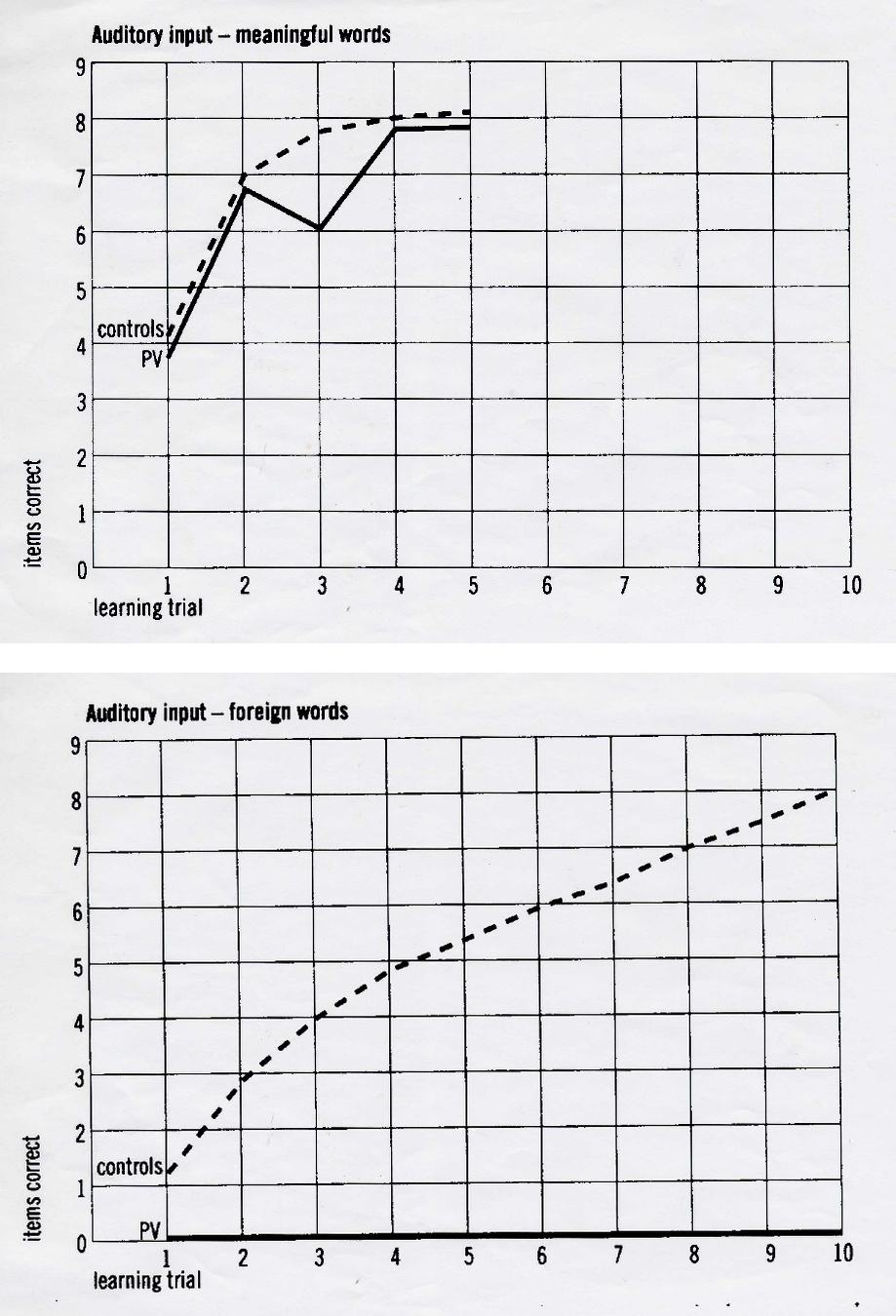
What was PV's Russian vocabulary task (Baddeley et al., 1988)?
Paired-associate learning: Italian–Italian (meaningful) vs. Italian–Russian (no lexical representation).
How did PV do on Italian–Italian vs. Italian–Russian pairs?
Normal on Italian–Italian (~8/9 by trial 5); flat 0 on Italian–Russian over 10 trials.
Why couldn't PV learn Russian words?
No preexisting lexical representation — she needed the impaired STS to hold the new phonological form.
What does PV's Russian study show about the phonological loop?
It’s critical for language acquisition — learning novel phonological forms of new words.