Academic and professional development 1
 Call Kai
 Learn
Learn Practice Test
 Spaced Repetition
 Match
Match Flashcards
 Knowt Play
1/17

Earn XP
Description and Tags
veterinary practices
Name | Mastery | Learn | Test | Matching | Spaced | Call with Kai | Chat |
|---|
No analytics yet
Send a link to your students to track their progress
18 Terms
general practice
First line of veterinary care
• Provide preventative healthcare
• Initiate investigations into illness and injury
• Treat variety of illness and disease
Emergency service clinic
• Will provide general practice care in addition to provision of emergency and critical care
Veterinary hospital
• Out-of-hours care provision
• Specialist equipment
• Ability to deal with more complex cases
Referral centres
• Specialist equipment and personnel
• Long-term accommodation
• Complex cases
• Care unable to be provided at general/veterinary hospital levels
• Out-of-hours care
• Emergency and critical care provision (but not a requirement)
Key Legislation
Animal Welfare Act (2006) and Welfare of Animals Act (Northern Ireland) 2011 state:
• Anyone responsible for a captive animal, including owners and temporary and permanent keepers,
must ensure that the welfare ‘needs’ of that animal are met
Duty of care by the person(s) responsible for an animal (obligation to do something)
• Owner
• Someone in charge of the animal (e.g., owner of cattery, neighbour looking after dog)
• Parent or guardian of a person under 16 years of age who is responsible for an animal
If law is broken, action must be taken to improve welfare, or criminal prosecution can be
pursue
Five Welfare Needs -Animal Welfare Act
(2006)

Key Legislation: continued - Animal Boarding Establishments Act 1963
Establishments must be licensed by the local authority (annually) to trade. These conditions
apply:
• Records of animal arrivals and departures and details of owners
• Provision of suitable accommodation
• Adequate and appropriate supplies of food and water
• Exercise facilities available
• Protection of disease and risk of fire
Establishments subject to inspection by an authorised officer or veterinary surgeon at any time
Pet Animals Act 1951, 1983
Outdated and ‘replaced’ by AWA
Prohibits keeping a pet shop without a license
License granted if following conditions are met:
• Proper care
• Suitable accommodation
• Housed in the correct conditions referring to heating, lighting etc
• Provided with appropriate food
• Observed and checked at suitable intervals during the day
• Sold only after weaning and after a suitable age has been reached
• Prevention of spread of disease
• Emergency and fire preventions for the premises are in place and operational
1983 amendment makes it illegal to sell animals in a public place
Laws for Veterinary Practices
All veterinary practice premises in the UK must comply with the law to operate
To supply medicines, all practice premises must be registered
RCVS hold this register on behalf of the Veterinary Medicines Directorate (VMD).
Practices are inspected by the VMD every four years, but if they are part of the Practice
Standards Scheme, they are exempt
RCVS Practice Standards Scheme?
Initiative to accredit UK vet practices to ensure the highest standards of veterinary care
Membership is voluntary (~69% of eligible practices are part of it)
• RCVS Accredited Practices
Different levels of accreditation are available, depending on the type of premises, services offered,
and species treated
Practices can apply for awards in areas they excel in
Small Animal Practice Accreditations-Core standards
Relevant to all practices
• Reflects legal requirements for running a practice (mandatory requirements of good practice)
General practice
• Applies to small animal, equine and farm animal practices
• Reflects the requirements of primary care practices to achieve high standards of clinical practice
• Has many of the facilities to be a nurse TP
Small Animal Emergency Service Clinic (ESC)
• Reflects the work of a small animal emergency service provider
• Can deal with emergency or critical care cases without appointment
• Has a dedicated OOH service
Hospital/Veterinary Hospital
• All of the above plus
• Additional facilities and protocols for investigation and treatment of more complex case
Kennel Requirements Under PS
Requirements of kennels depends on the stated tier of the hospital
Core tier
• Inpatient facilities of suitable size and escape proof
• At least one kennel suitable for a large breed dog - or a plan in place for this facility if the need arises
General practice tier (and small animal emergency)
• Must be a range of accommodation of suitable size for the number and species routinely treated
• Giant breeds may be referred to a different hospital
Veterinary hospital tier
• Must have a minimum of six kennels or cages for the hospitalisation of patients
• Minimum of one kennel for giant breeds
• Minimum of one walk in kennel
Practices that are part of the PSS are exempt from VMD inspection (q4y). This is because the PSS assessment
process includes a medicines module, which meets VMD requirements.
RCVS Practice Standards Scheme
RCVS Practice Standards Scheme
Additional stipulations:
• Secure and escape proof
• Made of non-permeable materials (ease of
cleaning and disinfection)
• Adequate heating, lighting and ventilation
materials
• A range of bedding materials must be
provided
• Provision of adequate food and water
• Consideration should be given to predator-
prey scenarios
• Written isolation protocol
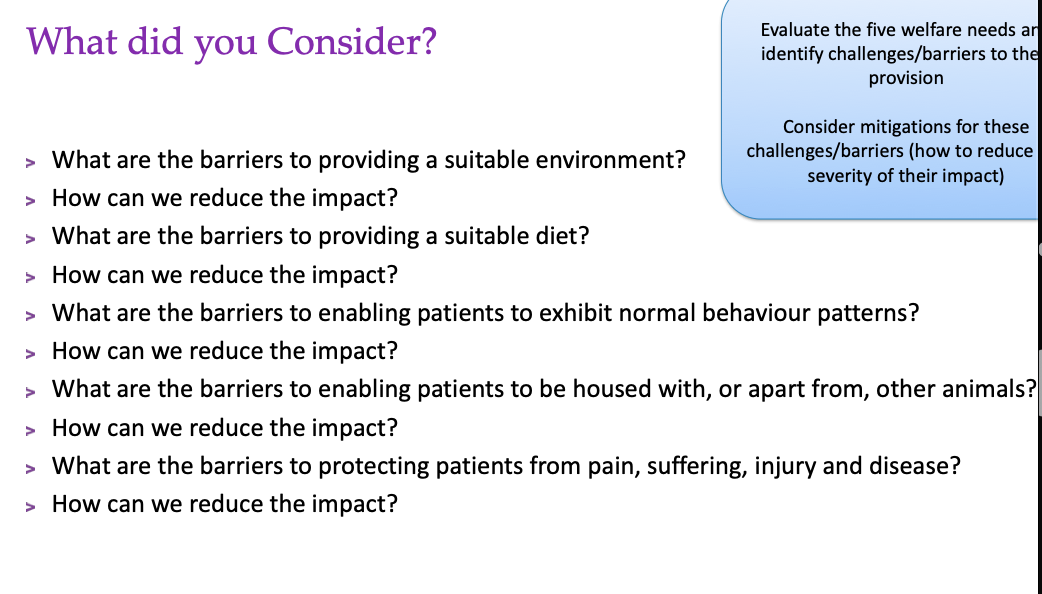
Barriers for the environment > cost of enrichment , outdoor space,
Reduce impact of this barriers- mimic natural environment- grass area
Barriers of suitable diet -picky or stress patients - in pain and struggle to control the pain , our knowledge could be a limitation of knowing how to feed diff types of animals
Reduce by-
Barriers to enable patients to exhibit normal behaviour patterns - outdoor cannot go out
Reduce- being a kennel but monitoring , make sure cats have suitable environment - allows them to get enrichment
Barriers of housed patients - sick patients with non sick
Reduce impact- cat wards are not looking at each other since they want to be more independent
Barriers of protecting patients from pain , suffering, injury and disease - our awareness of pain
Cost can be a barrier