chemical equilibria and kinetics
 Call Kai
 Learn
Learn Practice Test
 Spaced Repetition
 Match
Match Flashcards
 Knowt Play
1/40

There's no tags or description
Looks like no tags are added yet.
Name | Mastery | Learn | Test | Matching | Spaced | Call with Kai | Chat |
|---|
No analytics yet
Send a link to your students to track their progress
41 Terms
dynamic equilibria
Reaction doesn't stop when equilibrium is reach
Rate of product and reactant formation and reaction is equal
So that culmativily, reaction is constant

equilibrium constant
ratio of products: reactants
K = [products]p / [reactants]r
Little letter=where big number goes
K constant value at equilibrium
Change in concentration will not change K
Size of K indicates extent of the reaction
Change in temperature will change K
If K >> 1 equilibrium is product favoured
If K << 1 equilibrium is reactant favoured
![<p>ratio of products: reactants</p><p>K = [products]p / [reactants]r</p><ul><li><p><span>Little letter=where big number goes</span></p></li></ul><p>K constant value at equilibrium</p><ul><li><p>Change in concentration will not change K</p></li></ul><p>Size of K indicates extent of the reaction</p><ul><li><p>Change in temperature will change K</p></li></ul><p></p><p>If K >> 1 equilibrium is product favoured</p><p>If K << 1 equilibrium is reactant favoured</p>](https://assets.knowt.com/user-attachments/44d86c40-8a5a-4925-829d-073a3dee00ce.png)
Do not include pure liquids in K
Do not include solid components in K
conc= amount in given volume
If pure, made entirly of that
If some taken away, volume decreases => conc is constant
Tehrefore don’t incude
K expression for calculations
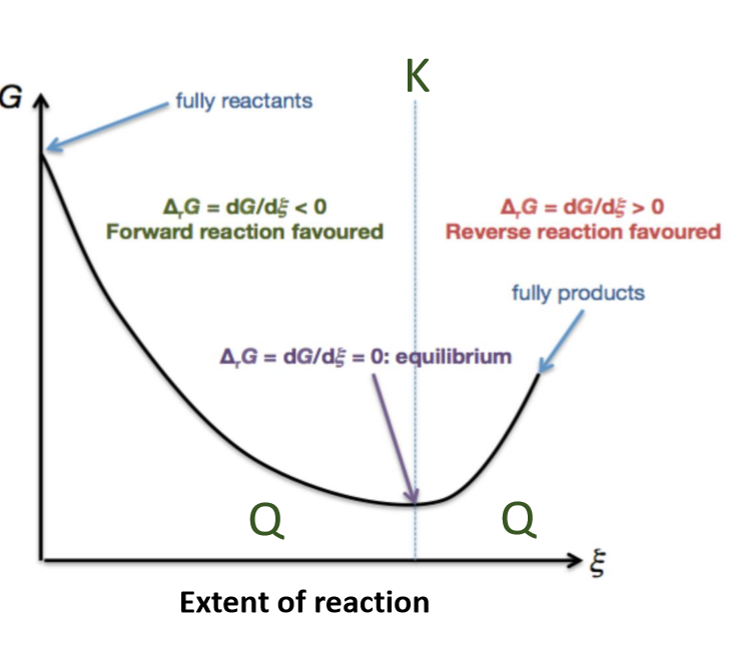
when deltarG=0, reaction is at equilibrium
At equilibrium, there are special conditions, so use K
G<0=forwards reaction favour
G>0=reverse reaction favoured
Q for when not at equilibrium
comparing Q and K
can determie direction of reaction
Q < K favours forward reaction, towards products
Q > K favours reserves reaction, towards reactants
thermodynamics of equilibria
∆𝑟𝐺 = ∆𝑟𝐺𝑜 + 𝑅𝑇 𝑙𝑛 [𝐶]𝑐[𝐷]𝑑 / [𝐴]𝑎[𝐵]𝑏
at equilibrium:
∆rG = 0 & K = Q
0 = ∆𝑟𝐺° + 𝑅𝑇 ln 𝐾
∆𝒓𝑮° = −𝑹𝑻 𝐥𝐧 𝑲
when using in calculations, convert celcius to kelvin. +273.15 for temp
![<p>∆𝑟𝐺 = ∆𝑟𝐺𝑜 + 𝑅𝑇 𝑙𝑛 [𝐶]𝑐[𝐷]𝑑 / [𝐴]𝑎[𝐵]𝑏</p><p>at equilibrium:</p><ul><li><p>∆rG = 0 & K = Q</p></li><li><p>0 = ∆𝑟𝐺° + 𝑅𝑇 ln 𝐾</p></li></ul><p>∆𝒓𝑮° = −𝑹𝑻 𝐥𝐧 𝑲 </p><p>when using in calculations, convert celcius to kelvin. +273.15 for temp</p>](https://assets.knowt.com/user-attachments/9349963e-2a47-4910-947d-30ee3d0518c5.png)
van’t hoff isochore
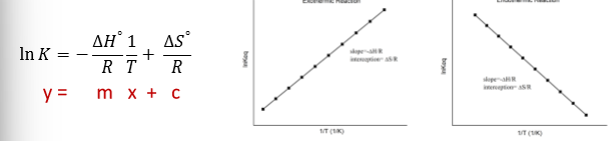
𝐥𝐧 𝑲 = − ∆𝑯°/ 𝑹𝑻 + ∆𝑺° / 𝑹
tehrefore estimating K at different temperature
if we know K1 at T1 we can estimate K2 at T2 (because of the linear relationship
n 𝐾2 − ln 𝐾1 = − ∆𝑟𝐻° / 𝑅 (1/ 𝑇2 − 1/ 𝑇1)
acid base chemistry is just equilbira
𝐾𝑎 = [𝐴−][𝐵𝐻+]/ [𝐻𝐴]
Ka tells us how much dissociate has occurred
Larger Ka stronger the acid
pKa = -log10(Ka)
smaller pka= stronger acid
![<p><strong>𝐾𝑎 = [𝐴−][𝐵𝐻+]/ [𝐻𝐴]</strong></p><ul><li><p>Ka tells us how much dissociate has occurred</p></li></ul><ul><li><p>Larger Ka stronger the acid</p></li></ul><p><strong>pKa = -log10(Ka)</strong></p><ul><li><p>smaller pka= stronger acid</p></li></ul><p></p>](https://assets.knowt.com/user-attachments/82442b6f-0a46-4f37-8ee5-69b477fe95ac.png)
ph scale
PH=-log [H3O+]
Simple way of expressing concentration of H3O+ ions in a solution. Measure of acidity, but also basicity.
in acid
Identify if a strong or weak acid
• Determined by the value of Ka
Calculate [H3O+]
• If strong acid [H3O+] = [HA]
• If weak acid [H3O+] = √(Ka x [HA])
Convert to pH scale
• pH = -log10[H3O+]
in base
dentify if a strong or weak base
• Determined by the value of Kb
Calculate [OH-]
• If strong acid [OH-] = [base]
• If weak acid [OH-] = √(Kb x [base])
Convert to pH scale
• pOH = -log10[OH-] then
• pH = 14 - pOH
buffers in biology - breathing
Respiration reaction produces CO2
This then reacts with H2O in the blood forming carbonic acid (H2CO3)
Do more exercise, produce more CO2, pushes the reaction forward.
Second equilibrium occurring, forming bicarbonate (HCO3-) and protons (H+)
decreasing blood ph
Breathe harder, expels more CO2, pushes the equilibrium backwards
increae blood ph

blood as a buffer
Changes in pH controlled through a combination of
chemical and physical processes
Amount of CO2 controlled by respiration
Amount of HCO3- controlled by renal system
Buffering maintains the pH (keeps us alive!!!)

what is a buffer
Aqueous solution that is resistant to pH change.
Made of weak acid [HA] & its conjugate base [A-]
Add strong acid,
addinsg prtons in, react with conjugate acid, so don’t get build up of protons
Add string base
OH reacts with weak base, forms equilibrium reaction forming h2o and conjugate base (ph stays stable
![<p>Aqueous solution that is resistant to pH change.</p><p>Made of weak acid [HA] & its conjugate base [A-]</p><p>Add strong acid,</p><ul><li><p><span>addinsg prtons in, react with conjugate acid, so don’t get build up of protons</span></p></li></ul><p>Add string base</p><ul><li><p><span>OH reacts with weak base, forms equilibrium reaction forming h2o and conjugate base (ph stays stable</span></p></li></ul><p></p>](https://assets.knowt.com/user-attachments/8316ff55-3c3f-437d-9f52-8f025f30db0b.png)
ph of a buffer
dependent on ratio of [A-]/[HA]
When [HA] = [A-] pH = pKa
When [HA] > [A-] (more acid is present)
pH (of buffer) < pKa - buffer has greater capacity to neutralise base
When [HA] < [A-] (more base is present)
pH (of buffer) > pKa and buffer has base capacity to neutralise acid
Ka=acid dissociation constant
The biger the pka the stronger aicd/ph
When doing covid test, must put swab into buffer, as antibodies and nasal mucus have different ph
buffering capacity
The best buffering will occur when the ratio of [HA] to [A-] is almost 1:1.
When pH = pKa. Buffers are effective with [HA] to [A-] ranges between ± 10%
Total concentration of the buffer impacts capacity. More mols of buffer available to absorb additional H+/OH- ions.
Although too strong can affect the reaction. By controlling the [HA] to [A-] ratio, we can control the pH of the buffer
relating pH, pKa, concentration ratio - Henderson-Hasselbalch Equation
at equlibrium, HA=A- therefore HA/A=1. log1=0, therefore PH=pka
𝑝𝐻 = 𝑝𝐾𝑎 + 𝑙𝑜𝑔10 ([𝐴−] / [𝐻𝐴])
[A-] = conjugate base
[H+] = protons
[HA] = weak acid
assumptions
Monoprotic acid
Salt completely dissociates
Ignoring self-ionisation of water (Kw)
Limitations
Most valid for pKa 4-9 range
![<p>at equlibrium, HA=A- therefore HA/A=1. log1=0, therefore PH=pka</p><p><strong>𝑝𝐻 = 𝑝𝐾𝑎 + 𝑙𝑜𝑔10 ([𝐴−] / [𝐻𝐴])</strong></p><ul><li><p>[A-] = conjugate base</p><p>[H+] = protons</p><p>[HA] = weak acid </p></li></ul><p>assumptions</p><ul><li><p>Monoprotic acid</p></li></ul><ul><li><p>Salt completely dissociates</p></li><li><p>Ignoring self-ionisation of water (Kw)</p></li></ul><p>Limitations</p><ul><li><p>Most valid for pKa 4-9 range</p></li></ul><p></p>](https://assets.knowt.com/user-attachments/38bfb540-1072-43c5-81f3-0ff2d943843c.png)
kinetics vs thermodynamics
Depending on activation energy, can get thermodynamically favoured products or kintically favoured products
Just because a reaction is spontaneous DOES NOT mean we will see it occur.
If a reaction can produce different products (cis vs trans isomers) the thermodynamically most stable MAY NOT be the main product.
Understanding the kinetics of a reaction is clearly important

energy landscape
Energy lncscape of molecule=potential energy surface of moelcule
Molescule want to minimise energy, take lowest energy pathway to get from reaxtant to product
Can map out potentional energy surfaces of reactions
transition states
Very short-lived transient structure
Cannot measure the structure by “normal” experimental methods
Can determine the barrier height (Ea/∆H‡/∆G‡) by experimental and computational methods (highest energy point on pathway directly connecting A and B)
as move around potential energy surface, take lowest energy pathways.
When projected into 2d, see curve, with big lump where transition state as reaction progresses (between reactnt and final product)
Transition state is evry shortlived
Reaction coordinate: transition state is set of specific coordinates that link reactant to product
Reaction coordinate= Specific state of molecule at particular time
Cannot easily be detected, btu can get info about structure via chemical intuition
Determine height of barrier= determine transition state= determine activation energy

activation energy
Rate of reaction is inversely proportional to activation energy
Reactions can be elementary (single-step) or complex (multi-step
The step with the highest barrier is known as the rate limiting step
Slowest step of the reaction, controls the rates
activation energy= energy required to activate reaction
Study kinitic to determine whetehr have single step reacton or multistep reaction with mulitple intermediates and transsition states
Can use this info to improve reaction,eg can stop one of byproducts reacting to ensure get one enantiomer, lower activation energy etc
One of barrier is bigger than the others, is slowest step= rate limiting step
three step mechanism of spontaneous reaction
determine rate limiting step
reaction energy diagram
consider brond breakage/formation, to preditc transition state structures

studying kinetics in a lab - rate of reaction
rate of reaction=change in conc as funciton of time
Products increases, reagents decrease (so negative sign)
Interested in change in concentration of species during a reaction.
𝑟𝑎𝑡𝑒 = 𝑑[𝑃𝑟𝑜𝑑𝑢𝑐𝑡𝑠] / 𝑑𝑡
𝑟𝑎𝑡𝑒 = − 𝑑[𝑅𝑒𝑎𝑔𝑒𝑛𝑡𝑠] / 𝑑𝑡
d=reaction differential= change of concentration
Rate=change in conc/change in time
Any experimental method that can determine concentration (even inderictly eg beer lamberts law) can be used to study kinetics
experimental rate law
Rate of reaction is often found to be proportional to the oncentrations of the reactants raised to a simple power
Rate = kr[A]a[B]b
r is the experimental rate constant
[A] is the concentration of reactant A
a is the power term, partial orders
overall, order of reaction is sum of partial orders
partial order
power term called partial orders
As rate of reaction control by whats in there, more often than not are integer values
Sum of partial order= overall order of reaction, can then determine mechanism and rate limiting step of that reaction
partial order
The partial orders relate the concentration of the reactants and the rate of the reaction.
Usually simple numbers (0, ½, 1, 2) and they may be positive or negative.
Classify reactions based on kinetics – similar behaviou
similar behaviour=molecularity (unimolecular, bi molecular etc)
1st order: rate of reacrion on depend on A, proportioanl to A conc
2nd order, bimolecular: 1st order with respect to A and B, 2nd order overall, requires molecule A and B to react together
2nd order: with respect to A only
determining orders and rate laws
Initial rate method
Start of the reaction, we’ll know the exact concentration of reagents and slope is will be steepest.
if we vary the concentration and measure initial rates, we can see the effect of that reagent of the rate of reaction.
Repeating for all reagents, we determine the rate law
If we double [A] and we find that:
rate does not change, then alpha = 0, zeroth order in A
rate doubles, then alpha = 1, or first order in A
rate quadruples, then alpha = 2, or second order in A
start is most accurate point, so if vary conc and see effect on rate of reaction, can identify how important componenets are to reactions, then can isolate to see specific compounds effect
mechanism of reactions via rate law and stoichiometry
You cannot write experimental rate law based only on reaction stoichiometry. All comes down to mechanisms…
By comparing the experimental rate law and the stoichiometric reaction we can get some understanding of the mechanism
compare numbers between stoichiometry reaction (big number) and rate of law
If rate law matches stoichiometry= elementary reaction
But if have rate law different to reaction stoichiometry, must be complex mechanism

Determining orders & rate laws - initial rate method
interested in variation in rate with [reactant]
Start of the reaction, we’ll know the exact concentration of reagents and slope is will be steepest.
If we vary the concentration and measure initial rates, we can see the effect of that reagent of the rate of reaction.
Repeating for all reagents, we determine the rate law
If we double [A] and we find that:
rate does not change, then a = 0, zeroth order in A
rate doubles, then a = 1, or first order in A
rate quadruples, then a = 2, or second order in A
Determining orders & rate laws - integrated rate law
looks at relationship between [reactant] an time
Write the rate law in a form that can be integrated:
r = k[A][B]→ y=m x +c
Apply to data and plot graphically, Which equation does the data fit?
Looking for straight line
Gradient is significantly more accurate than y intercept, therefore intergrated rate law is more accurate
![<p>looks at relationship between [reactant] an time</p><p>Write the rate law in a form that can be integrated:</p><ul><li><p>r = k[A][B]→ y=m x +c</p></li></ul><p>Apply to data and plot graphically, Which equation does the data fit?</p><ul><li><p>Looking for straight line</p></li><li><p>Gradient is significantly more accurate than y intercept, therefore intergrated rate law is more accurate</p></li></ul><p></p>](https://assets.knowt.com/user-attachments/4a2b1776-7c8d-493c-b128-67853fb4bf9e.png)
zeroth order reaction
[A]= -kt +[A]o
can use equation to plot [A] vs time (t)
slope=-k
intercept= [A]o
negative straight line slope, starts high gets lowers
![<p>[A]= -kt +[A]o</p><p>can use equation to plot [A] vs time (t)</p><ul><li><p>slope=-k</p></li><li><p>intercept= [A]o</p></li><li><p>negative straight line slope, starts high gets lowers </p></li></ul><p></p>](https://assets.knowt.com/user-attachments/c7e8d14b-0ef0-4ce0-b311-8197c8145355.png)
first order reaction
ln[A]= -kt +ln[A]o
plot ln[A] vs time (t)
slope=-k
intercept=ln[A]o
straight line, negative relationship (starts high, gets lower)
exponential decay
![<p>ln[A]= -kt +ln[A]o</p><ul><li><p>plot ln[A] vs time (t)</p></li><li><p>slope=-k</p></li><li><p>intercept=ln[A]o</p></li><li><p>straight line, negative relationship (starts high, gets lower) </p></li></ul><p>exponential decay</p><p></p>](https://assets.knowt.com/user-attachments/ec8213cd-3ffb-4700-b378-5fd69240bddb.png)
second order reaction
1/[A]=kt + 1/[A]o
plots 1/[A] vs time (t)
slope= k
intercept= 1/[A]o
positive straight line relationship
non exponential decay
![<p>1/[A]=kt + 1/[A]o</p><ul><li><p>plots 1/[A] vs time (t)</p></li><li><p>slope= k</p></li><li><p>intercept= 1/[A]o</p></li><li><p>positive straight line relationship </p></li></ul><p>non exponential decay</p><p></p>](https://assets.knowt.com/user-attachments/d934341b-a04a-4022-ae86-ba5728ad3e99.png)
half lives: first order reactions
t1/2= - (ln1/2/k)=ln2/k
independent of concentration
radioactive decay
All radioactive decay process follow 1st order kinetics
Independent of initial concentration
Ideal of archaeological analysis
eg radiocarbon dating
Radiocarbon dating
14C isotope has half life 5730 yrs.
Converted to CO2
Analysed using mass spectrometry

half lives: second order reactions
1/k[A]o=t1/2
half life of second order reaction is dependent onn intial conc as nonexponential decay curve, cannt use for carbon dating
second order reaction, two reactants
at any point in time, [A]=[A]o - x and [B]=[B]o - x
so ln ([A]o[B]/[A][B]o)= k([B]o-[A]o)t
![<p>at any point in time, [A]=[A]o - x and [B]=[B]o - x</p><p>so ln ([A]o[B]/[A][B]o)= k([B]o-[A]o)t </p>](https://assets.knowt.com/user-attachments/7b15c0f2-f46f-45a4-9506-1e8ad5f155d6.png)
Kr: rate constant
rate constant only constant at a given temp (as tellls us how many molecule are going over the barrier at a given temp, change temp, changes rate, changes rate constant)
Temp dependence of the reaction rate, dependent on activation energy
Rate is the measured experimentally
Determine partial orders and overall order
Last thing to consider is kr – the rate constant
Directly links the reagent concentrations to the rate
ONLY a constant at a given temperature. Because determined
by transition state barrier height
Explains why reactions vary with temperature (change temp, changes Kr)
determining Kr (from integrated rate plots)
Units of kr
Rate = mol L-1 s-1
Conc = mol L-1
1st order reaction
𝑘𝑟 = 𝑚𝑜𝑙 𝐿−1𝑠−1 / 𝑚𝑜𝑙 𝐿−1 = 𝒔−𝟏
second order reaction
𝑚𝑜𝑙 𝐿−1𝑠−1 / 𝑚𝑜𝑙 𝐿−1 𝑚𝑜𝑙 𝐿−1 = 𝒎𝒐𝒍−𝟏 𝑳 𝒔−𝟏
can also use equation Kr=rate / [A]a[B]b
for 1st and 2nd order, value of gradient is same as value of rate law when detemrining rate constant from integrated rate plots
how do molecules react
collide in correct orientation wth enough energy
for a reaction, collisions must have correct energy, and orientation when colliding
Most particles do not have enough energy overcome the energy barrier, pink is proportion of particles with enough energy to react
The larger the rate constant, the more reaction is happening, the higher the proportio of molecules that have enoug energy
If increase temp, more particles have high enough energy, therefore rection happens quicker (more reaction happens as a function of time - rate increases)
Numerically determine within rate constant, as directly relates to reaction rate
determining Ea from rate constant (Kr)
eg here with 1st order reaction, as temp increase, rate constant also increases
Exopoential relationship between rate cosntant and temp, governed by activation energy (height of barrier
This relationship describes why reactions vary with temp
If plot values A with function of time, get curved graph, difficult to extract data from due to exponential term, can instead use natural log to give different equation
A= number before exponential term, at this level= what rate constant would be if reaction was barrierless
Tells max rate that could happen if no barrier
lnK= -Ea/RT + lnA
plot lnKr vs 1/temp (Kelvin)
slope = -Ea/R
therefore Ea=-slope x R (slope given by excel)

types of catalysts
Homogeneous (organic, metal ion, complexes, salts)
• Heterogeneous (solid surfaces, porous materials; metals, oxides)
• Enzymes
catalysts
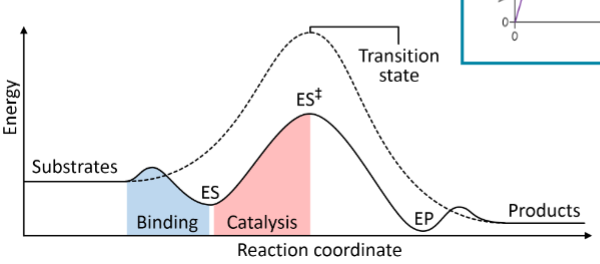
Catalyst allows for a new reaction pathway, with a lower Ea, and is not consumed during the reaction.
lower Ea, therefore under same conditions more reactions occur
catalytic converter eg as in automobiles
Converts convert harmful exhaust gases into less harmful ones.
Heterogeneous reaction – Pt, Pd, Rh on an Al2O3 porous structure
enzyme catalyst
Enzyme active sites are complex 3D structures, consisting of hydrogen bonding interactions, hydrophobic regions, vdw interactions, that lead to an optimised fit for the substrates.
Product dissociates from active site, allowing for catalytic turnover.
But active site is very sensitive to its environment.