ASTRO 101 - Midterm (Chp. 1 - 6, 14)
 Call Kai
 Learn
Learn Practice Test
 Spaced Repetition
 Match
Match Flashcards
 Knowt Play
1/58

There's no tags or description
Looks like no tags are added yet.
Name | Mastery | Learn | Test | Matching | Spaced | Call with Kai | Chat |
|---|
No analytics yet
Send a link to your students to track their progress
59 Terms
1st Level of “Cosmic Address” (smallest)
Planets
2nd Level of Cosmic Address
Systems! Includes planets, the sun which they orbit, their moons, and other smaller objects like astroids, comets, and space debris.
What is the 3rd level of cosmic address?
Galaxies. Great islands of stars in space, held together by gravity and orbiting a common center. Most are found in groups, some may be isolated.
What are local groups & galaxy clusters?
The 4th level of the cosmic address. Clusters of relatively smaller galaxies with 1-2 larger ones, such as the local group surrounded around the Milky Way. Galaxy clusters mainly consist of larger galaxies.
Superclusters
Regions (very large scale) of giant chains of galaxies and galaxy clusters in which they are tightly pulled together — “clusters of galaxy clusters.” 5th layer of cosmic address.
The Universe
6th (and final) layer of cosmic address. The sum total of all matter and energy, encompassing the superclusters and voids and everything within them.
What is an Astronomical Unit (AU) & its purpose?
The earth’s average distance from the sun (about 93 million miles), used to measure DISTANCE within the solar system.
What is a light year?
The distance light can travel to us in a single year. Used to measure distance within GALAXIES. If a star is 600 light-years away, it’ll take 600 years for its light to reach us — meaning if it blew up today, we wouldn’t know for… 600 years.
The farther away we look in distance, the further we look back in ____.
Time.
When we say the universe is expanding, it really means…
The distance between galaxies are growing larger with time.
If we represent the solar system on a scale that allows us to walk from the Sun to Pluto in a few minutes, then
the planets are MARBLE-SIZE (or smaller) and the nearest stars are thousands of miles away.
The total number of stars in the observable universe is roughly equivalent to
The number of grains of sand on all the beaches on Earth.
If stars existed but galaxies did not
We would NOT exist because we are MADE of material that was recyled in galaxies.
What is the observable universe?
The entirety of the universe we can currently observe. 14 billion light years. This isn’t a permanent limit of the universe, in fact, it’s likely bigger — the light literally just hasn’t reached us yet.
What makes a planet a planet?
Must orbit a star, large enough for its own gravity to make it round, and has cleared most other objects from its orbital path. If 1 & 2 only, it is a dwarf planet.
The age of our solar system is about…
one thirs of the age of the universe.
All galaxies are moving away from us, with more distant ones moving faster & further. What can we conclude from this?
The universe is expanding.
The “Raisin Cake” Analogy (Universe Expansion)
As the cake begins to bake, the raisins expand apart. Further raisins move further away from the reference raisin. The expanding dough (universe) pulls further away raisins (galaxies) even further b/c its pulled by the expansion of space itself.
What is nuclear fission and its importance?
Lightweight atomic nuclei smash together and fuse to make heavier nuclei, which generates energy. This builds enough energy to make new elements, which are spread when a star finally supernovas.
What direction does the sun, moon, and stars rise and set?
Rise in the east, set in the west, because the earth rotates from west to east.
Suppose you watch a star over the course of a night. What direction will you see it travel?
East to west.
What is the trick for remembering counterclockwise rotation of the Earth?
Right hand fingers curl. That is the direction the Earth rotates in reference to the north pole.
What is the ecliptic plane?
The flat plane that is defined by Earth’s orbit around the sun.

What is axis tilt?
The earth’s axis is tilted 23.5 degrees to the right (in reference to the ecliptic plane), which allows for seasons. The axis tilt remains in the same position year round.
Asteroid vs Comet
Both orbit stars, however. asteroids are rock-based while comets are ice-rich.
Which star does the axis point to, and what is the importance?
Polaris, earning the name “the north star.”
When the big bang occured, what were the two major elements that allowed for the creation of new ones?
Hydrogen and Hellium. Base of ALL elements.
In relation to a single year, how long have we been here?
Human civilization would be a single second, whereas our own lives would be a fraction of a second.
What are constellations?
Regions of the sky. 88 of them in total.
What are the traits of the celestial sphere (and local sky)?
Zenith (the point directly above observer), Horizon (the line seperating observable and nonobservable horizontal view), the Ecliptic (path the sun follows) and the Meridian (the lin going directly north and south)

Angular Size
The angle an object appears to span in your field of view. Doesn’t account for distance away.
Why are there seasons?
The tilt of Earth’s axis causes them. Sunlight will strike each hemisphere at a steeper/shallower angle depending on the time of year.
It’s summertime in the Northern Hemisphere. Why is it hotter?
Earth’s axis is tilted toward the sun, so the angle the sun’s rays hit the earth are steeper, making the heat more concentrated on a smaller part of the earth, making it hotter. This is combined with more daylight, allowing more time for the sun to be up to be hot.
How to determine a position of an object in the sky?
Look at its DIRECTION along the horizon, and its ALTITUDE above the horizon.
What is the angular measurement conversion?
1 degree = 60’ arcminutes, 1’ arcminute = 60” arcseconds
Why do we always see the same side of the moon?
It rotates the same speed & direction it revolves around the earth. We see the left side as the “dark side” whereas the right is the light.
What is a lunar eclipse and how can it happen?
Must happen during a full moon, where the earth is perfectly in between the path of sun and moon. Earth’s shadow gets cast upon the moon. The blue light is absorbed by the earth, so the red/orange light is bended onto the moon.

What is a circumpolar star?
A star that never sets or rises. Constantly in the sky, rotating around one of the celestial poles.
Umbra vs Penumbra
Full shadow projected onto an object, versus a partial “fuzzy” shadow region.

What is a solar eclipse and when can it happen?
Moon comes directly between sun and earth, creating a shadow from the moon onto the earth. Only occurs at NEW MOON.
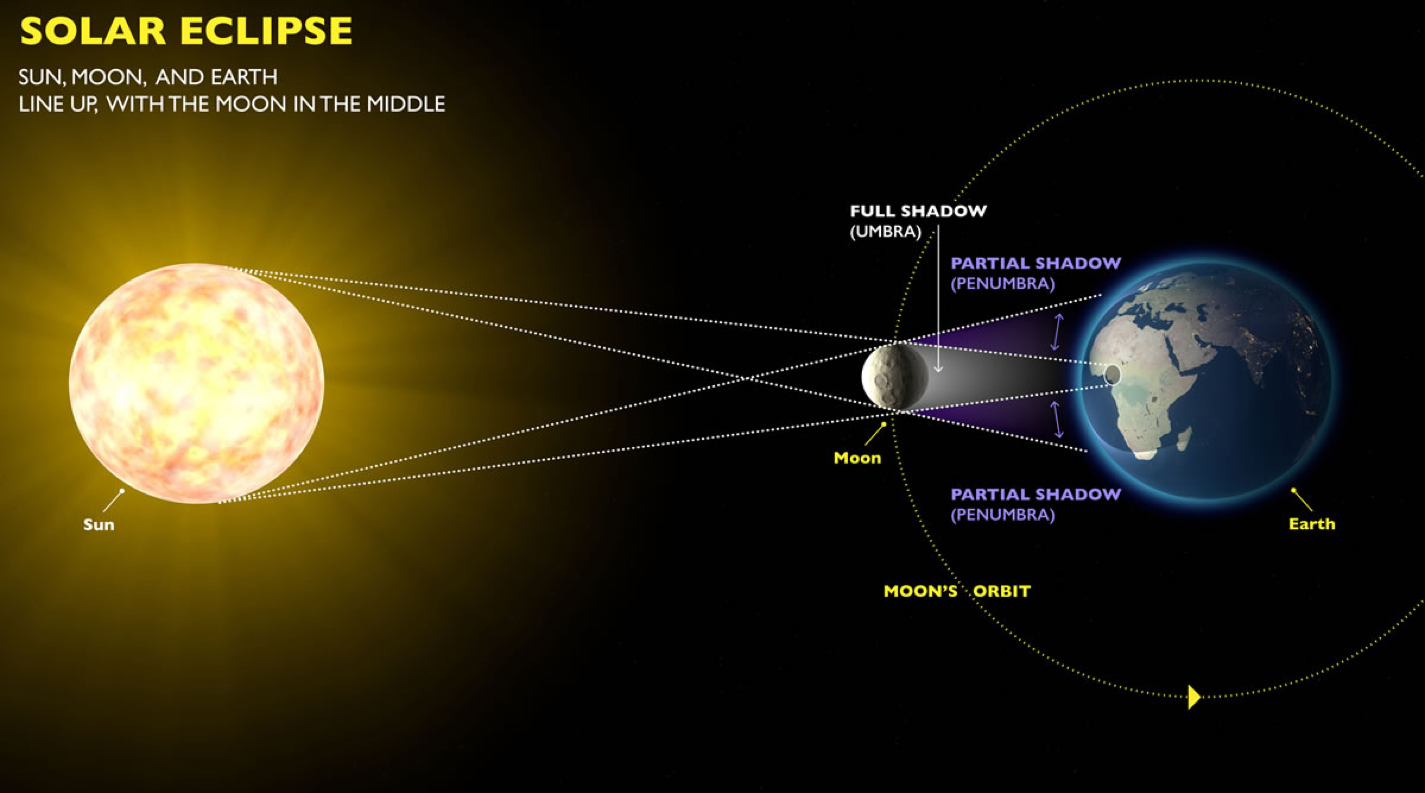
What is a node?
Two specific points on the ecliptic plane which the moon can cross and potentially block the sun (or be blocked by the earth).

If Earth was closer to the sun during a lunar eclipse, would the penumbra increase or decrease in relation to the umbra?
Increase, because the object is closer, it casts a larger shadow.
If we double the distance of the moon from the earth, what happens?
The moon would no longer fully cover the sun, so we’d only get a penumbral shadow (partial).
Types of solar eclipses
Partial (sun/moon not perfectly aligned), Total (moon appears bigger than sun), Annular (perf. alignment, but sun is closer and moon further than usual).
The earth is closest to the sun on Janurary 3rd, and furthest on July 4th. Which time are we more likely to see a total eclipse (more umbra)?
Janurary 3rd. We are closer to the sun, meaning the shadow will be more concentrated and deeper.
Why don’t we have an eclipse at every new and full moon?
The moon’s orbit is tilted 5 degrees to ecliptic plane, so we can only have two eclipse seasons with a lunar at full and a solar at new.
Types of lunar eclipses
Total (passes entirely through umbra), partial (part passes through umbra), penumbral (moon passes through penumbra)
Eclipses do not occur every month because
The orbit of the moon is tilted relative to the earth-sun plane. Eclipses can only occur when the two planes are aligned (when moon passes a node), about twice per year.
Waxing vs Waining in moon phases
Light is increasing vs light is decreasing.
Order of the moon phases
New, waxing crescent, first quarter, waxing gibbous, full moon, waining gibbous, last quarter, waining crescent.
The moon rises in the ___, and sets in the ____.
East, and West. Because earth rotates from west to east.
The phase of the moon is ___ during a solar eclipse, and ___ for a lunar eclipse.
NEW, FULL
How much does the sun drift each day?
1 degree eastward.
How much does the moon drift each day?
13 degrees eastward a day.
What is apparent retrograde motion?
As earth passes a planet with a longer orbital period, it appears to move “backward” even though its not. Just like when you pass a car, as you approach the car it appears to be moving forward. Then, when you’re right next to it and passing it, the car appears to be moving backwards, even when it obviouisly isn’t. The planet goes back to a normal path apperance