Quantum and Statistical Mechanics of Molecules and Solids
 Call Kai
 Learn
Learn Practice Test
 Spaced Repetition
 Match
Match Flashcards
 Knowt Play
1/48

There's no tags or description
Looks like no tags are added yet.
Name | Mastery | Learn | Test | Matching | Spaced | Call with Kai | Chat |
|---|
No analytics yet
Send a link to your students to track their progress
49 Terms
What is the Schrodinger equation?
Psi = Wavefunction
E = Energy
H = Hamiltonian
T = Kinetic Energy
V = Potential Energy

What information does the wavefunction contain?
ALL information about the system
What are the conditions about the wavefunction?
Normalised
Finite
Single-valued
Continious
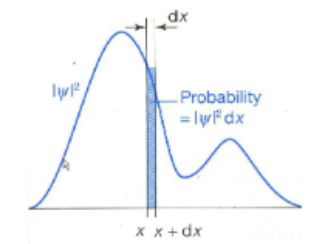
What is wavefunction² proportional to?
Probability of finding particle at x
→ BORN INTERPRETATION
What atom do you need to use to get solution of Schrodinger equation?
Hydrogen atom

What are the ways to show electron spin?

What quantum numbers are needed to specify state of an electron?
n, l , ml , ms
What is the Pauli principle?
“If the labels of two electrons are exchanged, the total wavefunction must change sign”
How do you satisfy the Pauli principle?

Why are atomic units (au) used?
Calculations become clumsy so set physical calculations = 1
What are Born-Oppenheimer approximations?
Allows us to separate nuclear and electronic motion

What does the full wavefunction depend on for Born-Oppenheimer approximations?
Depends on nuclear and electronic coordinates, R and r
→ CAN BE SEPARATED TO A GOOD APPROXIMATIONS (see picture)

What is the electronic Schrodinger equation?
VNN is a constant for fixed nuclear geometry
→ Can now find internal energy,U, for any arrangement of nuclei: Potential energy surface


How do you work out the Hamiltonian for a H2 molecule with nuclei A & B and electrons 1 & 2 in Born-Oppenheimer approx?

How do you express the full wavefunction that describes a molecule is a function of coordinates of all electrons?
Psie has a value for every possible arrangement of electrons
→ High amplitude for likely arrangements
→ Low amplitude for unlikely arrangements
→ Zero amplitude for impossible arrangements

What is the 3-body problem so what do you use instead?
When you cannot exactly solve the molecular Schrodinger equation with many-electron atoms
→ Use orbital approximation instead
What is the orbital approximation?
Each molecular orbital (psii) describes motion of ONE electron

What is the Hartree-Fock method?
Standard approach for calculating molecular orbitals

Set of 1-electron Schrodinger equations, where each electron feels average repulsion from all others
How do you use Hartree-Fock method equation effectively?
Effective potential each electron feels depends on all others, so solve equations iteratively until they are “Self-consistent”
→ Self consistent field method

What is the Variation theorem?
If psiapprox is an approximate wavefunction for the ground state of a molecule, then Eapprox is greater or exact to Eexact
→ Eapprox is the energy corresponding to psiapprox

What is the linear combination of atomic orbital approach?
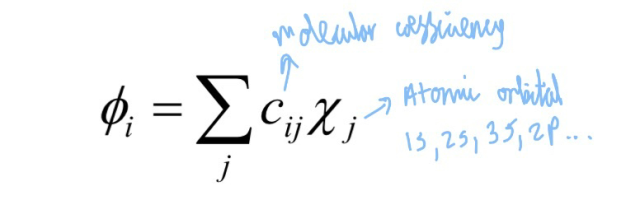
cij = Determines how much atomic orbital (kaij) contributes to the molecular orbital (psii)
How do you minimise the Hartree-Fock energy?
Find best choice of “MO coefficients” cij
Solve the equation by solving Roothan-Hall equations

What happens if you use the LCAO approach to H2?
Forms MOs as linear combinations of s-orbitals on each nucleus XA and XB

What does bonding MO create?
Constructive interference
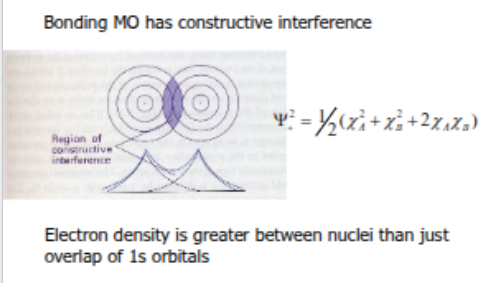
What does anti-bonding MO create?
Destructive interference

What does the variation theorem tell us about psi+ and psi-?
That psi+ is better description of ground state of H2

How can you calculate HF energy for any bond length?
Draw out diagram
→ HF is qualitatively correct, but quantitatively wrong
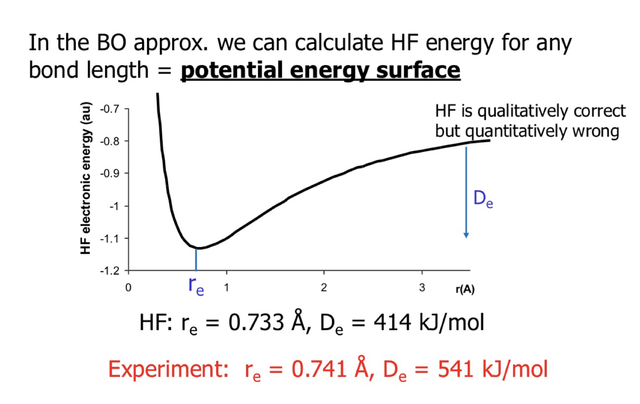
Potential energy curve
What is a basis set?
Set of known functions used to build unknown functions in quantum calculation
What is the basis set for the pi-system of conjugated buatiene pz orbitals describing all the pi-MOs
In phase orbitals show positive numbers

How do you show the radial part of a Slater-type orbital (STO)
Zeta ζ = Controls how quickly function decays: Higher values for higher effective nuclear charge
r = Radius

What are Slater-type orbitals?
Family of cuntions used as atomic-orbital-like building blocks in LCAO basis set

Why is the exponential part important here?

Matches true hydrogen-like orbtial, forms a cusp at the nucleus
Tricky to wortk with and awkward
Why is Gaussian-type orbital (GTO) used instead of Slater-type orbitals (STO)

Has no cusp at nucleus
Easy to integrate
How do you improve the shape of Gaussians at small and large r?

Use several Gaussians linked together

What is STO-3G?
Using 3 Gaussian type orbitals to mimic one slater type orbital

Acts as one Slater basis function when used in fixed combination
What is a minimal basis set?
Smallest possible basis set uses single basis function for each occupied orbital on each free atom
What is the minimal basis set for hydrogen?
1s orbital
What is the minimal basis set for carbon?
1s2, 2s2, 3 × 2p
Or 1s orbital, 2s orbital and full set of three 2p orbitals
What is a disadvantage of using minimal basis sets such as STO-3G?
Lacks flexibility to describe bonding in real molecules
How do you make minimal basis sets “more flexible”?
Use 2 or 3 basis functions per occupied orbital
Termed as double zeta (DZ) or triple zeta (TZ)
e.g = 2 × 1s or 2 × (1s, 2s, 3×2p)

Basis functions of different sizes allow MOs to expand or contract according to their environment
What are the disadvantages of using double zeta (DZ) or triple zeta (TZ) basis sets?
More coefficients to evalulate = Slower calculations and more integrals/RAM requirements
Chemistry takes place mainly in valence orbitals so:
→ Core electrons do not change in response to environment
→ Adding flexibility for core electrons is inefficient
What are split-valence basis sets?
Gives more flexibility to valence electrons than core
Solution to using DZ and TZ

What do DZ and split-valence basis sets allow MOs to do?
Allow MOs to expand or contract, but not to change shape from atomic orbitals

What function do you use to describe multiple bonding, lone-pairs,hypervalency
Polarisation functions
What are polarisation functions?
Functions with higher angular momentum than required in free atom

What do polarisation functions allow?
Allow proper description of electrons in molecular environment

What are the common polarised split-valence basis sets?

What is the variation theorem for the ground state?
Lower energy = Better wavefunction