EM - Trauma pt. 1
 Call Kai
 Learn
Learn Practice Test
 Spaced Repetition
 Match
Match Flashcards
 Knowt Play
1/60

There's no tags or description
Looks like no tags are added yet.
Name | Mastery | Learn | Test | Matching | Spaced | Call with Kai | Chat |
|---|
No analytics yet
Send a link to your students to track their progress
61 Terms
Golden hour conditions
Sub/epidural bleeds, HTX/PTX, Spleen/liver lac
Primary survey
ABCDEF
(airway, breathing, circulation, disability, exposure, full VS)
Airway red flags
Abnormal Voice
Bleeding/secretions
Facial burns/swelling
Stridor
AMS
Hypoxia
Absent Gag reflex
When is nasotracheal intubation contraindicated?
basilar skull fracture, apnea, facial trauma
Rapid Sequence Intubation (RSI)
Short active sedatives: Etomidate, Propofol
Neuromuscular blocking agents: succynolcholine, rocuronium
What should you do if concerned for tension pneumothorax
Needle decompression THEN tube thoracostomy
Breathing red flags
Tracheal deviation
Decreased breath sounds
Crepitus
Abnormal chest movement
Multiple rib fx
Open chest wounds
AMS
open PTX tx
3 sided dressing
Hemothorax tx
chest tube
Pt has tachycardia, hypotension or obvious blood loss. How do you manage this pt?
Stop bleed, emergent transfusion, consider early OR
Circulation red flags
Bleeding
Decreased/absent pulses
Tachycardia
Narrow pulse pressure
Hypotension
Poor perfusion
Abnormal heart sounds
Class 1 blood loss
Up to 15%
Class 2 blood loss
15-30%
Class 3 blood loss
30-40%
*hypotension
Class 4 blood loss
> 40%
How to access consciousness
Pupils, GCS, CT without contrast if head injury concern
Disability red flags
Focal neuro deficits
Abnormal pupils
Posturing
GCS eye opening
4 - spontaneous
3 - to voice
2 - to pain
1 - none
GCS verbal response
5-Oriented
4-Confused conversation
3-Inappropriate words
2-Incomprehensible sounds
1-None
GCS motor response
6- obeys commands
5- moves to localized pain
4- flex to withdraw from pain
3- abnormal flexion (decorticate)
2- extension response (decerebrate)
1- none
Cushing reflex
HTN, bradycardia, and respiratory depression (BP, brady, breathing)
Exposure and Environment red flags
FBs
Penetrating injuries
Burns
What should you perform immediately following primary survey?
FAST exam
Secondary survey
AMPLE Hx: allergies, meds, PMH/pregnancy, last meal, events
Visualize everything, palpate, imaging
Which pt would you send to the Operating Room vs. Observation
OR: unstable, ongoing bleeding
Observation (ER/Inpatient): blunt abdominal trauma, head, chest injuries
How are TBIs classified?
GCS
Mild: > 14
Moderate: 9-13
Severe: < 9
TOC for head injuries
CT scan
Basilar skull fracture sx/red flags
raccoon eyes, battle sign, CSF leak, hemotympanum
Pt comes in following blunt force trauma to the head. They have a lucid interval -> decompensation; fixed and dilated pupil on side of injury, opposite side paresis. What is suspected Dx?
Epidural hematoma
*biconvex, MC MMA involved
Injury resulting from tears of bridging veins following acceleration-deceleration injury
Subdural hematoma
You suspect patient has a SAH, what LP finding would confirm this suspicion?
Xanthochromia -> yellowish appearance of CSF
Pt comes in with blown pupil; what is this finding indicative of?
Same side elevated brain pressure
Canadian head rules
High risk if:
GCS < 15 2 hrs post-injury
Suspected open/depressed skull fracture
Sx of basilar skull fx
2 or more episodes of vomiting
Age > 65
Retrograde amnesia > 30 min
Dangerous mechanism
PECARN criteria (younger than 2 yrs)
AMS or GCS < 15 or Palpable skull fx -> CT head
PECARN criteria
AMS or GCS < 15 or sx of basilar skull fx -> CT head
Head trauma management
Maintain cerebral perfusion
- fluid and pressors
Keep sats > 90%
Treat elevated ICP
- mannitol 1 g, HOB > 30, 3% hypertonic saline 250 cc bolus (refer to specialist for mannitol/hypertonic saline), intubated goal pCO2 30-35 mmHg
Treat hyperglycemia
Seizure prophylaxis
- antiepileptic if GCS < 10
Keep body temp 36C-38.3C
Reverse coagulapothy
Indications for intubation after trauma
Burns to airway
Rapidly expanding hematoma
GCS < 8
Facial trauma imaging
CT maxillofacial without contrast
Common indications for ABX following facial trauma
Sinus fx, open fx
Key facial injuries
Frontal bone - fractures of INTERNAL frontal sinus wall
Blowout fractures w entrapment of extra-ocular muscles
Septal hematoma
Zygomaticomaxillary complex fx
Le fort fractures (upper jaw)
Open fractures/intraoral laceration (lower jaw)
*look for septal hematoma and CSF leaks
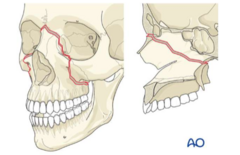
Le Fort 1
Transverse fracture through lower maxilla, above roots of teeth
*palate mobile, stable fx

Le Fort II
Pyramidal fx from central maxilla through orbital rim, nasal bridge, and hard palate
*nose and maxilla mobile
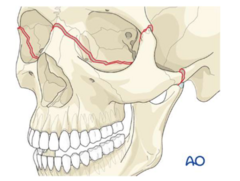
Le Fort III/IV
Fx through frontozygomatic sutures, orbits, nose, and ethmoids (+ frontal bone = IV)
*entire face mobile, unstable, +/- CSF leak (cribiform plate)
Admit + IV ABX
Le Fort 1/2 management
ENT or facial surgery consult
*EARLY intubation, avoid paralytics, consider awake intubation
Le Fort III and IV management
Admission and IV ABX
EARLY intubation, avoid paralytics, consider awake intubation
Pt presents w malocclusion, trismus, lower lip paresthesia. What should you consider?
Mandibular fx
*consider bilateral and open until proven otherwise
Mandibular fx DX/TX [open vs closed]
CT, intraoral exam
Open: admit, IV ABX, OR
Closed: Barton bandage f/u OMFS
Blunt Neck Trauma red flags
Seatbelt sign
Clothesline injury
Steering wheel/dashboard to the neck
*neuro sx may be delayed
Blunt neck trauma imaging
CTA
Blunt neck trauma tx
Unstable -> intubate, ENT consult
Penetrating neck trauma
Injury through platysma muscle
Zone 2 penetrating neck trauma
MC; cricoid to angle of mandible
Hard signs of penetrating neck trauma
HARD Bruit
Hemoptysis/hematemesis/hypotension
Arterial bleeding
Rapidly expanding hematoma
Deficit (neurologic/pulse)
Bruit
Soft signs of penetrating neck trauma
Hoarseness, SQ air, vocal cord paralysis, facial nerve injury, nonexpanding hematoma
Management for penetrating neck trauma w hard signs
OR or Angio
Management for penetrating neck trauma w soft signs (hoarseness, CN 7 injury, SQ air, vocal cord paralysis)
CTA
Unstable cervical spine fractures
Jefferson
Bilateral facet dislocation
Odontoid
Atlanto-occipital dislocation
Hangman
Teardrop
Jefferson fracture
Burst fracture @C1, due to axial loading
Key imaging for Jefferson fracture
Odontoid view, CT

Hangman's fracture
Fracture of posterior elements of C2, due to hyperextension-compression
Teardrop fracture
Antero-inferior cervical vertebral body fx
