ID Foundational
 Call Kai
 Learn
 Practice Test
 Spaced Repetition
 Match
 Flashcards
 Knowt Play
1/166

There's no tags or description
Looks like no tags are added yet.
167 Terms
What do different Gram Stain results mean?
Stains purple→Gram +
Stains pink→Gram -
Doesn’t stain well → Atypical(Chlamydia, Legionella, Mycoplasma) or Mycobacterium tuberculosis
Gram + cocci that are clusters
Staphylococcus(including MRSA)
Gram + cocci that are chains/pairs
Streptococcus pneumoniae
Streptococcous ssp.
Enterococcous spp(including VRE)
Gram + rods
Listeria monocytogenes
Corynebacterium spp.
Gram + anerobes
Peptostreptococcous
Cutibacterium acnes
Clostridium difficile
Clostdrium spp.
Gram + bacteria breakdown

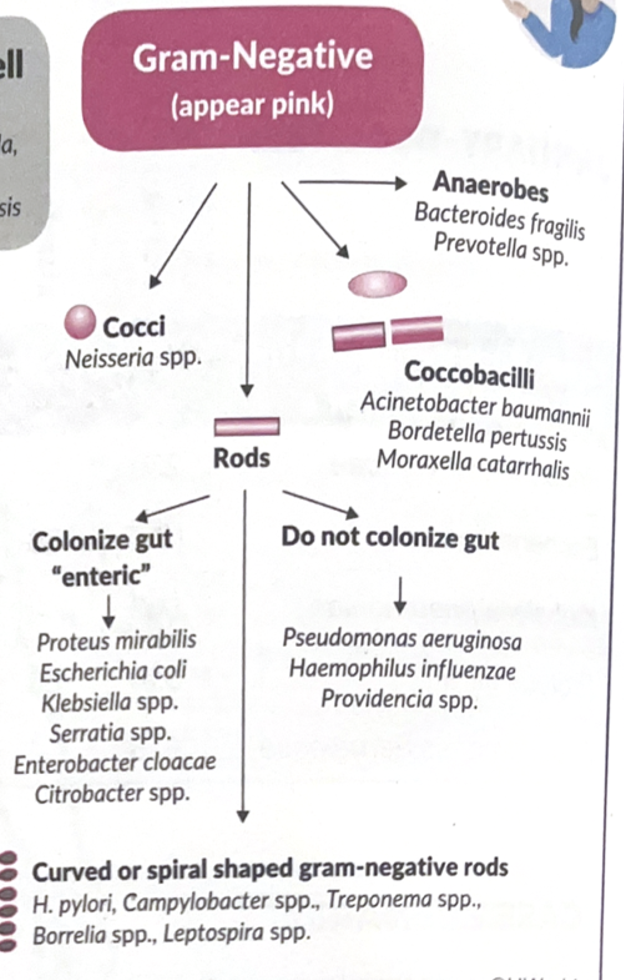
Gram negative cocci
Neisseria spp.
Gram negative coccobacilli
Acienetobacter baumannii
Bortdella pertussis
Moroxella catarrhalis
Gram - anaerobes
Bacteroides fragilis
Prevtolla spp.
Gram - rods that colonize gut
PEK SEC
Protus Mirababilis
E. coli
Klebsiella spp.
Serratia spp.
Enterobacter clocae
Citrobacter spp.
Gram - rods that do not colonize gut
Pseudomonas aeruginosa
Haemophilus influenzae
Providencia spp(ironic)
Gram - rods that are curved or spiral shaped
H. pylori
Campylobacter spp
Treponema spp
Borrelia spp
Leptospira spp.
Gram - breakdown
HNPE Bacteria
· Haemophiles
· Neisseria
· Proteus
· E. coli
HNPEK Bacteria
· Haemophiles
· Neisseria
· Proteus
· E. coli
· Klebsiella
KEC (these are the AmpC hyperproducers)
· Klebsiella pneumoniae
· Citrobacter freundii
· Enterobacter Cloace
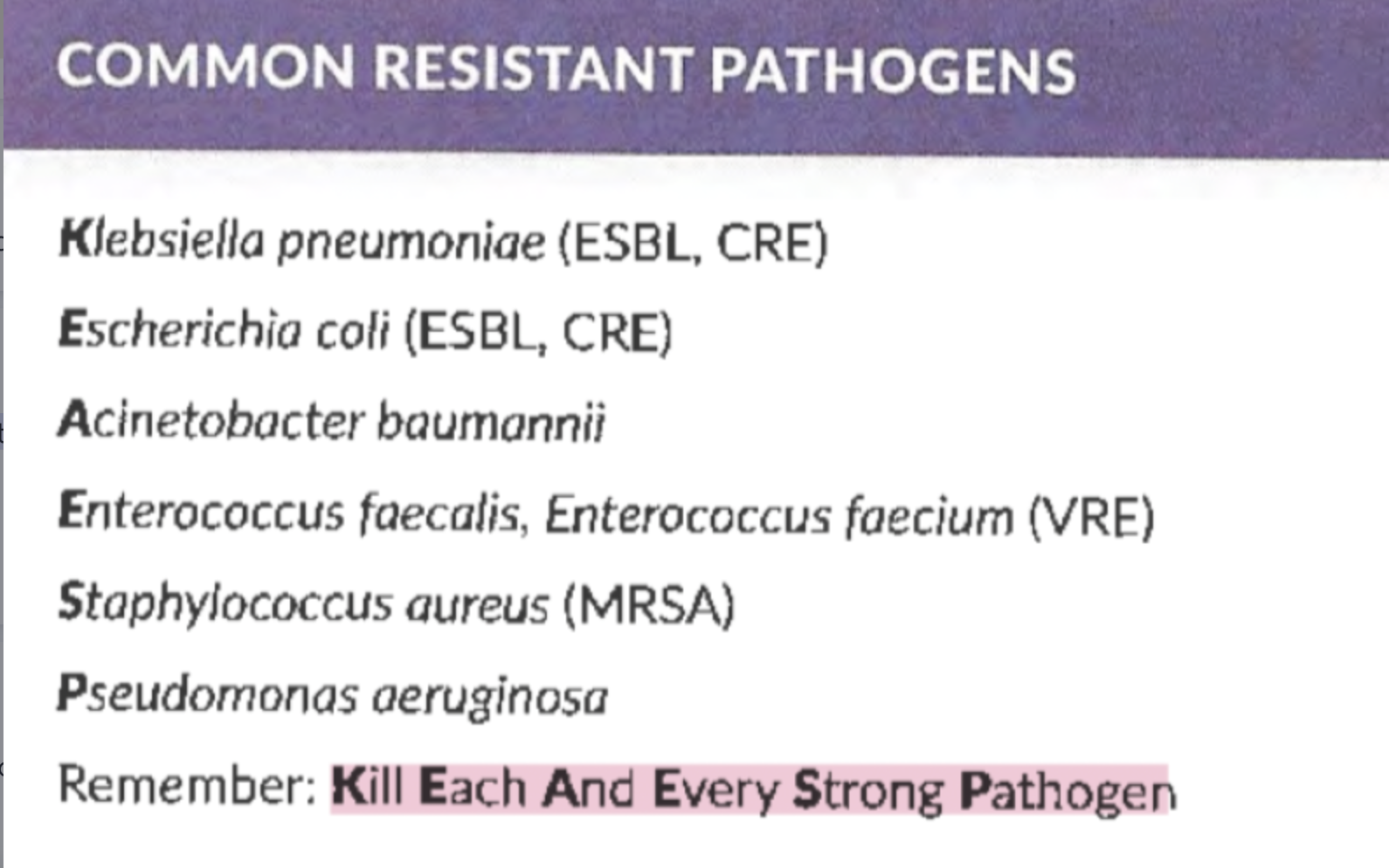
What are the Common Resistant Pathogens (6 mnemonic)?
What are the concentration dependent ABx?
• Aminoglycosides
• FQ
• Daptomycin
What are the exposure dependent ABx?
• Vancomycin
• Macrolides
• Tetracyclines
• Polymyxins
What are the time dependent ABx?
Beta lactams (PCN, cephs, carbapenems)
5. groups of Hydrophilic ABx

6 groups of Lipophilic Abx

What classes are considered beta-lactam ABX?
• Penicillins
• Cephalosporins
• Carbapenems
PCNS have no coverage of what?
MRSA or atypical organisms
Beta-lactam MOA
inhibit bacterial cell wall synthesis by binding to PBPs
What are the Natural PCN drugs & what do they coverage?
Drugs:
Penecillin V potassium→ PO
Penicillin G Aqueous→IV
Penicillin G Benzathine (Bicillin L-A)→IM
Coverage: Streptococcus, Enterococcous, Gram + anaerobes; No Staph
What are the Anti-staph PCN drugs & what do they cover?
Drugs:
Dicloxacillin(PO)
Nafcillin(IV)
Oxacillin(IV)
Covers: Staph(MSSA) and Streptococcus
Not Enterococcous, Gram – pathogens, and anaerobes
What are the Amino-PCN drugs & what do they cover?

Extended PCN with beta lactamase inhibitor drug + coverage
Drugs: Piperacillin/Tazobactam (Zosyn)→IV
Coverage: Same as aminopenicillins with beta lactamase inhibitors + Pseudomonas + AmpC hyperproducers(KCE)
BBW for Penicillin G benzathine?
Do not give IV; can cause cardio-respiratory arrest and death
T/F: All PCNs should be avoided pts with a beta lactam allergy
True
Exceptions: Treatment of Syphilis during Pregnancy or in pts with poor adherence
What are the ADRs of PCNs?
Seizures if accumulation occurs
GI sx
Rash(including SJS/TEN)/allergic reactions/anaphylaxis
Hemolytic anemia(if positive Coombs test)
Pearls about Antistaphylococcal PCNs?
Preferred for MSSA infections
requires no renal dose adjustments
Nafacillin is a vesicant
Pearls about Aminopenicillins?
Ampicillin PO has poor oral bioavailability
IV Ampicillin/Sulfbactum are diluted in NS
Penicillin VK features
1st line treatment for pharyngitis(strep throat)
Amox/clav key features
Common uses: AOM( pediatric dose 90mg/kg/day) and bacterial sinusitis
Use the lowest dose of clavaulante to decrease diarrhea
Amoxcillin key features
Uses:
AOM( pediatric dose 90mg/kg/day) and bacterial sinusitis
infective endocarditis prophylaxis
H. pylori regimens
Penicillin G Benzathine Key features
Drug of choice for Syphilis
not for IV use
Pip/Taz Key features
Only PCN active against Pseudo
Note: extended infusions can maximize T>MIC
What are the DDI with PCNs?
Probenecid can increase levels which interfere with renal excretions
What do cephalosporins not cover?
Enterococcous or any Atypical organisms
What are the first gen cephalosporins and what do they cover?
Drugs:
Cephalexin → PO
Cefazolin → IV
Coverage: Gram + cocci (i.e. Streptococci and MSSA), and Gram negative PEK
What are the 2nd gen cephalosporins and what do they cover?
Drugs:
Cefuroxime: PO, IV
Cefotetan, Cefoxitin: IV
Coverage: MSSA, more resistant S. pneumoniae, and HNPEK
Cefotetan, Cefoxitin can also cover Gram – anaerobes (B. fragilis)
What are the 3rd gen cephalosporins and what do they cover?
There are two groups:
Group 1:
Drugs:
Ceftriaxone; PO
Cefidinir(Omnicef): PO
Coverage: MSSA, resistant streptococci,(S. pneumonia or S. viridian) and resistant HNPEK
Group 2: Ceftazidime→ IV
Coverage: Pseudomonas (lacks gram + activity)
What are the 4th generation cephalosporins and what do they cover?
Cefepime→IV
Coverage: Broad gram - (HNPEK, KCE, Pseudomonas) and Broad gram + like CTX
What are the 5th gen cephalosporins and what do they cover?
Ceftaroline (Teflaro)→ IV
Coverage: Broad gram positive and negative, MRSA; no pseudo
Only Beta lactam that covers MRSA
What are the CI to Ceftriaxone?
Hyperbilirubinemic neonates: can cause biliary slugding, kernicertus
Concurrent use with calcium IV products
What are the side effects of Cephlasporins?
Seizures if accumulation occurs
GI sx
Rash(including SJS/TEN)/allergic reactions/anaphylaxis
Hemolytic anemia(if positive Coombs test)
Ceftriaxone: biliary sludging
What cephalosporin has no renal adjustments?
Ceftriaxone
DDI with Cephalosporins
CTX can form insoluble precipitates with Calcium containing fluids
Cefuroxime and Cefpodoxime should be separated by antacids by 2 hours
avoid PPI or H2RA
What cephalosporins can be used for pseudomonas?
cefepime
cefazidime
Cephalaxin key features
1st gen ceph
commonly used for : skin infections, strep throat(pharyngitis)
Cefuroxime key features
2nd gen ceph
commonly used for: AOM, CAP
Cefidinir key features
3rd gen ceph
commonly used for AOM
Cefazolin key features
1st gen ceph
commonly used for surgical prophylaxis
Cefotetan and cefoxitin key features
2nd gen ceph
anaerobic covergae(B. fragilis)
Surgical prophylaxis
Key features of Ceftriaxone
3rd gen ceph
commonly used for: CAP, meningitis, SBP, pyelonpehritis
no renal dose adjustments
do not use in neonates(0-28 days)
Key features of ceftazadime & cefepime?
cefepime= 4th gen, ceftazadime= 3rd gen, group 2
active against Pseudomonas
Key principles of Ceftaroline
5th gen ceph
has activity against MRSA
commonly used CAP, Skin and Soft Tiisue infections
Carbapenem uses
Reserved for MDR Gram negative infections (ESBL and Pseudomonas)
No activity for atypical organisms, MRSA, VRE, C. diff, Stenotrophomonas
What are the Carbapenems and their coverage?
Drugs:
Meropenem→IV
Imipenem/Cilastatin→IV
Ertapenem→IV or IM
Coverage: Broad gram +, gram negative(HNPEK, KCE, Pseudomonas, Acinetobacter, and ESBL), Anerobic
However Ertapnem doesn’t cover Pseduomonas, Acientobacter, or Enterococcous
Ertapenem must be diluted in what before use?
Normal Saline
Ertapenem has no coverage for
ErtAPenem does not cover EPA: Enterococcous, Pseudomonas, Acinetobacter
Common uses of carbapenems
polymicrobial infection
empiric therapy where resistant organisms are suspected
ESBL +
resistant pseudomonas or acinetobacter(except ertapenem)
Monobactum use and coverage
Drug: Aztreonam(Azactam)→IV
Coverage: Broad Gram – coverage (including Pseudomonas and HNPEK)
no activity for gram + or anerobic activity
Used when someone has a PCN allergy (has low cross reactivity)
Mechanism of action for Aminoglycosides
Bind to 30S ribosome to interfere with bacterial protein synthesis
What are the aminoglycosides and their coverage?
Drugs:
Gentamicin
Tobramycin
Amikacin
Coverage: Gram negative bacteria (including Pseudomonas)
Typically used with other antibiotics
Gentamycin and Streptomycin are used for synergy in combination with a beta lactam or Vancomycin to treat gram + infections
What are the BBW for aminoglycosides?
Nephrotoxcity
ototoxicity
Neruomuscular blockade
Avoid with other neurotoxic/nephrotoxic drugs
Aminoglycosides weight-based dosing
Dosing:
If underweight( TBW <IBW): use Total body weight
If normal weight: can use either TBW or Ideal Body Weight
If obese: use adjusted BW
When CrCl >60: dosed every 8 hours
Compare the two dosing strategies for aminoglycosides
Traditional dosing: uses lower and more frequent doses
Trough is drawn before 4th dose and peak is drawn 30 mins after 4th dose
Dose: 1-2.5mg/kg/dose
When CrCl >60: dosed every 8 hours
Extended interval dosing: uses higher & less frequent doses
Dose: 4-7mg/kg/dose
Draw random level and plot on the nomogram
if level plots on line, round up to the next dosing interval to avoid toxicity
bacterial killing is better
risk of nephrotoxicity is lower
Aminoglycoside target levels in traditional dosing
For Tobramycin and Gentamicin(in gram negative infection):
Peak: 5-10 mcg/mL
trough: <2 mcg/mL
How does altering parameters of aminoglycoside affect traditional dosing?
Altering dose→ affects peak
Alter frequency→ affects trough
Which Abx class has post antibiotic effect(continues to kill after serum drops below MIC)
aminoglycoside
Fluoroquinolones MOA
inhibit DNA Topimerase IV and gyrase(topo II) preventing supercoiling
Fluoroquinolones Drug + coverage
Drugs:
Ciprofloxacin(Cipro)
Levofloxacin
Moxifloxacin
Ofloxacin(Ocuflox)
Coverage:
All: Atypicals, Gram -(PEK) and Gram +
Additional coverage:
S. pneumoniae: Moxifloxacin, Levofloxacin
Pseudomonas: ciprofloxacin, Levofloxacin
Anerobes: moxifloxacin
FQs BBW
Tendon rupture
Peripheral neuropathy
CNS effects(seizures)
FQ ADRs:
QTc prolongation(highest with Moxi)
Hypoglycemia and hyperglycemia
Psychiatric disturbances
Photosensitvity
Which FQ does not need renal dose adjustments?
Moxifloxacin
Which FQ should not be used fir UTI since it does not concentrate in urine well?
Moxifloxacin
FQ DDI
antacids and other polyvalent ions
phosphate binders(Lanathum and sevelamar)
Warfarin(increase INR= increased bleeding)
QTc prolongation drugs
Ciprofloxacin is a 1A2 inhibitor→ can increase levels of Theophylline,tizanadine,caffeine
IV to PO ratio for FQ
1: 1 ratio seen for Levo and Moxifloxacin
Which groups should not receive systemic FQ?
Pregnant, breastfeeding, in children→ musculoskeletal toxicity
Key points of FQ
commonly used for: pneumonia, UTI, intra-abdominal infections, travelers diarrhea
used last line for acute bacterial sinusitis, Acute exacerbation of chronic bronchitis, acute cystitis
Macrolide MOA
Binds to 50S ribosomal unit to to inhibit protein synthesis
Macrolide drugs and their coverage
Drugs:
Azithromycin(Zithromax, Z-Pack)
Clarithomycin
Erythromycin(EES, Ery-Tab, Erythocin)
Coverage: Atypicals
What are the CI for Clarithomycin and Erythromycin?
Do not use with simvastatin or lovastatin
Macrolide ADRs:
QTc prolongation(erythromycin>azithromycin> clarithromycin)
Hepatotoxicity
GI upset
which macrolide should be cautioned with CAD?
Clarithromycin
Macrolide DDI
Azithromycin is a 3A4 substrate and has fewer DDI than the rest
Erythromycin & Clarithromycin are major 3A4 inhibitors and have DDI with simvastatin and lovastatin
Key features of macrolides
Azithro & Clarithro used→CAP, Mycobacterium complex treatment
Azithromycin used for→COPD exacerbations, pertussis, chlamydia, MAC prophylaxis, and severe travelers diarrhea
Erythromycin used for gastroparesis
Tetracycline MOA
reversibly binds 30S ribosomal subunit to inhibit protein synthesis
Tetracycline drugs +coverage
Drugs:
Doxycycline
Minocycline
Coverage: Broad gram + and - (including respiratory flora) and atypicals
Doxy has broader indications than other tetracylines:
CAP
CA-MRSA skin infections
Tickborne disease
STI(chlamydia)
What are the warnings of tetracylines?
Do not us in:
Pregnancy and breastfeeding
tetracycline & minocyline: <8 yo—> teeth discoloration
Which ABx can cause DILE?
Minocycline
Which tetracyclines have a IV: PO 1 to 1 ratio?
Doxycycline, Minocycline
Which tetracycline has no renal dose adjustments?
Doxycycline
Why should you sit upright for 30 mins after taking Doxycycline?
To avoid esophageal irritation
Tetracyclines DDI
Antacids
cations
sucralfate
Bismuth subsicyclate
bile acid resins
Sulfonamides MOA
inhibit bacterial folic pathway