5.3 Data Conversion (2 QUESTIONS) LEVEL 1

0.0(0)
Studied by 0 people
call kaiCall Kai
learnLearn
examPractice Test
spaced repetitionSpaced Repetition
heart puzzleMatch
flashcardsFlashcards
GameKnowt Play
Card Sorting

1/13

encourage image

There's no tags or description

Looks like no tags are added yet.

14 Terms

1
New cards

Digital Signals

Have two set values such as (EXAMPLE):


0V = “OFF“

5V = “ON”

2
New cards

Alternating Current (AC) Analogue Signals

can be Bipolar, in that they have positive and negative limits

<p><span style="color: yellow;"><strong>can be Bipolar</strong></span>, in that they have <span style="color: yellow;"><strong>positive and negative limits</strong></span></p>
3
New cards

Direct Current (DC) Analogue Signals

Are unipolar, i.e., they fluctuate between 0 V and either a positive or a negative value; but they never alternate between positive and negative voltages (REFER PIC)


either 0v to -5v


or 0v to 5v


never -5 to 5

<p><span style="color: yellow;"><strong>Are unipolar</strong></span>, i.e., they fluctuate between 0&nbsp;V and either a positive or a negative value; but <span style="color: yellow;"><strong>they never alternate between positive and negative voltages (REFER PIC)</strong></span></p><p></p><p><span style="color: yellow;"><strong>either 0v to -5v </strong></span></p><p></p><p><span style="color: yellow;"><strong>or  0v to 5v </strong></span></p><p></p><p><span style="color: yellow;"><strong>never -5 to 5</strong></span></p>
4
New cards

Analogue Signals

They suffer from the fact that every tiny detail of the voltage pattern matters. If the pattern is slightly altered by unwanted noise or distortion, the output will not be identical to the input.

<p><span style="color: yellow;"><strong>They suffer</strong> </span>from the fact that <span style="color: yellow;"><strong>every tiny detail of the voltage pattern matters</strong></span>. If the pattern is slightly altered by unwanted noise or distortion, the output will not be identical to the input.</p>
5
New cards
6
New cards

Digital Data Signals

Only have Two (binary) levels of voltage: high for ‘ON’ and low for ‘OFF’. (0 or 1)


Digital Signal = must be decoded first before understood

Analogue Signal = simple to hear and understand

7
New cards

The difference Between Analogue and Digital Signals

Analogue signals vary in magnitude uniformly i.e., an infinite number of positions between “off” and “on/full”. An example is a dimmer switch in a lighting system.


Digital signals, by contrast, express variation in the system’s variable in response to a set of discrete values e.g., a light with an “on/off” switch or with set degrees of dimming.
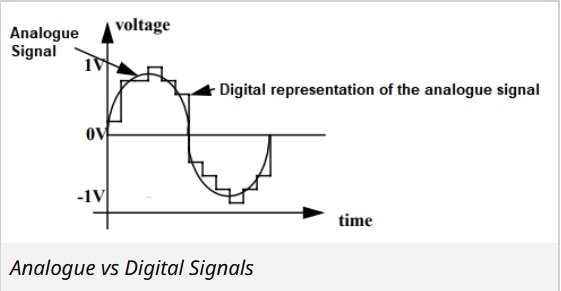
<p>Analogue signals vary in magnitude uniformly i.e., an infinite number of positions between “off” and “on/full”. An example is a dimmer switch in a lighting system.</p><p></p><p>Digital signals, by contrast, express variation in the system’s variable in response to a set of discrete values e.g., a light with an “on/off” switch or with set degrees of dimming.</p>
8
New cards
9
New cards
10
New cards
11
New cards
12
New cards
13
New cards
14
New cards



