Pharmaceutical industry 01
 Call Kai
 Learn
 Practice Test
 Spaced Repetition
 Match
 Flashcards
 Knowt Play
1/23

There's no tags or description
Looks like no tags are added yet.
24 Terms
Drugs/therapeutic products
- Substances or biolo prods used to diagnose, prevent or treat disease
- 2 categories: Small-molecule drugs & Biological products (biologics)

Small-molecule drugs
- Relatively low molecular weight
- Prod by chem synth

Biological products (biologics)
- Larger and/or structurally more complex products
- Prod using biolo systems
- Ex: vaccines

Innovator (research-based) pharma companies
- Research-intensive, invest heavily to discover & develop new molecular entities
- Very large size
- Ex: Pfizer

Generic pharma companies
- Don't conduct og discovery or clinical development needed for a NME
- Enter market w generic alternatives after relevant patent & regulatory exclusivity periods expire
- R&D focuses on formulation development, manufacturing process, etc.
- Medium-large size
- Ex: Teva

Biotechnology companies
- Develop innovative therapeutics & tech's using science
- Originate from academic discoveries, established co's
- Range from start-ups to multinational co's
- Partner or acquired by larger pharma co's
Ex: Amgen

Contract research organizations (CROs)
- Provide specialized services for pharma industry including specialty manufacturing, specialty chem synth, etc.
- Focus on niche research areas
- Range from specialized small CROs to large global org's
- Ex: Parexel

Drugs sold in Canada
- 1000's licensed prods: most are versions of other prods
- Drug product database: prod records (Health Canada)
- Compendium of pharma & specialities: data on molecular entities
Molecular entity
- Active chem responsible for the drug's pharmacological activity
- Ex: acetaminophen

Drug product
Finished formulation containing the molecular entity & excipients (other ingredients)

Typical drug project progression
1. Idea/target identification
2. Discovery
3. Preclinical development (research)
4. Clinical development (trials)
5. Regulatory review & approval
6. Market & post-market

1. Idea/target identification (drug project progression)
- Identify a biolo threat, pathway, disease mech or therapeutic strat
- Project initiation & feasibility

2. Discovery (drug project progression)
- Identify & optimize promising compounds
- Select a drug candidate (NME) from an idea for further development
- 1-3 years

3. Preclinical development (research) - drug project progression
- Labo & animal studies: pharmacology, safety, etc.
- Formulation & manufacturing-process development
- IND submitted to FDA to allow clinical investigation
- 1-2 years

4. Clinical development (trials) - drug project progression
- Evaluate safety, tolerability & dose
- Determine efficacy & characterize adverse effects
- Confirm efficacy & safety in large popu's
- NDA filed
- 1-5 years optimal, 5-7 avg

5. Regulatory review & approval (drug project progression)
- Submit evidence on quality, safety & efficacy
- Reg. review by FDA/Health Canada
- Decision on marketing authorization
- 0.5-1.5 years

6. Market & post-market (drug project progression)
- Monitor safety & effectiveness after approval
- Detect rare/long-term adverse effects
- Investigate additional indications/uses

NME, IND and NDA abbreviation
- NME: Drug candidate / New Molecular Entity
- IND: Investigational New Drug
- NDA: New Drug Application
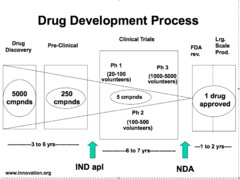
Drug candidate (NME)
- Identified after 1-3 yrs of research
- Confidential structures & data
- FDA authorization thru an IND not needed to do labo studies
- Animal researched is subject to applicable requirements
Investigational new drug (IND) application
- Regulatory submission needed before IND's start clinical investigation
- Submitted to FDA before human clinical studies
- FDA determines if studies expose participants to unreasonable risk → may be placed on hold
- Contain confidential commercial & scientific info

IND application contents
- Animal pharmacology & toxicology info
- Manufacturing/CMC info
- Investigator info
etc.

New drug application (NDA)
- Application to FDA for market approval
1. Safety of drug
2. Efficacy of drug: benefits outweight risks?
3. Appropriate labeling: instructions & warnings
4. Manufacturing methods: quality control, reproducible methods?

Abbreviated new drug application (ANDA)
- Application submitted to FDA for approval of a generic drug
- Excipients may differ
- Applicant demonstrates pharma equiv & bioequiv to reference listed drug
- Generic applicants don't repeat full animal & clinical efficacy to establish drug's safety & effectiveness
- Prod must meet manufacturing, quality & labeling rules

ANDA: The proposed generic generally must have the same...
1. Active ingredient(s)
2. Strength
3. Dosage form
4. Route of administration
5. Conditions of use as the reference prod. Subject to exceptions
