3.1 - Cell Biology
 Call Kai
 Learn
 Practice Test
 Spaced Repetition
 Match
 Flashcards
 Knowt Play
1/13

There's no tags or description
Looks like no tags are added yet.
14 Terms
What did Robert Hooke and Anton van Leeuwenhoek do for the history of cells?
Robert Hooke used an early microscope to observe slices of cork. He saw “little boxes” that reminded him of the cells that monks live in, coining the name cells
Anton van Leeuwenhoek was the first to observe living cells, including
algae Spirogyra
Vorticella
He dubbed these microorganisms animalcules
What is cell theory and its rules?
Cell theory is the summary of work from various scientists and is comprised of 3 rules:
Every organism is made up of 1+ cells
Cells are the most basic unit of structure in an object
New cells are only formed from the self-reproduction of past cells
How did microscopy affect the study of cell biology?
The study of cell biology was limited until the invention of the compound light microscope, which eventually led to the 7 characteristics of life:
7 Characteristics of Life
Living things are made up of organized parts
Living things need energy from their surroundings
Living things perform chemical reactions
Living things change with time
Living things respond to their environment
Living things can reproduce
Living things maintain homeostasis
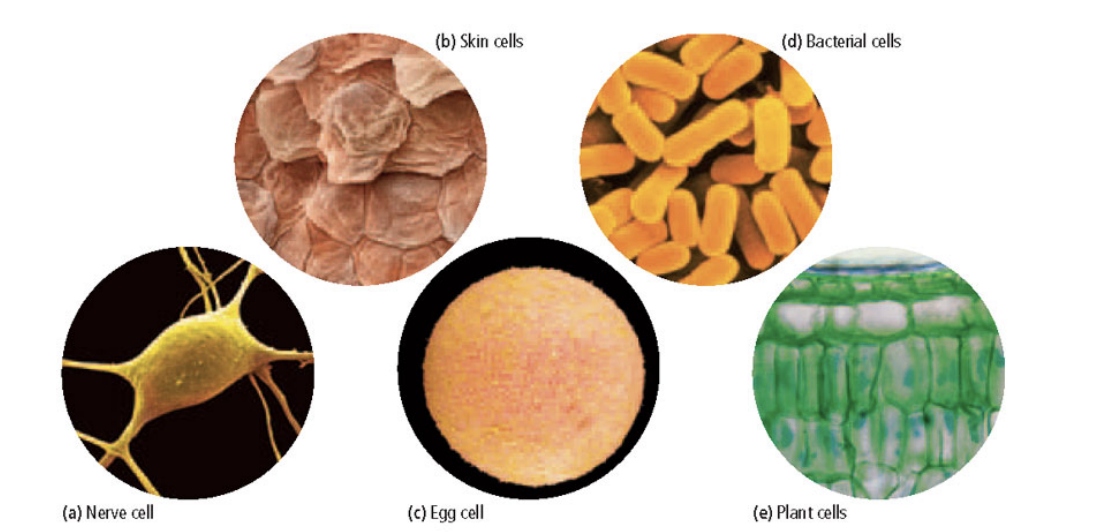
How do cells vary, and why?
Cells are very diverse:
shape
size
organization
function
This diversity has led to different functions, either simple or complex. These structures have evolved for maximum effectiveness in function
How does the volume of cells relate to the surface area and why?

Bigger cell → lower surface area: volume ratio
Cells usually have more surface area despite the ratio however in order to expel more waste and to allow entrance of nutrients
Name the basic parts of the cell.
Plasma Membrane
Cytoplasm
Control Center
What is the Plasma Membrane and its purpose?
It covers the surface of the cell like a wall for the entrance and exit of materials
What is the Cytoplasm and its purpose?
It is the region of the cell inside the membrane and contains important parts:
Fluids
Cytoskeleton
All organelles (except nucleus)
The cytosol
What is the Control Center (nucleus) and its purpose?
It is the largest controls the majority of functions in the cell. It maintains its shape with a protein skeleton called a nuclear matrix
What are the two types of organisms and their differences
Prokaryotes and Eukaryotes
Prokaryotes have prokaryotic cells
Eukaryotes have eukaryotic cells
Characteristics of Prokaryotic Cells
Lacks a membrane bound nucleus and organelles
Divided into two domains:
Bacteria: related to basic cell life forms
Archaea: Related to eukaryotic cells
Characteristics of Eukaryotic Cells
Has a membrane bound nucleus and organelles
Larger cells than prokaryotes
Difference between a Colonial Organism and a Multicellularity
Colonial organisms are organisms with cells that live together in a connected group.
Multicellularity is an organism that has cells that cannot survive without each other.
Colonial Organisms can live independently, but a multicellularity has dependent cells