L24 - Cell Membrane Physiology Osmolarity, Tonicity
 Call Kai
 Learn
Learn Practice Test
 Spaced Repetition
 Match
Match Flashcards
 Knowt Play
1/60

There's no tags or description
Looks like no tags are added yet.
Name | Mastery | Learn | Test | Matching | Spaced | Call with Kai | Chat |
|---|
No analytics yet
Send a link to your students to track their progress
61 Terms
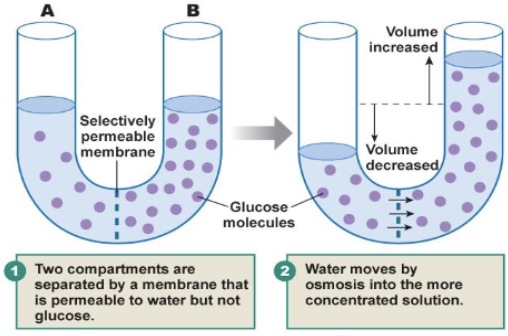
What is Osmosis?
Passive movement of water toward the higher solute concentration across a semipermeable membrane
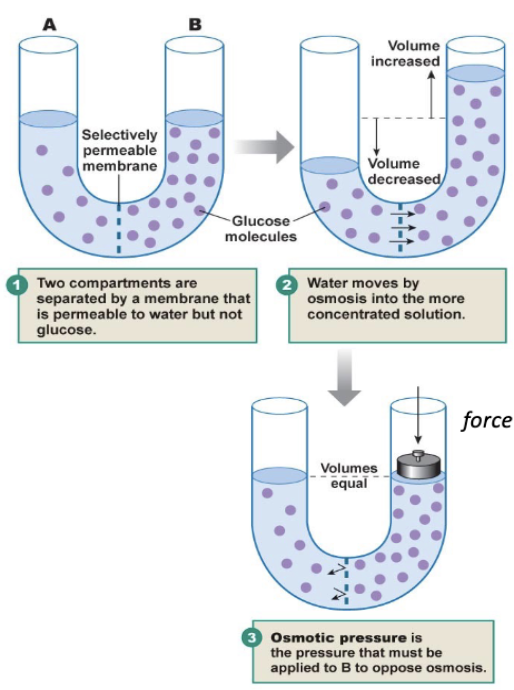
What is Osmotic Pressure?
The pressure required to stop osmotic flow
Depends on the number of solute particles
What determines the direction of Osmosis?
Differences in particle concentration across a semipermeable membrane
Does Osmosis require ATP?
No
Osmosis is passive transport
What does Osmolarity measure?
Total number of dissolved particles per liter of solution
→ Units = mOsm/L
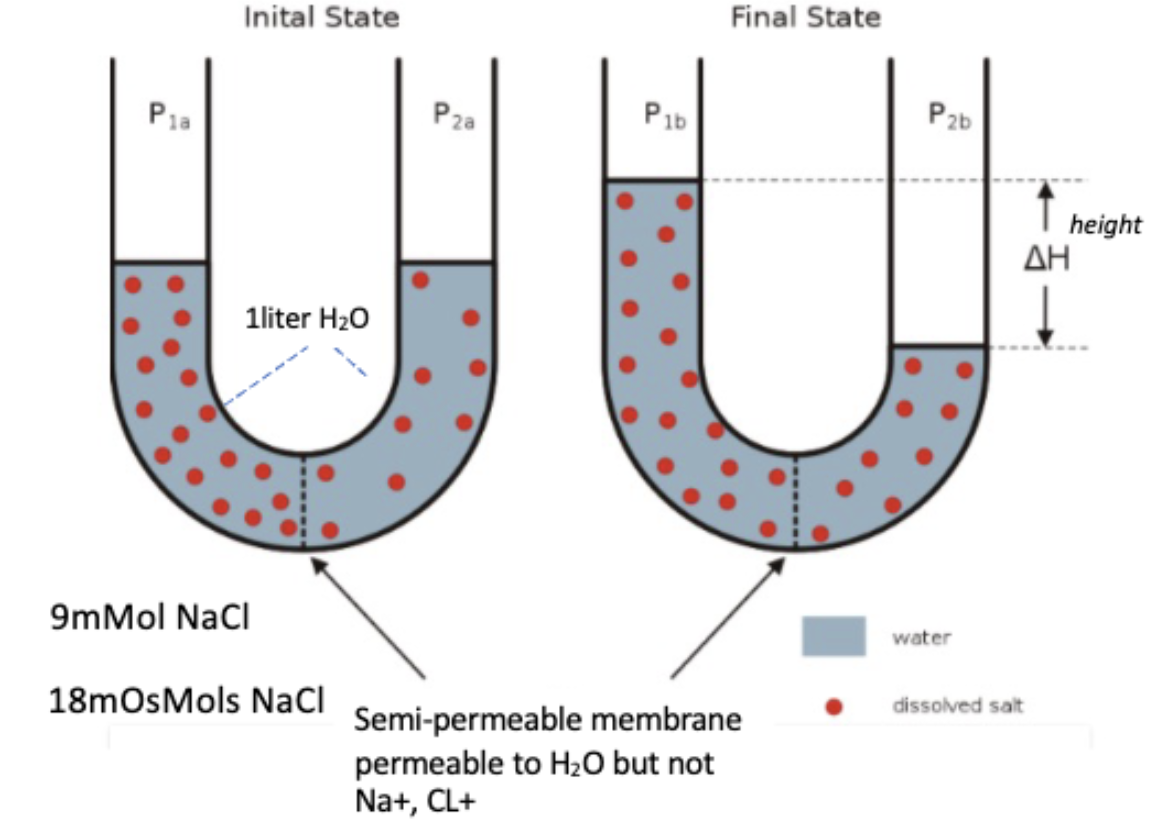
Why is Osmolarity different from Molarity?
Molarity: counts formula concentration/L
Osmolarity: counts the total particles after dissociation
What is the Osmolarity of 9 mM NaCl?
18 mOsm/L
NaCl → Na⁺ + Cl⁻ = 2 particles x 9 mM

Does Osmolarity depend on the type of solute?
No
It depends mainly on the total number of dissolved particles
Why can temperature & pressure affect Osmolarity?
They can change solution volume, and osmolarity is measured per liter
What does Osmolality measure?
Number of osmoles per kilogram of solution.
→ Units = mOsm/kg
What is the key difference between Osmolarity and Osmolality?
Osmolarity = particles/L
Osmolality = particles/kg

Which is more accurate: Osmolarity or Osmolality? Why?
Osmolality, because mass does not change with temperature or pressure
Which is more practical clinically?: Osmolarity or Osmolality? Why?
Osmolarity, because measuring liquid volume is more convenient
How can plasma osmolality be measured?
Osmometer
What are the Body's 2 Major Fluid Compartments?
Intracellular fluid (ICF)
Extracellular fluid (ECF)
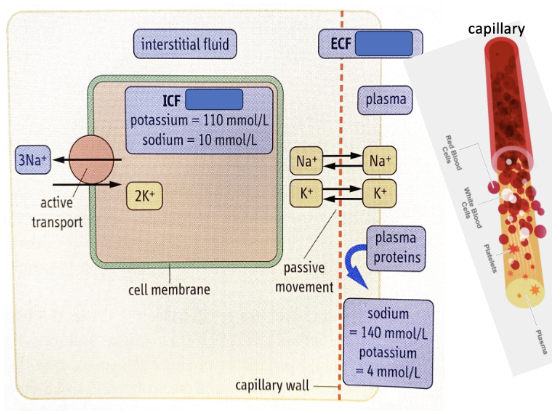
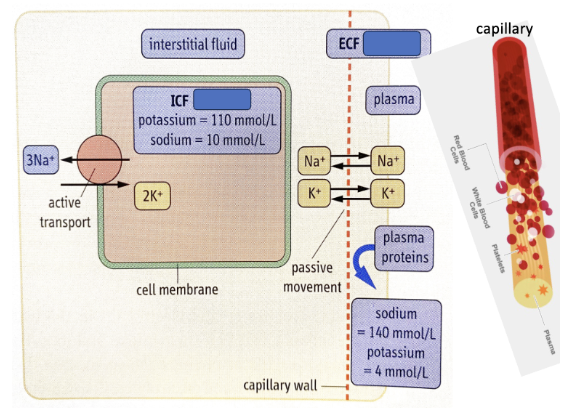
What makes up the ICF?
Fluid inside cells
What makes up the ECF?
Plasma + interstitial fluid

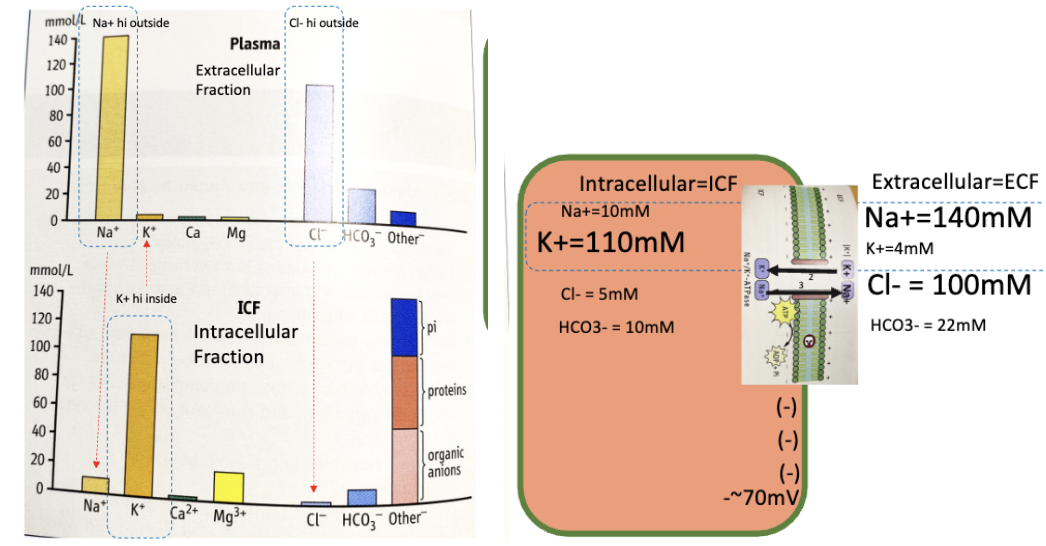
Which ions are HIGH in the ECF?
Na⁺ HIGH + Cl⁻ HIGH
K⁺ low
Which ion is HIGH in the ICF?
K⁺ HIGH
Na⁺ and Cl⁻ low

What maintains the Na⁺/K⁺ gradient between ICF and ECF?
Na⁺/K⁺-ATPase (sodium-potassium pump)

What electrical charge is maintained inside the cell?
Negative intracellular charge

What happens if ECF Osmolality INCREASES?
Water moves ICF → ECF
Cell dehydrates/shrinks

What happens if ECF Osmolality DECREASES?
Water moves ECF → ICF
Cell swells

What normal ECF osmolality is emphasized in the lecture?
About 290 mOsm/kg H₂O
At homeostasis, ICF is also ~290

What is Hydrostatic Pressure?
Pressure that PUSHES fluid OUT of capillaries → interstitial space
What is Oncotic Pressure?
Osmotic pressure from plasma proteins that PULLS fluid INTO blood vessels
Which plasma protein is most important for Oncotic Pressure?
Albumin

What happens at the Arterial End of a capillary?
HYDROSTATIC > oncotic
Fluid pushed OUT of capillary

What happens toward the Venous End?
Hydrostatic pressure falls
Oncotic pressure draws fluid back INTO the capillary

How does Hydrostatic Pressure change across a capillary?
Decreases from arterial → venous end

How does Oncotic Pressure behave across the capillary?
Remains relatively constant and is largely determined by plasma albumin

Hydrostatic vs. Oncotic?
Hydrostatic = PUSH OUT
Oncotic = PULL
What is the key difference between Osmolality and Tonicity?
Osmolality: counts all solutes
Tonicity: counts only effective, non-permeable solutes
What is an Effective Osmole?
A solute that cannot freely cross the membrane and therefore causes sustained water movement
What is an example(s) of an Ineffective Osmole?
Urea, because it can freely cross the ICF/ECF barrier.
What is an example(s) of an Effective Osmole?
Na⁺
Glucose,
K⁺,
Cl⁻
What does Tonicity determine about cells?
Whether cells:
Gain water
Lose water,
Maintain their volume.

What does an Isotonic solution do to cells?
No net water shift → cells maintain normal size.

What does a Hypertonic solution do to cells?
Water moves out of cells → cells shrink
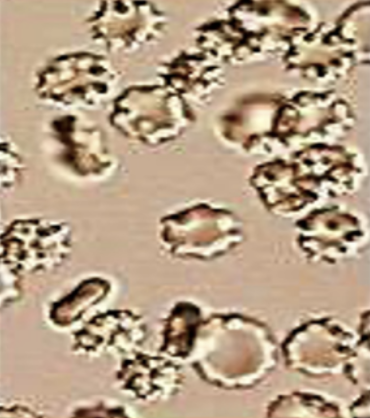
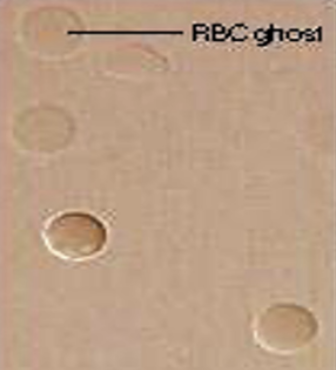
What does a Hypotonic solution do to cells?
Water moves into cells → cells swell
Why is Tonicity important when giving fluids?
It determines water shifts and whether cells shrink, swell, or remain stable
Which tonicity was selected for blood loss in the lecture example?
Isotonic normal saline, to avoid causing cells to shrink or swell
How can kidney damage cause proteinuria/albuminuria?
Glomerular/tubular damage allows albumin to be lost into urine
How does albumin loss affect plasma Oncotic Pressure?
↓ Albumin → ↓ oncotic pressure → ↓ ability to pull water back into capillaries

Explain the pathway to nephrotic edema in CKD.
Kidney damage
Albumin loss in urine
↓ Plasma albumin
↓ Oncotic pressure
↓ Fluid return to capillaries
Water remains in tissues
Edema
Hydrostatic vs. Oncotic Pressure
Hydrostatic pressure → PUSHES water out
Oncotic pressure (albumin) → PULLS water back in
Why does low albumin promote edema?
Blood loses part of its ability to pull water back into capillaries
What diagnostic finding can indicate albumin loss?
Proteinuria/albuminuria
What is Exocrine Pancreatic Insufficiency (EPI)?
Decreased production of digestive enzymes by the pancreas
What clinical signs of EPI are emphasized?
Polyphagia
Weight loss
Large-volume loose stools
Why do undigested nutrients remain in the intestine with EPI?
There aren't enough pancreatic digestive enzymes to properly digest fats, proteins, and carbohydrates
Why does EPI cause Osmotic Diarrhea?
Undigested nutrients = ↑ solutes in intestinal lumen
Water is drawn into lumen
Diarrhea
How can Osmotic Diarrhea contribute to Dehydration?
Water is pulled into and lost through the intestinal lumen
What is the complete EPI → osmotic diarrhea pathway?
EPI is about having lots of solute particles in the intestinal lumen
↓ Pancreatic digestive enzymes
Food isn't properly digested
Undigested nutrients stay inside the intestinal lumen
↑ Solute concentration in the lumen
Water is drawn into the lumen
More water stays with the fecal material
= Osmotic Diarrhea
What common principle connects CKD edema and EPI diarrhea?
Changes in solutes/proteins alter where water moves between body compartments
Osmolarity vs. Osmolality SUMMARY
Osmolarity | Osmolality | |
Measures | # particles per liter | # particles per kg |
Units | mOsm/L | mOsm/kg |
Based on | Volume | Mass |
Affected by temp/pressure? | Yes | No |
More accurate | No | Yes |
More practical | Yes | No |
Memory trick | OsmolaRity → LiteR | Osmolality → kg |
ICF vs. ECF SUMMARY
K⁺ = Keeps inside
Na⁺ + Cl⁻ = outside in ECF
The Na⁺/K⁺ gradient is maintained by Na⁺/K⁺ active transport
ICF | ECF | |
Location | Inside cells | Outside cells |
Includes | Intracellular fluid | Plasma + interstitial fluid |
Na⁺ | ↓ LOW | ↑ HIGH |
K⁺ | ↑ HIGH | ↓ LOW |
Cl⁻ | ↓ LOW | ↑ HIGH |
ECF Osmolality & Water Movement SUMMARY
Water moves toward the side with MORE solute particles
ECF | Water moves | Cell response |
↑ ECF osmolality | ICF → ECF | Cell dehydrates |
Normal | Balanced | Normal cell |
↓ ECF osmolality | ECF → ICF | Cell swells |
Hydrostatic vs. Oncotic Pressure SUMMARY
Hydrostatic | Oncotic | |
Main action | PUSHES water | PULLS water |
Direction | OUT of capillary | INTO capillary |
Main contributor | Blood pressure | Albumin |
Arterial → venous | ↓ Decreases | Relatively constant |
Key Concept | PUSH OUT | PULL IN |
Arterial end
Hydrostatic > Oncotic
Blood → Interstitial space
Venous end
Oncotic > Hydrostatic
Interstitial space → Blood
Osmolality vs. Tonicity SUMMARY
Osmolality = How many particles are there?
Tonicity = What will those particles do to the cell?
Osmolality | Tonicity | |
Counts | ALL solute particles | Only effective osmoles |
Permeable solutes count? | Yes | No |
Non-permeable solutes count? | Yes | Yes |
Example permeable solute | Urea | Urea doesn't count |
Key Concept | Total particles | Effect on cell volume |
Tonicity & Cell Size SUMMARY
Solution | Example | Osmolality | Tonicity |
Hypotonic | ~250 mOsm/L | ECF → ICF | Swells |
Isotonic | ~290 mOsm/L | No net shift | Normal |
Hypertonic | ~330 mOsm/L | ICF → ECF | Shrinks |
Clinical Applications SUMMARY
CKD: Hydrostatic vs. Oncotic Pressure
Kidney damage → albuminuria → ↓ blood albumin → ↓ oncotic pressure → ↓ water return to capillaries → water remains in tissues → EDEMA
EPI: Osmosis / Osmolarity
↓ digestive enzymes → undigested fats/proteins/carbs remain in intestinal lumen → ↑ luminal solutes → water drawn into lumen → water accumulates in lumen → OSMOTIC DIARRHEA
CKD → Nephrotic Edema | EPI → Osmotic Diarrhea | |
Initial problem | Kidney/glomerular damage | ↓ Pancreatic enzymes |
What accumulates/is lost? | Albumin lost in urine | Undigested nutrients in intestinal lumen |
Consequence | ↓ Plasma albumin | ↑ Solutes in lumen |
Water movement problem | ↓ Water pulled into capillaries | Water drawn into intestinal lumen |
Result | Edema | Diarrhea + dehydration |