Pathology - Unit GI Pathology
 Call Kai
 Learn
 Practice Test
 Spaced Repetition
 Match
 Flashcards
 Knowt Play
1/50

Earn XP
Description and Tags
51 Terms
A high kVp range of _____ kVp is typically used to adequately penetrate
110-125
What is the exception to high kVp in fluoroscopy?
Double contrast studies.
Decrease to 100 kVp to avoid over-penetrating the air-filled anatomy
True or False:
Iodine and Barium have a higher atomic number; therefore, they absorb a greater % of the x-ray beam than low atomic number materials (soft tissue)
True.
Low atomic number soft tissues not coated with contrast are over-penetrated which allows them to “fade into the background”
Why are short exposure times needed in fluoroscopy?
To control peristalsis (normal involuntary constriction and relaxation of GI muscles)
Gallstones (Cholelithiasis):
Presence of one or more calculi (gallstones) in the gallbladder.
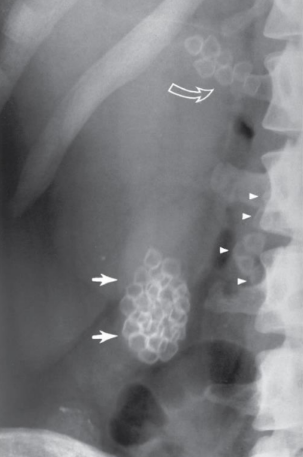
The majority of gallstones are radio-_____.
Lucent
What factors predispose a patient to gallstones?
Family hx
Over 40 years of age
Overweight
Female
What is the primary cause of Acute Cholecystitis?
Impacted gallstone in the cystic duct.
What are the symptoms of acute cholecystitis?
Abdominal pain
RUQ tenderness
Fever
Dysphagia:
Difficulty swallowing due to a congential or acquired condition, a trapped bolus of food, paralysis of the pharyngeal or esophageal muscles, or inflammation.
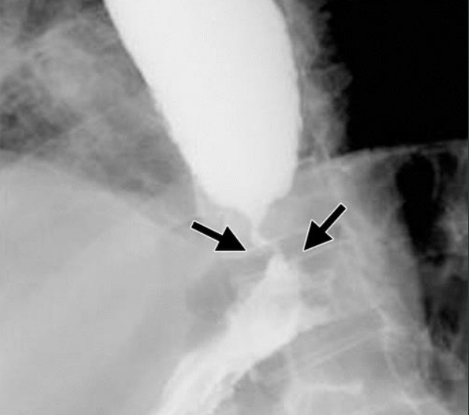
Achalasis:
(aka Cardiospasm). Motor disorder of the esophagus in which peristalsis is reduced along the distal 2/3 of the esophagus.
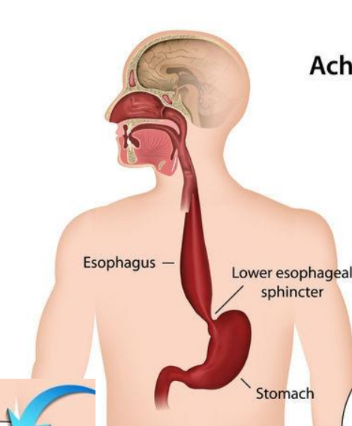
A patient with achalasia is unable to relax their _______, which causes:________
Esophagogastric sphincter
Regurgitation and chest pain
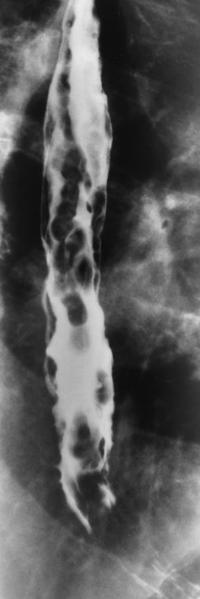
Esophageal Varices:
Dilation of the veins in the wall of the distal esophagus; often asymptomatic until bleeding occurs.
What condition often accompanies esophageal varices?
Acute liver disease
What is the most common cause of dilated veins in the walls of the esophagus?
Blood flow restriction associated with acute liver disease
What do esophageal varices look like on an esophagogram?
Cobblestone, wormlike appearance
GERD:
Entry of gastric contents into the esophagus, irritating the lining of the esophagus, aka heartburn.
Valsalva Maneuver:
Patient is asked to take a deep breath and while holding the breath in, to bear down.
Why is the Valsalva maneuver useful in evaluating GERD?
It distends the organs with air for more effective mucosal lining assessment.
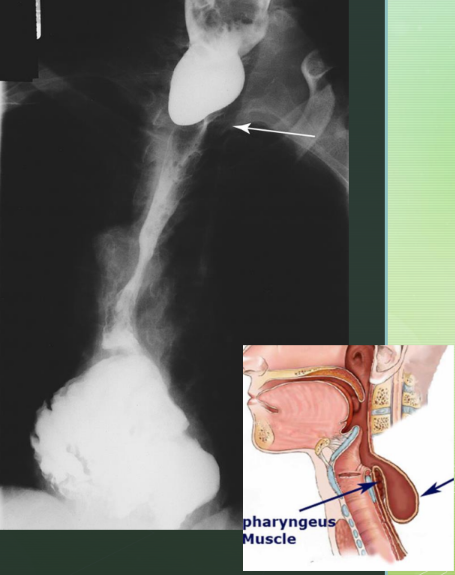
Zenker Diverticulum:
Large outpouching of the esophagus just above the upper esophageal sphincter, potentially caused by weaking of the muscle wall.
Bezoar:
A mass of undigested material that becomes trapped in the stomach.
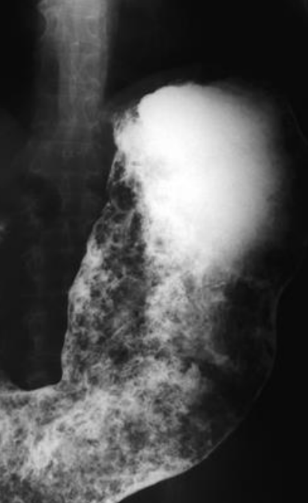
Trichobezoar:
Undigested hair
Gastritis:
Inflammation of the stomach mucosa.
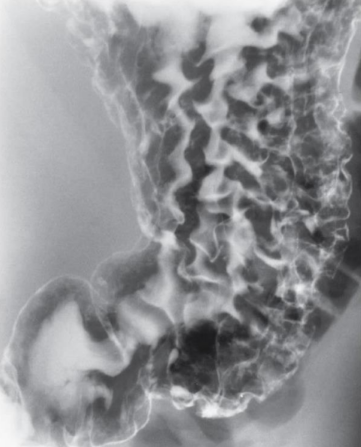
What causes gastritis?
Irritants
Alcohol
Corrosive agents
Infection
Peptic Ulcer Disease:
Group of inflammatory processes involving the stomach and duodenum.
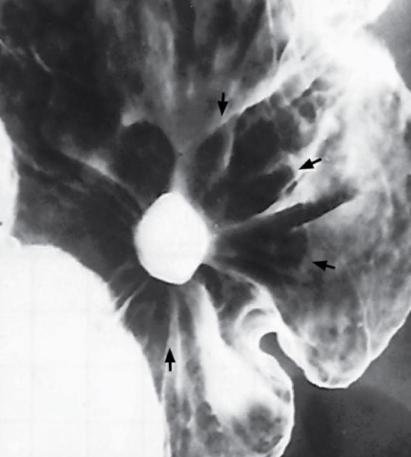
What are common causes of peptic ulcer disease?
Infection (H. pylori) and long-term use of NSAIDs
What type of ulcers can perforate when the patient has peptic ulcer disease?
Large, acute ulcers
Hiatal Hernia:
Portion of the stomach herniates though the diaphragmatic opening.
Commonly seen on Upper GI exams
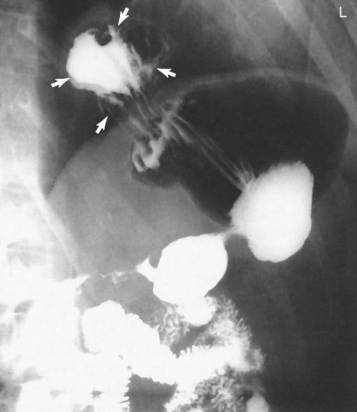
What causes a hiatal hernia?
Congentially short esophagus or weakening of the muscle that surrounds the opening
Hiatal hernias are common in ____% of the US population over the age of ____.
50
50
Crohn’s Disease (Regional Enteritis):
Idiopathic, chronic, inflammatory disorder involving any part of the gastrointestinal tract but commonly involving the terminal ileum.
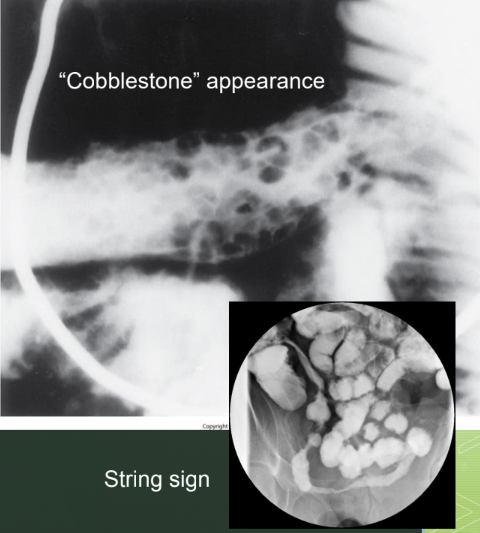
Crohn's disease may lead to ___, ____, or the formation of an ____.
Obstruction
Fistula
Abscess
What is the most common abnormality found on upper GI exams?
Hiatal Hernia
Diverticulosis:
Condition of having numerous diverticula or small, outpouchings of colon.
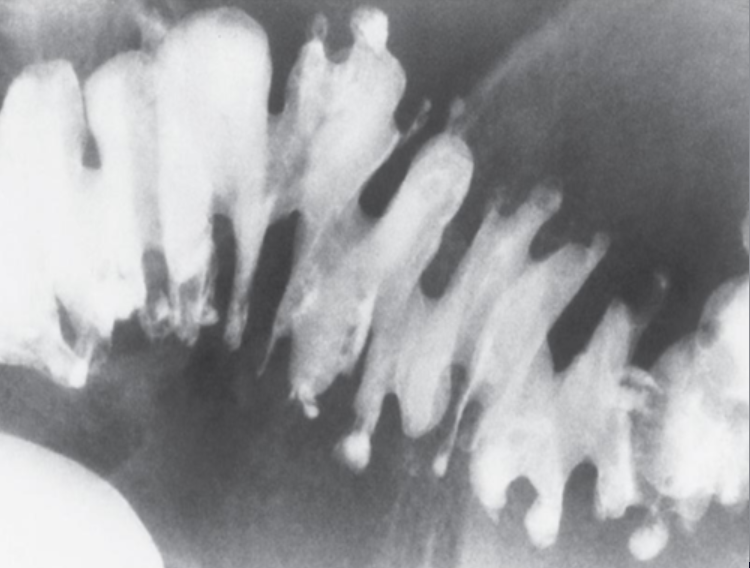
Diverticulitis:
Inflamed infected diverticula; leading to bleeding, necrosis, perforation, abscess, fistulas.
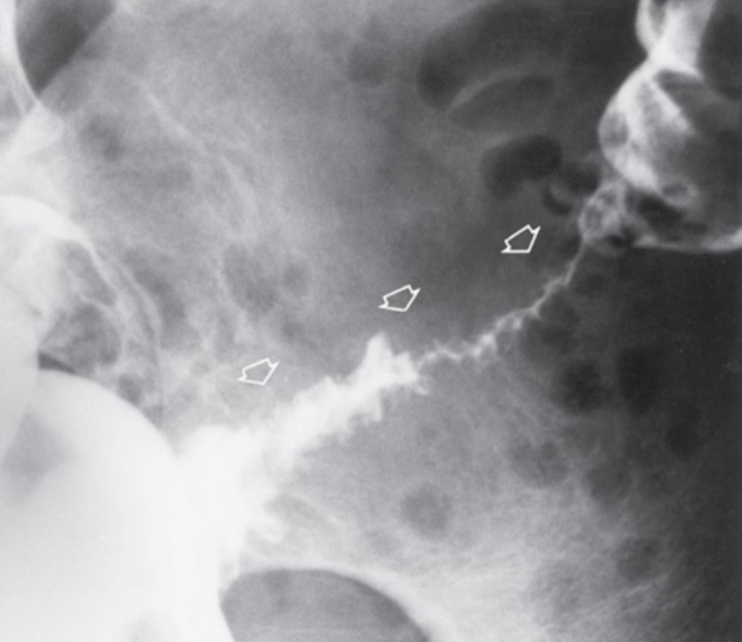
Meckel Diverticulum:
Common birth defect of the ileum caused by the persistence of the yolk sac, resulting in a saclike outpouching of the intestinal wall.
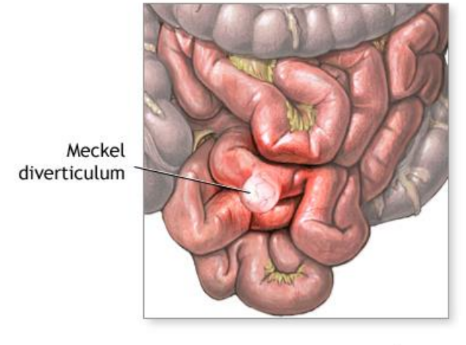
Surgical removal of a Meckel diverticulum is often recommended to prevent which conditions from developing?
Diverticulitis
Obstruction
Blood loss
What is the best modality to diagnose a Meckel diverticulum?
Nuc med
Malabsorption Syndrome:
Conditions in which the gastrointestinal tract is unable to process and absorb certain nutrients.
Sprue:
Inability to absorb certain proteins and dietary fats.
Celiac Disease:
Sprue that affects the small bowel: gluten intolerance.
What does malabsorption syndrome look like on a SBS?
Mucosa may appear thickened as a result of constant irritation.
Ulcerative Colitis:
Chronic idiopathic inflammatory disease of the colon.
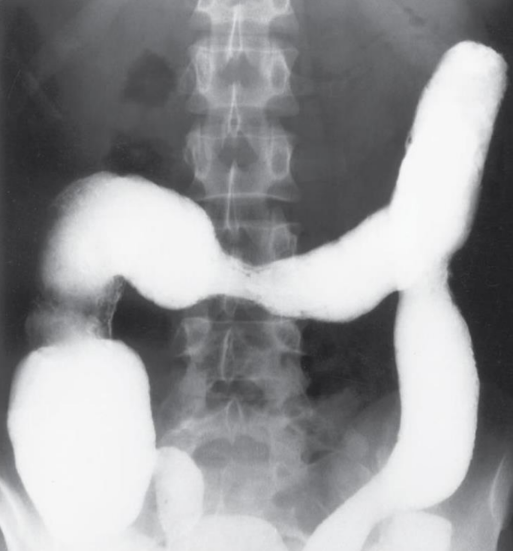
UC primarily affects which age group?
Young adults
UC most frequently involves the _____ region of the colon.
Rectosigmoid
What is a serious complication of ulcerative colitis?
Toxic megacolon (extreme dilation of a segment of colon) or perforation
A condition of acquired herniations of mucosa and submucosa through muscular layers at points of weaknesses of the bowel wall is known as ________
diverticulosis
Where do most carcinomas of the large intestine (colon) occur?
Rectum and sigmoid colon
What are some predisposing conditions of cancer in the colon?
Ulcerative colitis
Hereditary polyposis
Peristalsis:
Smooth muscle contractions that move the contents of the digestive system along the GI tract
Where do most colon cancers occur?
Rectum/sigmoid colon