DNA Structure & Replication
 Call Kai
 Learn
 Practice Test
 Spaced Repetition
 Match
 Flashcards
 Knowt Play
1/29

There's no tags or description
Looks like no tags are added yet.
30 Terms
Components of nucleic acids :
What is DNA?
Nitrogenous bases: Pyrimidines vs. Purines:
Nucleotide:
Pyrimidines – single ring structures
Cytosine
Thymine
Uracil
Purines – double ring structures
Adenine
Guanine
These have the same structure in DNA or RNA
DNA is an organic macromolecule that is composed of polymers of four nucleotides strung together into a strand, with a sugar phosphate backbone.

What is a nucleoside: difference between DNA and RNA
Nucleoside: base plus a sugar, either ribose or deoxyribose.
DNA nucleosides: Contain a nitrogenous base + deoxyribose sugar (no -OH group at the 2′ carbon) and use thymine (T). (e.g., deoxyadenosine, deoxycytidine).
RNA nucleosides: Contain a nitrogenous base + ribose sugar (extra -OH group at the 2′ carbon) and use uracil (U) instead of thymine. (e.g., adenosine, cytidine, guanosine).
What is a nucleotide?
Nucleotide: nucleoside plus phosphate(s). = phosphate group, the sugar (ribose or deoxyribose), nitrogenous base
When discussing DNA, scientists often write A, G, C, T instead of dA, dG, dC, dT for simplicity.
What happens to phosphate groups when a nucleotide is added to a growing DNA strand?
A new nucleotide enters with 3 phosphate groups (triphosphate).
When added to DNA, 2 phosphates are released as pyrophosphate (PPi).
1 phosphate remains in the DNA strand (monophosphate).
PPi can be broken down, and its phosphate groups recycled.
Example: dATP → dAMP (incorporated into DNA) + PPi (released).

Why is DNA having polarity significant when new nucleotides are added?
DNA has polarity and this is all based on the locations of the carbons in the sugar.
Polar ends of nucleic acid strands: backbone
At the 5 prime (5’) end: there is an –OH group of a phosphate.
At the 3’ end: there is the –OH group of the sugar.
DNA sequences are written 5′ → 3′.
New nucleotides are always added to the 3′ end, so DNA grows 5′ → 3′.

Explain how DNA strands are arranged Anit-parallel and the role of complementary base pairing
1. Antiparallel DNA
The two DNA strands run in opposite directions.
One strand runs 5′ → 3′.
The other runs 3′ → 5′.
2. Complementary Base Pairing
A pairs with T → 2 hydrogen bonds.
G pairs with C → 3 hydrogen bonds (stronger).
3. DNA Synthesis
New DNA is always built 5′ → 3′.
New nucleotides are added to the 3′ end.

What is DNA polymerase III, and how does it work?
DNA polymerase is an enzyme that synthesizes new DNA by adding complementary nucleotides to the 3′ end of an existing primer.
Synthesizes DNA 5′ → 3′.
Requires an RNA primer to begin.
Builds continuously on the leading strand and discontinuously on the lagging strand.
Proofreads DNA to correct errors.
ONLY EXTENDS 3’ END
What is DNA polymerase I, and how does it work?
DNA polymerase I is an enzyme that replaces RNA primers with DNA nucleotides during DNA replication.
It also proofreads and corrects DNA by excising erroneous nucleotides and synthesizing DNA in the 5′ to 3′ direction.
What are primers?
Primers: Short, single-stranded pieces of nucleic acid that tell DNA polymerase where to start copying DNA. Primers have polarity and have a 5′ end and a 3′ end.
The primer can be DNA or RNA, as long as it matches the template and has a free 3′-OH group
What are reverse Complement strands?
How do you determine where a primer binds and which direction DNA polymerase moves?
Reverse Complement: The primer binds to a matching DNA sequence on the opposite strand, running in the opposite direction (antiparallel).
Step 1: Find the DNA sequence complementary to the primer. Match the bases (A–T, G–C). Remember, DNA strands run in opposite directions. (5′-ATGC-3′ → 3′-TACG-5′)
Step 2: Position the primer antiparallel to the template. Reverse the complementary sequence
so it reads 5′ → 3′. (reverse complement)
Step 3: Locate the primer's 3′ end.
Step 4: DNA polymerase adds new nucleotides to the 3′ end of the primer.
Thus, DNA replication begins where a primer binds to a complementary stretch of DNA.


Describe Lego analogy
DNA Replication – Lego Analogy (Simplified Steps)
Nucleotides: Each Lego piece represents one nucleotide (A, T, C, or G).
DNA Strand: Lego pieces connect to form a DNA strand running 5′ → 3′.
Double-Stranded DNA: Two DNA strands connect through complementary base pairing (A–T, G–C) and run in opposite directions (antiparallel).
DNA Separation: An enzyme separates the two DNA strands (or heat in a lab).
Primer Binding: Primers attach to complementary sequences on each original DNA strand.
DNA Polymerase: Attaches where the primers are bound and begins adding new nucleotides to the 3′ end of each primer.
DNA Synthesis: DNA polymerase extends the primers, creating new DNA strands in the 5′ → 3′ direction.
Final Result: Each new strand consists of the original primer + newly synthesized DNA.

What are Okazaki fragments, and why do they form? what enzyme forms them?
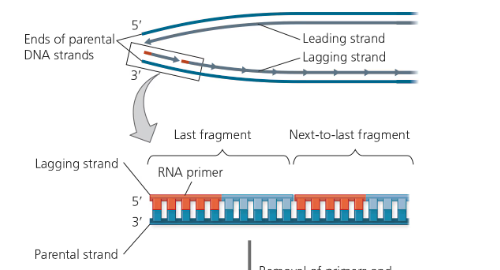
Okazaki fragments: Short pieces of DNA produced on the lagging strand during DNA replication.
Why do they form?
Why they form: DNA polymerase can only synthesize DNA 5′ → 3′, so the lagging strand must be built discontinuously in short fragments.
Enzyme that forms them: DNA polymerase III (in prokaryotes).
Primase: Creates an RNA primer for each fragment.
DNA ligase: Joins the fragments together after RNA primers are replaced with DNA.
Differentiate the Replication of the Leading and Lagging Strands
How does replication occur?
How does replication occur?
Leading Strand:
A primer binds to the DNA template.
DNA polymerase continuously adds nucleotides to the 3′ end.
The new DNA grows toward the replication fork.
Lagging Strand:
Multiple primers are added as DNA unwinds.
DNA polymerase makes short DNA sections (Okazaki fragments).
RNA primers are removed and replaced with DNA.
DNA ligase joins the fragments together.
What is helicase?
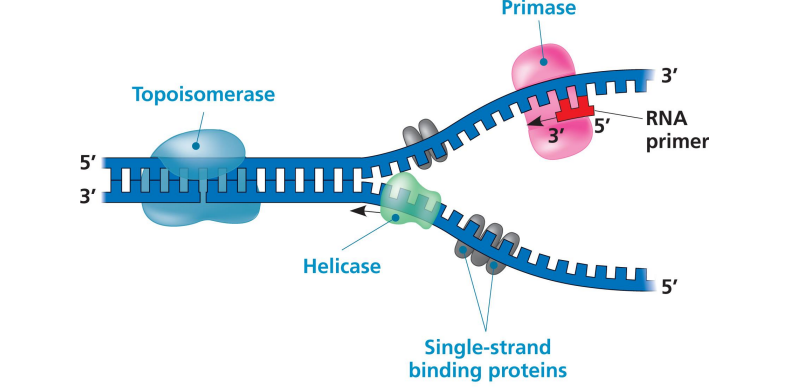
Helicase is an enzyme that unwinds and separates the two strands of DNA during DNA replication.
Helicase breaks the hydrogen bonds between complementary DNA bases (A–T and G–C).
This separates the two DNA strands, creating a replication fork.
Each separated strand acts as a template for DNA polymerase to build a new strand.

What is Topoisomerase?
Topoisomerase is an enzyme that relieves twisting and tension in DNA during DNA replication.
Relieves tension and supercoiling ahead of the replication fork by temporarily cutting, relaxing, and rejoining DNA.

What is primase? difference between leading and lagging strands
Primase is an enzyme that creates/lays short RNA primers during DNA replication.
Synthesizes short RNA primers that provide a starting point for DNA polymerase to begin DNA synthesis 5’-3’
(bubble needs to be large enough for primase to bind)
Leading strand: Usually needs 1 RNA primer.
Lagging strand: Needs multiple RNA primers (one for each Okazaki fragment).
What are single strand proteins? what do they do?
Single-strand binding proteins (SSBs) are proteins that bind to and stabilize separated DNA strands during DNA replication.
Helicase unwinds and separates the two DNA strands.
Single-strand binding proteins attach to the exposed DNA strands.
They prevent the strands from rejoining by forming hydrogen bonds with each other.

What is DNA Polymerase I (DNA Pol I)?
DNA Polymerase I (DNA Pol I) is an enzyme that removes RNA primers and replaces them with DNA nucleotides during DNA replication.
Uses 5′ → 3′ activity to remove RNA primers.
Uses 5′ → 3′ polymerase activity to replace them with DNA.
Also proofreads DNA using 3′ → 5′ exonuclease activity.
What is DNA ligase, and what does it do?
DNA ligase joins Okazaki fragments together by sealing nicks in the DNA sugar-phosphate backbone.
joins 3’ end of DNA that replaces primer to rest of leading strand DNA
Explain this diagram for the leading strand
How is the leading strand synthesized during DNA replication?
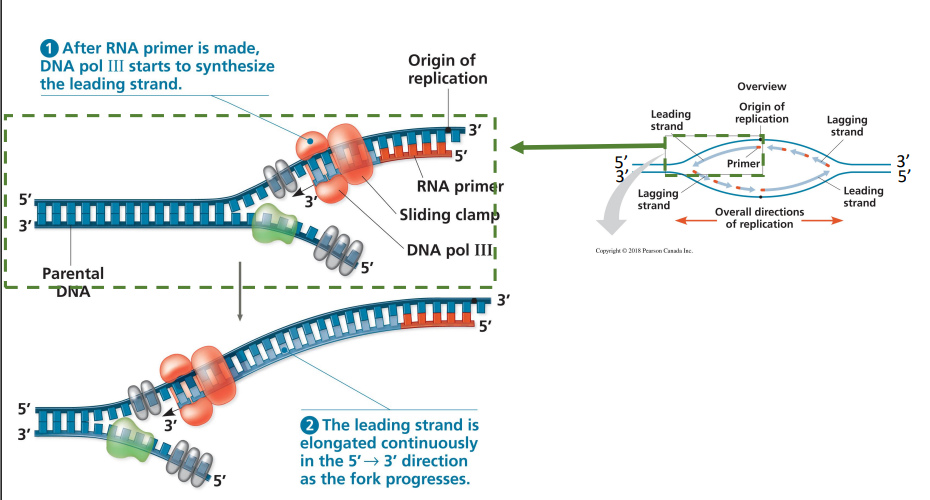
Helicase unwinds and separates DNA.
Single stranded binding proteins keep the strands separated.
Primase creates one RNA primer.
DNA Pol III attaches to the primer and builds DNA 5′ → 3′.
Sliding clamp keeps DNA Pol III attached to DNA.
Remember: The leading strand is built continuously toward the replication fork as helicase unwinds DNA.


How is the lagging strand synthesized during DNA replication?
Helicase unwinds DNA, and Single stranded binding proteins keep the strands separated.
Primase creates multiple RNA primers.
DNA Pol III builds short DNA segments called Okazaki fragments (5′ → 3′).
DNA Pol III detaches and repeats the process to form new fragments.
DNA Pol I removes RNA primers and replaces them with DNA.
DNA ligase joins the fragments together.


Briefly explain this diagram
Origin of replication: The point where DNA begins to unwind and separate.
Replication bubble: The opening in the DNA that expands in both directions (red arrows).
Replication forks: The two ends of the bubble where DNA is being unwound.
Leading strand: Synthesized continuously (5′ → 3′) toward its replication fork.
Lagging strand: Synthesized discontinuously (5′ → 3′) away from its replication fork, forming Okazaki fragments.
Orange segments: RNA primers that provide starting points for DNA polymerase.
Blue arrows: Show the direction in which new DNA is synthesized.

RECALL: What is a primer, and how do you design one?
Primer:
Annealing:
How to design a primer:
Primer: A short piece of DNA or RNA that binds to a complementary DNA sequence and allows DNA polymerase to begin replication.
Annealing: When a primer attaches to its complementary DNA sequence through hydrogen bonding.
Step 1: Identify the original DNA template.
Example:
5′-ATGCC-3′
Step 2: Find the complementary sequence using A–T and G–C pairing.
3′-TACGG-5′
Step 3: Reverse the complementary sequence so your primer is written 5′ → 3′.
Primer: 5′-GGCAT-3′
Step 4: The primer binds antiparallel to the original DNA template.
Original DNA: 5′-A T G C C-3′
                 | | | | |
Primer:       3′-T A C G G-5′
Step 5: DNA polymerase adds new nucleotides to the primer's 3′ end.
Remember: When asked to design a primer complementary to a given template written 5′ → 3′, write its reverse complement so the primer is also written 5′ → 3′.
Review the Proteins Involved in DNA Replication
Helicase, single-strand binding proteins, topoisomerase, primase, DNA polymerase III, DNA polymerase I, DNA Ligase
Protein/Enzyme | Function |
|---|---|
Helicase | Unwinds and separates the two DNA strands. |
Single-Strand Binding Proteins | Keep the separated DNA strands from rejoining. |
Topoisomerase | Relieves tension caused by DNA unwinding. |
Primase | Creates short RNA primers so DNA polymerase can begin. |
DNA Polymerase III | Builds new DNA by adding nucleotides in the 5′ → 3′ direction. |
DNA Polymerase I | Removes RNA primers and replaces them with DNA. |
DNA Ligase | Joins DNA fragments together by sealing gaps in the sugar-phosphate backbone. |
A polymerase is an enzyme that builds nucleic acid strands by joining nucleotides together
Create a table to compare different enzymes based on their templates, products, primers, direction, substrates, proofreading, and frequency.
Feature | DNA Polymerase I | Primase | Telomerase |
|---|---|---|---|
Template | DNA | DNA | RNA |
Product | DNA | RNA | DNA |
Primer required? | Yes | No | Yes (existing DNA 3′ end) |
Direction | 5′ → 3′ | 5′ → 3′ | 5′ → 3′ |
Substrate | dNTPs | NTPs | dNTPs |
Proofreading? | Yes | No | No conventional proofreading |
Template: The strand used as a guide to build a new strand.
Product: The new strand produced by the enzyme.
Primer: A short nucleic acid sequence that provides a starting point.
Substrate: The building blocks an enzyme uses.
Proofreading: DNA polymerase checks newly synthesized DNA and corrects incorrectly added nucleotides.
How does DNA become damaged?
What is proofreading?
What is Mismatch repair?
How can it be repaired through Nucleotide Excision Repair? + examples
DNA can become damaged by:
Harmful chemicals.
Physical agents, such as UV radiation.
Spontaneous changes.
Errors during DNA replication.
DNA proofreading: DNA polymerase checks newly synthesized DNA and corrects incorrectly added nucleotides.
Mismatch repair: Repair enzymes correct incorrectly paired DNA bases.
Nucleotide Excision Repair: A process that removes damaged DNA and replaces it with correct DNA.
Steps:
Damage: DNA becomes damaged.
Cut: Nuclease removes the damaged section.
Replace: DNA polymerase fills the gap with correct nucleotides.
Seal: DNA ligase seals the repaired section.
Remember: Damage → Cut → Replace → Seal
Thymine Dimers: UV light causes neighbouring thymine bases to become abnormally linked, damaging DNA.
Xeroderma Pigmentosum: A genetic disorder where DNA damage cannot be repaired properly, causing extreme UV sensitivity and increased skin cancer risk.
What Are Telomeres? Why are they important?
Telomeres: Repetitive DNA sequences located at the ends of eukaryotic chromosomes that help protect important genes.
Why are they important?
DNA polymerase cannot fully replicate the ends of linear chromosomes.
Therefore, chromosomes can become shorter after each round of replication.
Telomeres act as protective regions, delaying the loss of important genes.
Remember: Telomeres do not completely prevent DNA shortening.
Shortening of the ends of Linear DNA Molecules
Why Do Chromosomes Shorten?
DNA replication requires RNA primers.
The RNA primer at the end of the lagging strand is removed.
DNA polymerase cannot replace this final primer because there is no available 3′ end to extend.
This leaves a gap, causing the newly produced DNA molecule to be shorter.
Important: This is mainly a problem for eukaryotes because they have linear chromosomes. Most prokaryotes have circular chromosomes.
What Is Telomerase and how does it work?
Telomerase: An enzyme that lengthens telomeres by adding repetitive DNA sequences to the ends of chromosomes.
How Does Telomerase Work?
Telomerase binds to the end of the chromosome.
It uses its own RNA template to add DNA nucleotides to the 3′ end.
The chromosome's DNA strand becomes longer.
Primase and DNA polymerase help synthesize the complementary DNA strand.
Easy way to remember:
Telomerase binds → Adds DNA → DNA polymerase fills in
Telomerase is especially important in germ cells because it helps maintain chromosome ends across generations.
How are telomeres related to aging, cell division, cancer, and germ cells?
Aging: Telomeres shorten over time, contributing to cellular aging.
Cell Division: Very short telomeres can stop cells from dividing.
Cancer: Telomerase helps cancer cells continue dividing.
Germ Cells: Telomerase maintains telomeres to protect genetic information passed to offspring.