NE203 Exam 1
 Call Kai
 Learn
Learn Practice Test
 Spaced Repetition
 Match
Match Flashcards
 Knowt Play
1/131

There's no tags or description
Looks like no tags are added yet.
Name | Mastery | Learn | Test | Matching | Spaced | Call with Kai | Chat |
|---|
No analytics yet
Send a link to your students to track their progress
132 Terms
What is the Neuron doctrine?
nerve cells are discrete, individual cells that are polarized to receive and transmit information
What is the difference between chemical and electrical synapses?
Chemical synapses use neurotransmitter molecules to send signals across a gap
Electrical synapses use physical channels called gap junctions to let electrical current flow
How is electrical activity among neurons synchronized?
because their transmissions are bidirectional
it minimizes the voltage differences between the connected cells
What are astrocytes?
in the CNS, forms the blood-brain barrier and acts like the immune system for the brain
What ae oligodendrocytes?
in the CNS, wraps myelin around axons in the CNS
What are Schwann Cells?
in the PNS, wraps myelin around axons in the PNS
What are microglia?
act like macrophages and removes cellular debris from sites of injury, also controls apoptosis
What is silver stain by Golgi and what can you visualize?
silver salts are injected to see dendrites, axons, and glial cells
What is the difference between Cresyl violet and Nissl staining?
although they are both purple, cresyl violet can only see RNA and nissl staining can visualize RNA, DNA, and ribosomes
Afferent
towards the brain from the body
Efferent
away from the brain to the body
Does the expression of CsChrimson require that both GAL4 and UAS be in the same cell in order to make the expression happen?
Yes
What is grey matter?
cell bodies, dendrites, unmyelinated axons, and other support cells of the brain
What is white matter?
has myelinated axons, hence the white color
What is an electroencephalogram (EEG)?
non-invasive analysis of the brain’s electrical activity using electrodes on scalp
see where there is activity by mapping out the electrical activity
does not provide information about specific cortical areas and deeper structures
What is computerized tomography (CT)?
uses X-rays to visualize
can create 3D images of deeper structures of the brain
can distinguish grey and white matter
low resolution
high radiation exposure
What is positron emission tomography (PET scan)?
injected with radiolabeled metabolite and emit radioactive signal picked up by scanner
measure metabolite uptake and map on brain image taken by CT or MRI
detect differences in brain function in diseases
has to be used immediately because of its rapid radioactive decay
What is magnetic resonance imaging (MRI)?
measures the physics of atomic motion in brain tissue
generates high-resolution 3D image of living tissue
deemed safe and versatile
What is Diffusion tensor imaging (DTI)?
variant of MRI that can visualize axon pathways
What is functional magnetic resonance imaging (fMRI)?
variant of MRI, measures the amount of magnetic distortion by oxygen
essentially measures blood flow during a function
can combine with MRI imaging
What is magnetoencephalography (MEG)?
used to map changes in brain function
records magnetic consequences of brain electrical activity
Is the resting membrane potential positive or negative?
Negative
Is the action potential positive or negative?
positive
What is a receptor potential?
membrane potential changes due to activation of sensory neurons; changes the resting potential for fraction of a second
What is the synaptic potential?
signaling activated between neurons at synaptic contacts to transmit information
What is hyperpolarization?
making membrane potential more negative than its resting potential
What are passive electrical responses?
responses that do not need any unique property of neurons
What is depolarization?
making membrane potential more positive
What are active electrical responses and an example of it?
changes in neurons or any other aspect of neurons cause an electrical response
an example would be an action potential
Does an increase in intensity of a stimulus increase the amplitude of the action potential?
No, it increases the frequency of an AP
Are passive electrical signals strong enough to cover the distance of an axon?
No, it is not because axons have poor conductivity which leads to the electrical signals diminishing
What does local anesthesia do?
blocks APs from propagating because it blocks Na+ channels
which prevents depolarization
What does regional anesthesia do?
usually given with sedatives which enhance postsynaptic GABA receptors (inhibitory) so it increases inhibition of synapses
What does general anesthesia do?
causes unconsciousness, opens up K+ channels to hyperpolarize the resting membrane potential
What are active transporters?
proteins that actively move ions in and out of cells against their concentration gradients
What are ion channels?
proteins that allow ions to cross the membrane in the direction of their concentration gradient
What is the electrochemical equilibrium?
the exact balance between the concentration and electrical gradient
Which ion, K+ or Na+ is more abundant intracellularly at rest?
K+
Which ion, K+ or Na+ defines the resting potential of the neuron?
K+
What can the Nernst equation predict?
the equilibrium potential for a single permeant ion by looking at both its intracellular and extracellular concentrations
What does the Goldman equation calculate?
the membrane potential looking at both permeabilities of the ions involved
Does the permeability of the membrane change or stay put during the process of an AP?
No it does not, it changes because the ions (K+, Na+) have different permeability
When is K+ permeability highest?
during resting period and hyperpolarization
When is Na+ permeability highest?
during depolarization
What happens to the Na+ channels during depolarization?
They open up to be permeable to Na+ and it causes the ions to rush into the cell and depolarizes it.
What is the voltage clamp method?
a technique that uses electronic feedback to control the membrane potential of a cell while also measuring the transmembrane currents created by the opening and closing of ion channels
An experiment was set up where a cell was hyperpolarized and depolarized. What happened to the cell during both of those times?
Hyperpolarization - didn’t do anything besides increase the negative potential
Depolarization - triggered an AP
What is the early/inward current?
the very brief inward flow of Na+ into cell, extracellular region becomes negative
What is the late/outward current?
the outflow of K+ into the extracellular space after the depolarization of the cell caused by the early flow
What happens to the early/inward current when the membrane potential increases to a higher voltage?
it is elimated because the membrane potential becomes the equilibrium potential of that ion, thus does not have net movement and change
What evidence is there that Na+ is the early current?
removing external Na+ concentration makes the extracellular area negative, and Na+ flows out and leaves the neuron. So, the Na+ is the early current because there is a lot of it extracellularly and rushes into the cell when the channel is open
What evidence is there to support that K+ and Na+ have different ion permeability mechanisms?
the start time of the flow of Na+ and K+ are delayed; Na+ channels open first and then K+ channels open later.
What does the toxin tetrodotoxin do?
alkaloid neurotoxin found in poisonous animals that block Na+ current without affecting K+ current
What does tetrodotoxin’s function prove about the independence of permeability pathways?
Since tetrodotoxin only affects Na+ channels without affecting K+ channels, it shows that they have independent pathways
What does tetraethylammonium do?
blocks K+ currents without affecting Na+ currents
What is membrane conductance?
the measure of how easily charged ions can flow across a cell membrane through open channels
Passive v.s. Active current flow
Passive current flow is the conduction of electrical charge through and down an axon
Active current flow is the explosive, energy-driven influx of ions through specialized voltage-gated channels
What is time-dependent activation?
opening of ion channels in response to a stimulus is dependent on the time
What is the refractory period?
the brief period after the generation of an AP where the next AP is difficult or impossible to trigger during this period
Why does the refractory period happen?
the persistence of Na+ conductance inactivation does not allow for Na+ conduction activation to happen right away.
Why is the action potential a positive feedback loop?
Activation of voltage-depended Na+ conductance —> increases Na+ entry into neuron —> membrane potential depolarizes —> activate more Na+ conductance … and continues
Why is K+ conduction activation is a negative feedback loop?
it restores the membrane to its resting state, disrupting the positive feedback loop
What is a characteristic that Na+ conduction has that K+ conduction does not have?
Na+ conduction is able to be activated and inactivated rapidly during depolarization, K+ conduction remains open during depolarization
What is patch clamp recording?
measures ionic currents flowing through an individual ion channel
Characteristics of the cell-attached patch clamp recording method
pipette suctions on a part of a neuronal membrane

Characteristics of whole-cell recording
membrane breaks open inside the pipette and interior of pipette is continuous with cell cytoplasm

Characteristics of inside-out patch recording configuration
pipette takes a small vesicle of membrane with it away from cell and exposes intracellular surface to air
allows it to change the medium that the intracellular surface is exposed to
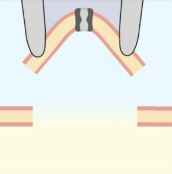
Characteristic of outside-out patch recording configuration
pipette takes a small vesicle membrane away from cell and exposes the extracellular surface to air
allows it to change the medium that the extracellular surface is exposed to

What is a microscopic current?
a current flowing through a single channel
What are macroscopic currents?
current flowing through a large number of channels in a specific region of PM
What does saxitoxin do?
similar to tetrodotoxin, blocks Na+ channels
What does μ-conotoxin do?
paralysis by blocking the pore of Na+ channels
What does α-toxin do?
slows the inactivation of Na+ channels —> prolongs AP
What does β-toxin do?
causes Na+ channels to open at potentials much more negative than normal which causes uncontrollable AP firing
What are thermosensitive ion channels?
responds to changes in temperature and contribute to the senses of pain and body temperature
Where are voltage sensors of ion channels located and how are they connected there?
sensors are on the side of the transmembrane structure subunits by helical linkers that push out and pull in the sensors when needed
What is the Na+/K+ ATPase pump?
maintains the transmembrane gradients for Na+ and K+ that is powered by ATP
What is the ratio for the Na+/K+ pump?
2 K+ into cell, 3 Na+ out of cell
What was discovered by the experiment that examined the release of acetylcholine at neuromuscular junctions?
EPPs (end plate potentials) are made up of individual units equivalent to MEPP (miniature end plate potentials) to start an AP
What is the role of calcium in neurotransmitter secretion?
Ca2+ concentration affects the amount of neurotransmitter released and it is a second messenger.
It binds to calmodulin which triggers a cascade that eventually leads to the release of a neurotransmitter
Explain the exocytosis process that is done by SNARE proteins.
SNARE proteins synaptobrevin on the vesicle binds with syntaxin and SNAP-25
SNARE complex works to pull vesicle to dock
Synaptotagmin binds with the SNARE protein which triggers Ca2+ release
Curvature of plasma membrane brings membrane together, fusion of membranes to release neurotransmitters
What does endocytosis look like?
a cyclic cycle that takes around 1 minute to recycle a vesicle by coating it and putting it back into endosomes
What is a synapsin?
protein that binds to synaptic vesicles and keeps them tethered within the reserve pool
What does Ca2+/calmodulin-dependent protein kinase type II do?
it phosphorylates synapsin and releases the synaptic vesicles from reserve pool to make their way to the PM
What do SNARE proteins do?
they dock the vesicles to the membrane
What primes synaptic vesicles for fusion?
NSF and SNAPs
What does priming synaptic vesicles entail?
organizing the different SNARE proteins into correct conformation for membrane fusion between the vesicle and PM
What are the SNARE proteins?
Synaptobrevin, synatxin, and SNAP-25
What happens if toxins cleave SNARE proteins?
blocks neurotransmitter release
What do synaptotagmins do?
proteins that are found in the membrane of synaptic vesicles that bind with Ca2+
acts like a Ca2+ sensor to trigger vesicle fusion
What is clathrin and what does it do?
most important protein for endocytotic budding of vesicles
triskelion assembles a cagelike coating around vesicle membrane
What is dynamin and what does it do?
involved in the pinching off of membranes during endocytosis
forms a ringlike coil that surrounds the lipid stalk and pinches off membrane and rounds out the vesicle
What is actin and what does it do during endocytosis?
cytoskeletal protein that carries vesicle away from the PM
Which proteins uncoat the vesicles?
Hsc70, auxilin, synaptojanin
Explain the flow of endocytosis
Clathrin assemble into a coat that curves membrane to form a coated pit
Clathrin then pulls the coated pit away from the membrane, making a lipid stalk
Dynamin comes in and rings around the lipid stalk and pinches it off
Actin carries the vesicle away
Hsc70, auxilin, and synaptojanin uncoates the vesicle
What is paracrine signaling?
longer range chemical communication that secretes chemical signals onto a group of nearby target cells
What is endocrine signaling?
secretion of hormones into bloodstream
What is intracellular signal transduction?
chemical signals that happen within the cell that usually triggers a cascade of events
What is signal amplification?
intercellular or intracellular signal transduction that involves reactions that generate a much larger number of products than the number of molecules that initiated the process
What are the three classes of signaling molecules?
Cell-impermeant
Cell-permeant
Cell-associated signaling molecules