Wilkins Chapter 20: Periodontal Examination
 Call Kai
 Learn
 Practice Test
 Spaced Repetition
 Match
 Flashcards
 Knowt Play
1/47

There's no tags or description
Looks like no tags are added yet.
48 Terms
Basic instruments needed for patients with permanent teeth?
- mouth mirror
-probes including furcation probe
-plastic probe (PSR) when dental implants present
-subgingival explorer
What are the different purposes for mouth mirror?
-Indirect Vision
-Retraction
-Illumination
-Transillumination
The use of the modified pen grasp and rest provide which of the following:
a. provide stability and control
b. assist in retraction of lips
c. a and b
d. none of the above
a and b
-Small deposits are light in color and not visible until they are dried
-Dried calculus appears chalky and presents a contrast to tooth color
supragingival or subgingival calculus?
Supragingival Calculus
Usually appears darker
Subgingival calculus
All of the following are subgingival explorers except:
a. ODU 11/12
b. Shepherd Hook explorer
c. TU-17
d. Pigtail or cowhorn
e. a and c
f. b and d
f. b and d
List the supragingival explorers
Pigtail or Cowhorn and Shepherd Hook explorer
List elevation tooth surface irregularities :
-Deposits: calculus
-Anomalies:enamel pearl
-Restorations: overcontoured, irregular margins (overhangs)
List depressions or grooves tooth surface irregularities:
Tooth surface: demineralized or carious lesion, abrasion, erosion, pits such as those caused by enamel hypoplasia
The explorer on facial and lingual surfaces should be adapted to the tip so the side of the point is always on the tooth surface. Move the instrument in short _________ strokes over the surface being examined. T/F?
The first statement is true; walking
Use of a shepherd hook?
To examine pits and fissures; examine surfaces and margins of restorations and sealants
List the reasons a probe is used for:
- Assess periodontal status; classify if gingivitis or periodontitis
-Determine CAL
-Conduct Mucogingival examination
-Make other Gingival determinations; measure gingival recession
-Guide Treatment; summarize gingival characteristics, probing depth, bleeding, and consistency
Name the instrument that is slender with a smooth, rounded tip design for examination of the depth and topography of a gingival sulcus or periodontal pocket :
Probe
List the parts of a probe:
handle, working end, shank
Pocket:
a diseased gingival sulcus
pocket measurements:
from the base of the pocket to the gingival margin
_________ surfaces are approached by entering from both the facial and lingual aspects of a tooth.
Proximal
What kind of tissue is involved when the probe is at the base of the sulcus or crevice, at the coronal end of the junctional epithelium.
Normal healthy tissue
what kind of tissue is involved when the probe tip passes through the junctional epithelium to reach attached connective tissue fibers
Advanced periodontitis
when the probe tip is within the junctional epithelium:
gingivitis and early periodontitis
Horizontal bitewing radiographs do not show the complete periodontal tissues that extend around the roots. When bone loss is moderate to severe, the crest of the bone may be seen in a vertical bitewing survey which is necessary during the periodontal maintenence phase. T/F?
Both statements are true.
____________ calculus is localized and commonly found on the lingual surfaces of the mandibular anterior teeth and the facial surfaces of the maxillary first and second molars, opposite the openings to the salivary ducts.
Supragingival
______________ calculus can be either localized or generalized.
Subgingival
When adapting the probe to the _______________orient the probe at the distal angle for both facial and lingual application. Insert the probe at the distal line angle and probe in a distal direction.
molars and premolars
When adapting the probe on _______ teeth initial insertion may be at a distal line angle or from the midline of facial or lingual surfaces.
anterior
Six measurements are recorded for each tooth: three from the facial and three from the lingual or palatal. Frequently the deepest probing will be in the col, directly under the contact area. T/F?
Both statements are true.
Sources of error for perio probing:
-Resistance of tissues that is affected by the level of inflammation in the tissues
-Calculus
-Diameter and/or variations in standardization of the probe marks
-Clinician errors in angulation and/ or insertion
-Probing pressure or force
refers to the position of the periodontal attached tissues at the base of the sulcus or pocket:
attachment level
a loss of clinical attachment is a primary clinical feature of ________ as the junctional epithelium migrates toward the apex.
periodontitits
Purpose for identifying MGJ:
-detect adequacy of the width of the attached gingiva
-locate frenal attachments and their proximity to the free gingiva
palpable vibration or movement
Fremitus
A tooth with fremitus has excess contact, possibly related to premature contact. Usually, the tooth also demonstrates some degree of mobility because the excess contact forces the tooth to move. T/F?
Both statements are true.
Method to assess tooth mobility and the scale :
Miller Index
N- normal, physiologic
1- slight mobility
2- moderate mobility, greater than 1mm displacement
3- severe mobility, moves vertically and is depressible in the tooth socket
teeth with two roots:
which teeth would they be?
Bifurcation
Mandibular molars, maxillary first premolars, primary mandibular molar
teeth with three roots:
which teeth would they be?
Trifurcation
maxillary molars, maxillary primary premolars
The crest of the interdental bone appears from ____ to ____ mm from the CEJ and is horizontal from the CEJ of one tooth to the adjacent tooth.
1.0, 1.5
When inflammation is the sole destructive factor, the bone loss usually appears ________
horizontal
reduction in height of crestal bone that is irregular; the bone level is not parallel with a line joining the adjacent CEJs. More commonly localized rather than generalized:
Angular or vertical bone loss
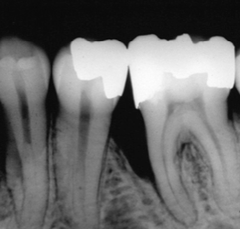
Normal crestal lamina dura appears ____ on radiograph:
white, radiopaque
indirect vision - mouth mirror
Indirect vision is used for all surfaces where direct vision is not possible
indirect Illumination- mouth mirror
The mirror is used to reflect the light from the dental overhead light or headlamp worn by the clinician to any area of the oral cavity.
Transillumination- mm
Transillumination refers to reflection of light through the teeth.
Retraction- mm
The mirror is used to protect or prevent interference by the cheeks, tongue, or lips.
Air water syringe- usage
To Improve and Facilitate Examination Procedures
To Improve Visibility of the Treatment Area during Instrumentation
To Prepare Teeth and/or Gingiva for Certain Procedures
Spraying air on gumline can help see the supra calc
can not be used sub
Subgingival Explorers
ODU 11/12
Back of tip can be applied directly to the base of the pocket without trauma or laceration.
The short tip can be adapted to rounded tooth surfaces and line angles.
Narrow short tip can be adapted at the base where the pocket narrows without undue displacement of the pocket soft tissue wall.
Supragingival Explorers
Use: Examining surfaces and margins of restorations and sealants.
Pigtail or cowhorn, TU-17
Use: Proximal surfaces for calculus or margins of restorations.
Adaptability: As paired, curved tips, they are applied to opposite tooth surfaces.
Shepords hook used for carries detection on occlusal
cephalometric radiograph
An extraoral radiograph of the bones and tissues of the head
panoramic radiograph
shows all of the structures in both dental arches in a single film