311 (Session 6) Muscles of the Face and the Scalp + Temporomandibular Joint and Muscles of Massifcation
 Call Kai
 Learn
Learn Practice Test
 Spaced Repetition
 Match
Match Flashcards
 Knowt Play
1/56

There's no tags or description
Looks like no tags are added yet.
Name | Mastery | Learn | Test | Matching | Spaced | Call with Kai | Chat |
|---|
No analytics yet
Send a link to your students to track their progress
57 Terms
What are the five layers of the scalp
Skin
Connective tissue
Aponeurosis
Loose connective tissue
Pericranium
What is the occipitofrontalis connected by
Epicranial Aponeurosis

What is the frontal belly vs the occipital belly of the occipitofrontalis innervated by
Frontal belly: Temporal Nerve (CN VII)
Occipital belly: Posterior auricular nerve (CN VII)
Both CN VII
What are the two parts of the orbicularis oculi muscle
Palpebral part
Orbital part

What is the orbicularis oculi muscle innervated by
Palpebral part: temporal nerve
Orbital part: zygomatic nerve
Both CN VII

What is the main function of the palpebral part of the orbicularis oculi muscle
Closes the eyelids gently

What is the function of the orbital part of the orbicularis oculi?
Closes the eyelids tightly
Name this muscle, what nerve its innervated by, and main function

Name: Corrugator supercilii
Innervation: temporal nerve (CN VII)
Function: draws eyebrowns downward medially and downward (vertical wrinkles)
What are the three muscles of the nose and what are they all innervated by
Procerus
Levator Labii Superioris Alaeque Nasi
Nasalis
All innervated by the zygomatic nerve
CN VII
What are the two movements involved in opening the TMJ
Rotation = initial / small mouth opening
Anterior translation = wide mouth opening
Name this muscle, innervation, and function

Name: Procerus
Innervation: Zygomatic nerve (CN 7)
Function: depreses medial ends of eyebrows and creates transverse wrinkles

What are the two parts of the nasalis muscle and their innervation
Transverse part
Alar part
Zygomatic Nerve (CN VII)

The posterior fibres of which muscle of mastication contribute to retrusion of the mandible?
Lateral pterygoid
A person can open the jaw only a small amount. At the temporomandibular joint, rotation of the mandibular head within the mandibular fossa still occurs normally. Which movement is restricted?
Anterior translation of the mandibular head
What are the main functions of the two parts of the nasalis muscle
Transverse part: narrows the nostrils
Alar part: flares nostrils
Name this muscle, innervation and main function

Name: Levator Labii Superioris Aleque Nasi
Innervation: Zygomatic Nerve
Function: Flares nostrils and raises the upper lip
Name this muscle, innervation, and function

Name: Orbicularis Oris
Innervation: Buccal Nerve
Function: Closes the mouth and protrudes the lipds (kissing or whistling)
What is the point of intersection for the orbicularis oris, risorius, and depresso anguli oris

Modiolus

Name the following six muscles of the upper lip
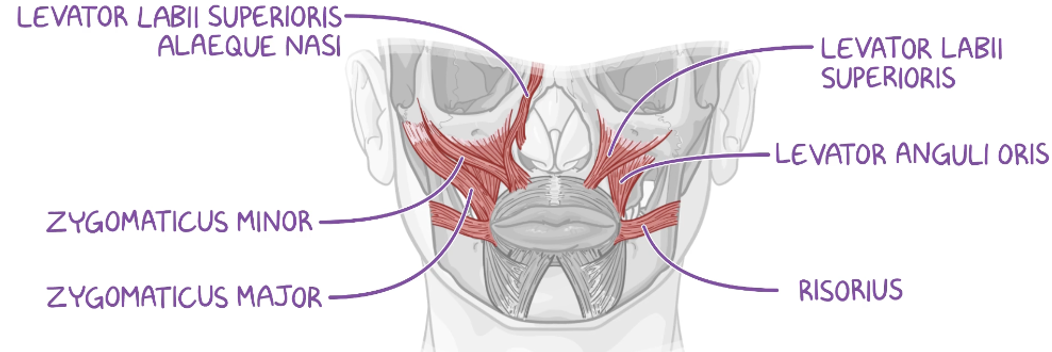
What are the muscles of the upper lips’ function and innervation
Dilators of the mouth
Innervated by: Zygomatic and Buccal nerve
What is the main funciton of the Risorius
Retracts corner of mouth

What is the main function of the levator anguli oris
Raises corner of the mouth
What is the main function of the levator labii superioris
Pull upper lip upwards
What is the main function of the Zygomaticus Minor + Major
Major = pulls corner of the mouht upward and laterally
Minor = ellevates upper lip
What is the main function of the Zygomaticus Major
Smiling
What are the muslces of the lower lip, their function, and what nerve their innervated by

Function: Dilators of mouth like upper lip muscles
Innervated by: Marginal Mandibular nerve (CN VII)
What is the function of the Depressor Anguli Oris and Depressor Labii I Inferioris
Pulls lower lip downward (sad and pout)
Identify this muscle, innervation, and function

Name: Mentalis
Innervated by: Marginal Mandibular Nerve (CN 7)
Function: Elevates and protrudes lower lip (pouting)
Identify this muscle, innervation, function

Name: Platysma
Innervation: cervical nerve (CN 7)
Function: Depresses mandible and draws corners down of mouth (grimacing or cringe emoji)
Identify this muscle, innervation, function

Name: Buccinator
Innervation: Buccal Nerve
Function: Presses cheek against teeth
What is the temporomandibular joint innervated by
CN V3 (Trigeminal V3)

What does the temporomandibular joint consist of and what are they separated by
Mandibular fossa
Articular tubercle
(Both are separated by the articular tubercle)

What is the function of the superior vs the inferior articular cavity of the temporomandibular joint
Superior articular cavity: allows mandible to glide (protrusion and retrusion)
Inferior articular cavity: allows hinge movements (elevation/closing and depression/opening and rotational movements of mouth)
Jaw is supported by LIGAMENTS, name the ligaments
Joint Capsule
1 Intrinsic ligament (lateral ligament)
2 extrinsic ligament
Sphenomandibular
Stylomandibular

What are the muscles of massification innervated by

Trigeminal nerve
What are the muscles of massificaiton
Temporalis
Masseter
Medial Pterygoid (2 heads)
Lateral Pterygoid (2 heads)

Identify the upper muscle; innervation; and function

Name: Temporalis muscle
Innervated by: Trigeminal Nerve
Function: Elevates and retrudes mandible
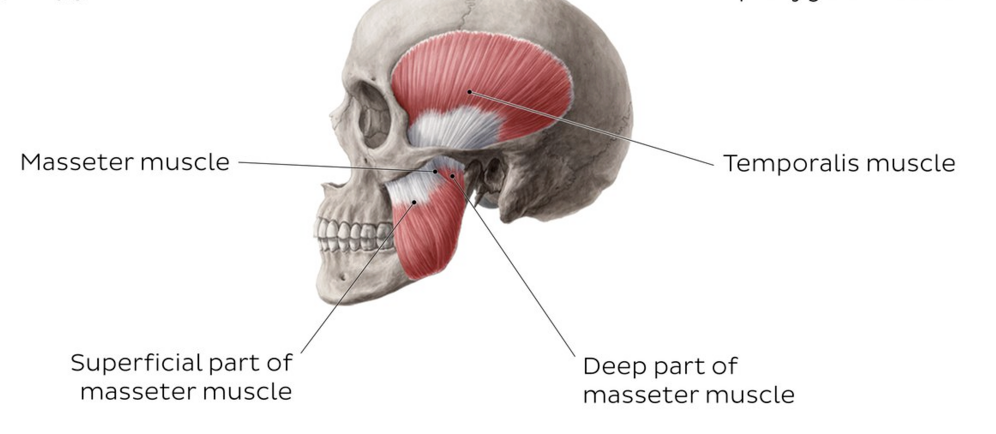
Identify the inferior muscle; innervation, and funciton
Name: Masseter
Innervation: masseteric nerve (part of the trigeminal nerve)
Function: mainly elevates mandible and contribute to protrusion
Identify this muscle and its parts, innervation, function
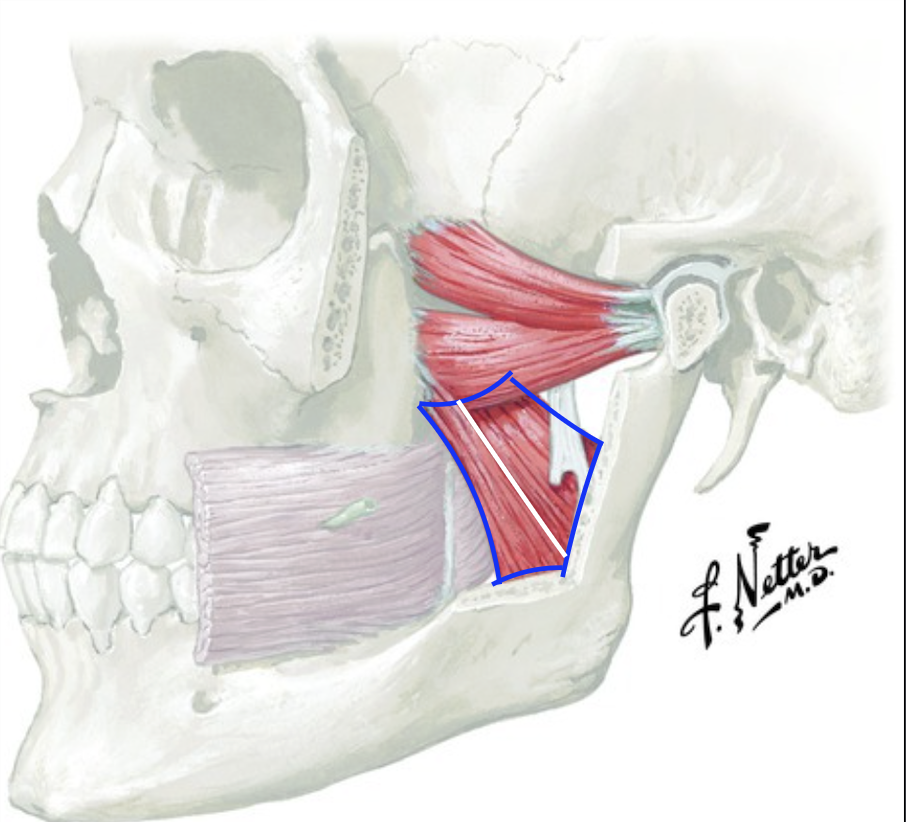
Name: Medial Pterygoid
Deep head and Superficial Head
Innervation: medial pterygoid nerve (part of trigeminal nerve)
Function: produce elevation and protrusion of mandible

Identify this muscle and its parts, innervaiton, and function
Name: Lateral Pterygoid
Superior head and inferior head
Innovation:
lateral pterygoid muscle (part of the trigeminal nerve)
Function:
Bilaterally: depression and protrussion
Unilateral: lateral or side to side chewing movements
Which masseter muscles are used in elevation movements
Temporalis
Masseter
Medial Pterygoid
What masseter muscles are used for depression
Mainly gravity
Lateral pterygoid
Masseter broad attachment; direction of pull; main action
Attachment: Zygomatic arch → ramus of mandible
Direction of pull: Superiorly and postieriorly
Main actions: Elevates mandible (closes jaw)
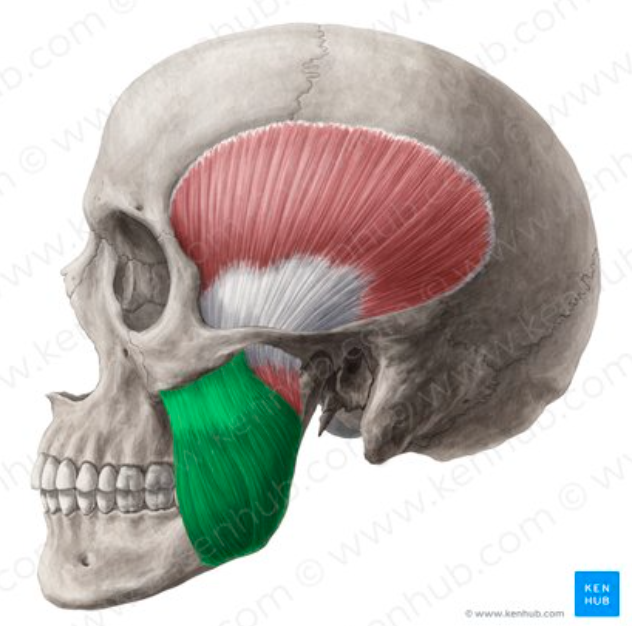
Temporalis broad attachment; direction of pull; main action
Attachment: temporal fossa → coronoid process of mandible
Direction of pull: Superiorly & Posteriorly
Main action: Elevates and retracts mandible

Medial pterygoid broad attachment; direciton of pull; main action
Attachment: pterygoid region → medial surface of mandibular ramus / angle
Direction of pull: Superiorly & Posteriorly
Main action: Elevates and protracts mandible; assists side of side movement
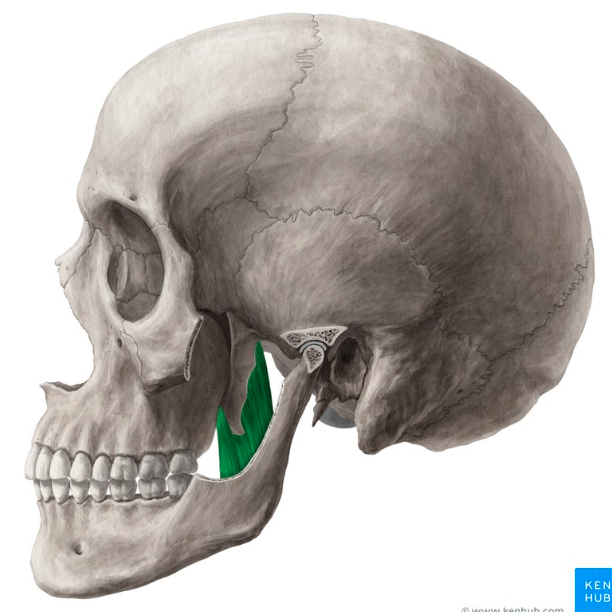
Lateral Pterygoid broad attachment; direction of pull; main action
Attachment: sphenoid / pterygoid region - mandibular neck + TMJ disc / capsule
Which muscle is responsible for raising the upper eyelid and what nerve innervate it
Levator Palpebrae superioris
CN 7
What muscle draws the eybrows together and downward? And what CN innervates this muscle
Corrugator supercilli
CN 7
What muscle raises the eyebrows together and what CN innervates this muscle
Occipitofrontalis (frontal belly)
CN 7
What muscles raise the corners of the mouth and what CN innervates it
Levator anguli oris and zygomaticus major
CN 7
What muscle closes and purse the lips and wha CN innervates it
Obicularis Oris
CN 7
What muscles lower the cortners of the mouth and what CN innervates it
Depressor anguli oris and platysma
CN 7
What muscle presses the cheek against the teeth and what CN innervates it
Buccinator
CN 7
Masseter;
origin and attachment;
direction of pull;
main action;
Motor supply: CN V3

Origin: zygomati arch
Insertion: ramus portion of mandibular
Direction of pull: superior
Main action: elevates mandible (closes jaw)
Motor supply: CN V3 (Trigeminal nerve)
Temporalis
origin and attachment;
direction of pull;
main action;
Motor supply: CN V3
Origin: temporal fossa
Insertion: coronoid process of the mandible
Direction of pull: superiorly & posteriorly
Main action: elevates and retracts (brings jaw back) mandible
Motor supply: CN V3

Medial Pterygoid:
origin and attachment;
direction of pull;
main action;
Motor supply:
Origin: pterygoing region
Insertion: Medial surface of ramus of mandibular
Direction of pull: Superiorly & Posteriorly
Main action: Elevates and protracts mandible (assists in side to side movement)
Motor Supply: CN V3

Lateral Pterygoid:
origin and attachment;
direction of pull;
main action;
Motor supply:
Origin: sphenoid/pterygoid region
Insertion: mandibular neck + TMJ disc / capsule
Direction of pull: Anterior
Main action: protracts mandible; assists jaw opening and side to side movement
Motor supply: CN V3
