Chapter 4: The Flow of Food and Thermometers
 Call Kai
 Learn
 Practice Test
 Spaced Repetition
 Match
 Flashcards
 Knowt Play
1/39

There's no tags or description
Looks like no tags are added yet.
40 Terms
Flow of Food
The path that food takes through the operation.
How do you keep food safe throughout the flow of food?
Prevent cross-contamination and time-temperature abuse.
What are ways to prevent cross-contamination?
Use separate equipment for raw and ready-to-eat food, clean and sanitize, prepare food at different times, or buy prepared food.
What is a way you can help employees remember to use separate equipment?
Buying sets of utensils in different colors and color coding them.
What should you be cleaning and sanitizing?
Work surfaces, equipment, and utensils.
When should you clean and sanitize?
Before and after each task.
Which type of food should you prepare first when preparing food at different times?
Ready-to-eat food
What foods should be separated?
Raw meat from unwashed and ready-to-eat produce.
What range of temperatures has food been time-temperature abused?
Food that was held in between 41F and 135F.
What temperature range does bacteria start to grow rapidly?
70F to 125F
What are the three ways food can be temperature abused?
Cooked to the wrong internal temperature, held at the wrong temperature, and cooled or reheated incorrectly.
How can you avoid time-temperature abuse?
Monitor time and temperature, make sure the right kinds of thermometers are available, record temperatures and times, minimize the time that food spends in the TDZ, and take corrective actions when needed.
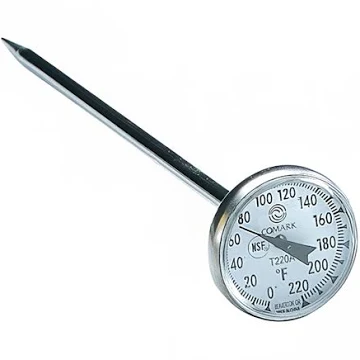
What type of thermometer is this?
Bimetallic stemmed thermometer
What are the parts of the bimetallic stemmed thermometer?
Indicator head, indicator nut, stem, and dimple.
What are the characteristics of the bimetallic stemmed thermometer?
It measures temperature through a metal stem, the sensing area is from the tip to the dimple, and has a calibration nut to keep it accurate.

What thermometer is this?
Thermocouple/thermistor
Is there a difference between thermocouples and thermistors?
No there isn’t.
What are the characteristics of thermocouples/thermistors?
They measure temperature through a metal probe, display temperatures digitally, the sensing area is at the tip of the probe, and they come with interchangeable probes.
What are the types of probes a thermocouple/thermistors can have?
Immersion probe, surface probe, penetration probe, and air probe

What thermometer is this?
Infrared thermometer
What is an infrared thermometer used for?
It’s used to measure the surface temperature of food and equipment.
How do you use an infrared thermometer?
Hold it as close to food or equipment as possible, remove anything between them, and follow the manufacturer’s guidelines.

What thermometer is this?
Maximum registering thermometer
What are the characteristics of a maximum registering thermometer?
It indicates the highest temperature reached during use and used where temperature readings cannot be continuously observed.

What thermometer is this?
Time-temperature Indicator
What does TTI stand for?
Time-temperature indicator
What are the characteristics of TTIs?
They monitor both time and temperature, attached to packages by the supplier, and a color change appears on the device when time-temperature abuse has occurred.
What should you do when using thermometers?
Wash, rinse, sanitize, and air-dry before and after using them, and calibrate them.
What temperatures should thermometers be at to check food?
Your thermometer must be accurate to +/- 2F or +/- 1.5C
What should you do when using thermometers?
Make sure they’re accurate, insert the thermometer probe into the thickest part of the food, take multiple readings, and wait for the reading to steady.
When should you use a glass thermometer?
When it’s enclosed in a shatterproof casing.
What type of thermometer should you never use?
A mercury thermometer because mercury is poisonous.
ice-point method
A method to calibrate your thermometer using ice.
How do you calibrate a thermometer using the ice-point method?
Fill a large container with ice and tap water, submerge the sensing area and wait 30 seconds. Adjust as needed so it reads 32F or 0C
When should you calibrate your thermometers?
After they have been bumped or dropped, exposed to extreme temperature changes, before deliveries arrive, and before each shift.
Can all thermometers be calibrated?
No, not all of them.
What is an immersion probe used for?
Used to measure liquids
What is a surface probe used for?
Used to measure the surface temperature of food or equipment
What is a penetration probe used for?
Used to measure the internal temperature of meats
What is a air probe used for?
Used to measure the air temperature of an area.