Chapter 7.2: Asexual Reproduction Results in Genetically Identical Daughter Cells
 Call Kai
 Learn
Learn Practice Test
 Spaced Repetition
 Match
Match Flashcards
 Knowt Play
1/21

Name | Mastery | Learn | Test | Matching | Spaced | Call with Kai | Chat |
|---|
No analytics yet
Send a link to your students to track their progress
22 Terms
Cell division events
Requires:
Cell division signals (initiated from any source)
DNA replication (for each cell)
DNA segregation (to ensure correct copies)
Cytokinesis (division of cells with membrane)

Binary fission
Type of cell division found in prokaryotes, involving growth, replication, then separation and segregation
Often triggered by good external conditions
Prokaryotic chromosome sites
Sites associated with chromosome replication before segregation, these include
Ori (the origin of replication)
Ter (the terminus of replication)
Prokaryotic DNA segregation
This starts with replication, with the ori regions moving towards opposite ends of the cell as proteins are bound and ATP is hydrolyzed for support
Prokaryotic cytokinesis
This occurs with DNA segregation, as the cell pinches in with a ring of fibers called the Z-ring primarily made of tubulin
Z-ring
A ring of fibers that aids in prokaryotic cytokinesis through the pinching of the membrane

Cell cycle
The phases through which a single eukaryotic cell passes to produce daughter cells as needed, broken into:
G1 phase (growth and normal functioning awaiting signals)
S phase (active replication)
G2 phase (preparation for mitosis)
M phase (DNA segregation for mitosis and cytokinesis)
Mitosis
The cell division process in eukaryotes, giving rise to two daughter nuclei that each contain the same number of chromosomes as the parent nucleus
Generally consists of five stages
Chromatin
The heavily compacted combination of DNA and its associated proteins for binding, such as the positively-charged histones
This condensation varies by region and time, with more condensation during M phase

Centromere
A structure that holds two replicated chromosomes together

Chromosome arm
The portion of the DNA molecule in each side of the centromere
Unreplicated chromosomes have 2
Replicated chromosomes have 4

Sister chromatids
The set of two essentially identical replicated DNA molecules, joined together before being separated in mitosis for chromosome distributions
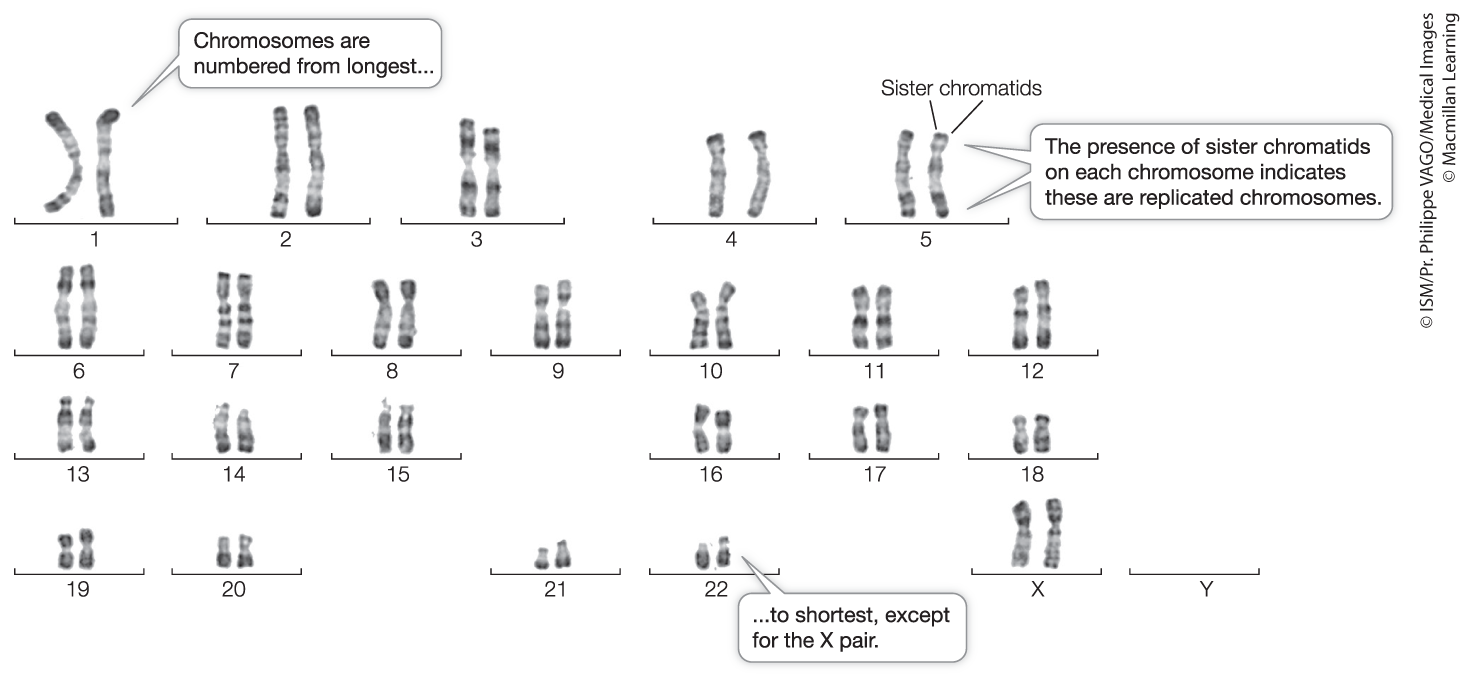
Karyotype
The number and sizes of the condensed chromosomes in a cell’s M phase
Eukaryotic DNA replication
This occurs at numerous origins of replication during a specific part of the cell cycle, not overlapping with segregation or cytokinesis
Eukaryotic DNA segregation
Due to multiple chromosomes, DNA must be highly condensed before this process after which it is moved by a spindle that aids in movement
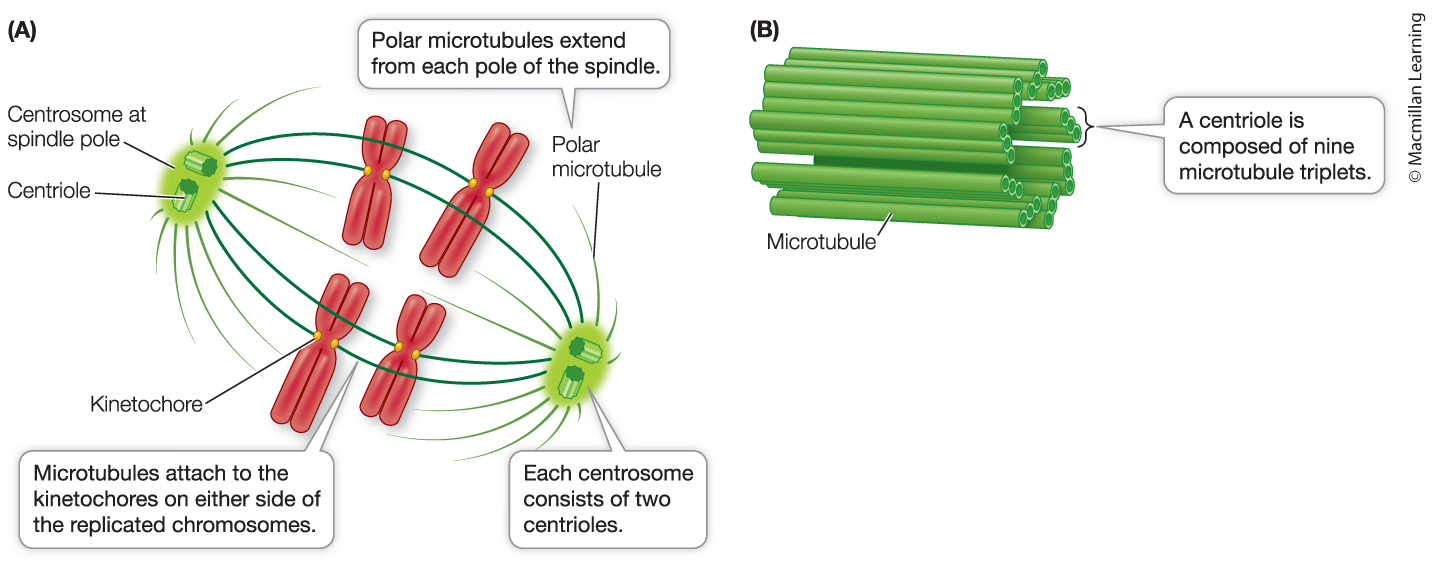
Prophase
The first stage of mitosis, where:
Chromosomes condense
Kinetochores appear on centromere sides, one per chromatid, for movement
Microtubule-comprised centrosomes and spindles form and self-orient
Centrosomes
Structures that orient themselves at the poles of the cell during prophase
Made up of a pair of centrioles, comprised of microtubules
One is duplicated during the S phase for use later on
Spindle
The microtubules that begin attachment to the kinetochores during prophase and prometaphase as they gain stability and the nuclear envelope breaks down
Metaphase
The third stage of mitosis, where chromosomes are aligned at the midline of the cell by kinetochores
Anaphase
The fourth stage of mitosis, where sister chromatids are separated into separate chromosomes as kinetochores are pulled apart
Telophase
The fifth stage of mitosis, where:
A nuclear envelope forms after separation
Chromosomes become less compact
The spindle disappears
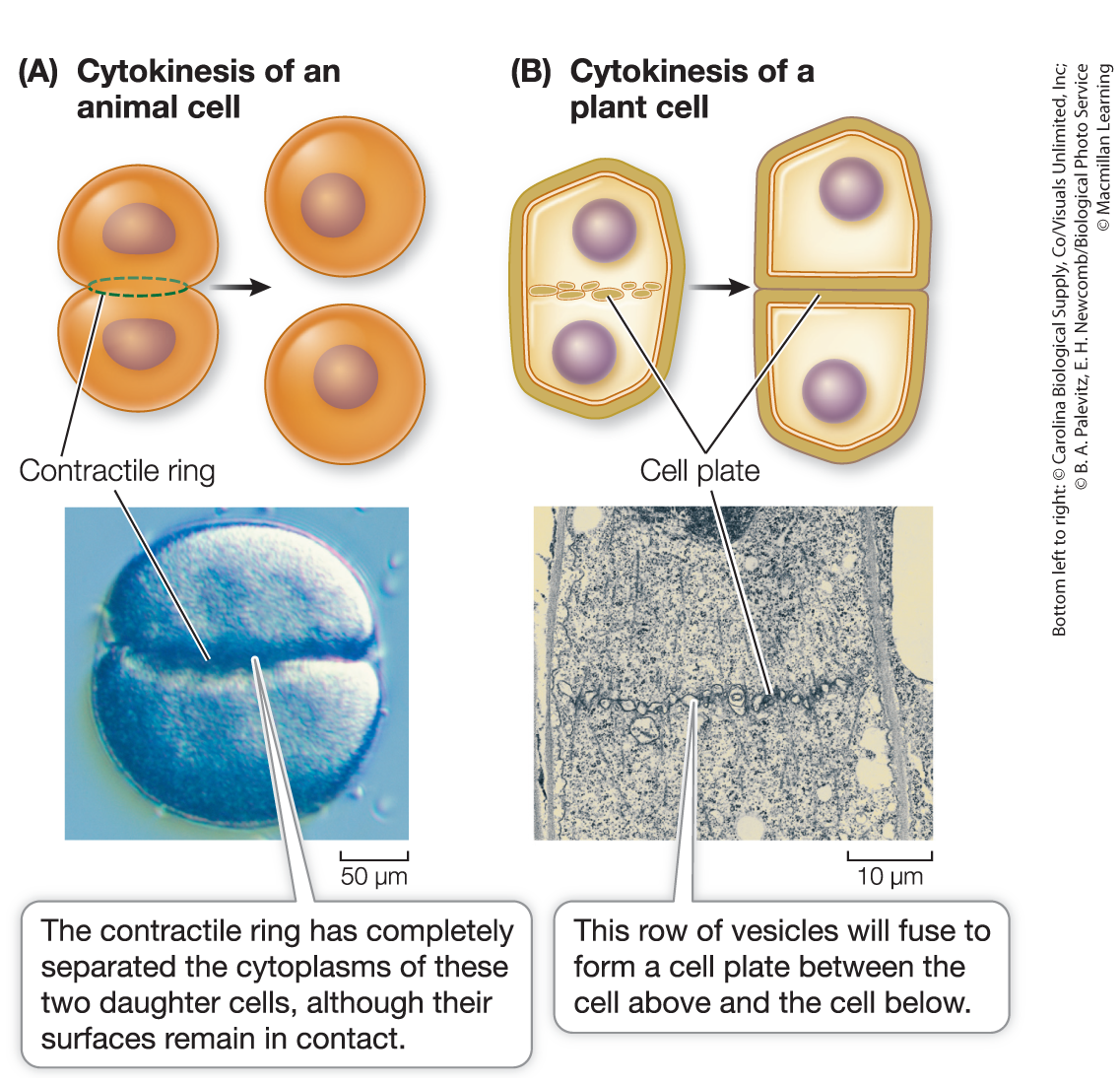
Cytokinesis
The division of the cell’s cytoplasm that occurs after mitosis, resulting in completely-formed daughter cells
In animals, a contractile ring forms under the cell membrane, forming a cleavage furrow
In plants, vesicles from the Golgi apparatus appear along the plane of cell division, forming a new cell membrane and cell wall from a plate