Cardiothoracic and Vascular Instruments
 Call Kai
 Learn
 Practice Test
 Spaced Repetition
 Match
 Flashcards
 Knowt Play
1/31

There's no tags or description
Looks like no tags are added yet.
32 Terms
Satinsky Debakey Vascular Clamp
-is precisely designed for partial or total occlusion of blood vessels, especially the vena cava-toothed tips of the instrument ensure a secure but gentle grip on the blood vessels, preventing any trauma or complication
-also used as a side biting, occluding cardiovascular instrument used for anastomosis between to vessels, in cardiothoracic procedures

Debakey Cross Action Bulldog Clamp, Curved
-a highly versatile surgical instrument used for stopping blood flow during cardiothoracic and vascular procedures -countable

Angeled Debakey Peripheral Vascular Clamp
-this vascular clamp has a 60 degree angled jaw with a serrated and grooved interior
-used to temporarily occlude vessels

Cooley Spoon Shaped Vascular Clamp
-also known as "c" clamp
-used to grasp and hold certain blood vessels to stop the blood flow and perform different procedures, such as the anastomosis of an artery.
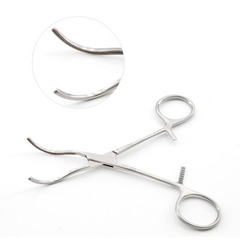
Lambert-Kay Vascular Clamp
-for aortic anastomosis or vessel occlusion

Profunda Clamp
-is quite versatile and permits increased exposure in limited operating fields. The clamp is particularly useful for vessel control in procedures such as profundaplasty, axillary, femoral bypass and carotid endarterectomy.

Davidson Scapula Retractor
-is a unique surgical instrument that allows surgeons to retract the spatula and expose the ribs during thoracic surgeries.

Bailey Rib Contractor
-secures and holds the ribs together after a thoracotomy for convenient suturing. Especially includes 3 sharp tips on each blade to prevent slippage. The tips also help to secure the ribs with minimal soft tissue damage.

Collin-Duval Lung Grasping Forceps
-are used for tissue grasping and often functional for grabbing internal organs such as the lunch

Sarot Bronchus Clamp
-Is used to clamp the bronchus during advanced thoracic surgeries. The instrument is non traumatic and is fixed throughout the surgical procedure due to its specially designed jaws.

Harken Clamp
- versatile surgical instruments commonly used during various cardiovascular surgeries to hold heart tissue. It is often used to hold and manipulate the auricles of the heart during delicate suturing or to achieve hemostasis.
-It is also commonly used in throacotomies to place a vessel loop around the pulmonary artery for isolation.

Giertz-Stille Rib Shears
-rib cutter

Bethune Rib Shears
-Rib/bone cutter
-is often used during cardiovascular surgery as well as orthopedic and trauma procedures.

Finochietto Rib Spreader Retractor
-used to retract tissue and ribs during a thoracotomy.

Morse Sternal Retractor
-is used to retract tissues and the sternum during an open heart procedure.

Doyen Rib Elevator
-commonly used to scrape bone and other hard tissues from the ribs, in order to smooth the edges of the selected bone and broaden the surgical approach.

Debakey Vascular Dilators
-a specialized surgical instrument that cardiovascular surgeons can use to broaden the lumen of small and large blood vessels, in order to apply stents or other devices that help in restoring the blood flow.

Yasargil Aneurysm Clip Applier and Bulldogs
-Aneurysm clips are intended for occlusion of cerebral aneurysms in a temporary manner. Used for clamping/occluding in AV fistulas. Commonly used in cardiac cases to semi occlude the coronary arteries for suturing when off pump.

Ryder Needle Holder
-is a ratcheted, finger ring instrument that features narrow jaws and is commonly used with very small suture needles in cardiovascular, plastic, and neurosurgical procedure.

Sarot Needle Driver
-is used for approximation suturing, often in cardiovascular procedures.

Potts Smith Toothed Forcep
-is a specialized instrument used for manipulating delicate tissues. It is used to access deep and narrow cavities as well as handle sensitive tissues during cardiothoracic, vascular, ophthalmic, ENT, and plastic surgeries.

Potts Smith Smooth Forceps
-is a specialized instrument used for manipulating delicate tissues. It is used to access deep and narrow cavities as well as handle sensitive tissues during cardiothoracic, vascular, ophthalmic, ENT, and plastic surgeries.

Kelly Wick Tunneler Set
-intended to aid in creating subcutaneous tunnels for the placement of vascular prostheses (grafts) or autogenous grafts for arteriovenous access, peripheral vascular, m and extra-anatomic bypass procedures.

Scanlan Tunneler and Sheath
-allows atraumatic tunneling and placement of grafts without kinking, twisting, stretching, or pulling

Flexible Bronchoscope
-is the instrument used to visualize the air way and lungs.
-Bronchoscopy: is a procedure that lets doctors look at your lungs and air passages. It's usually performed by a doctor who specializes in lung disorders (a pulmonologist).
-Note - a light and a small camera on the bronchoscope allow the provider to look inside the lungs' airway.

Rigid Bronchoscope
-is the instrument used to visualize the air way and lungs.
-Bronchoscopy: is a procedure that lets doctors look at your lungs and air passages. It's usually performed by a doctor who specializes in lung disorders (a pulmonologist).
-Note - a light and a small camera on the bronchoscope allow the provider to look inside the lungs' airway.

Doppler and Doppler Box
-A doppler ultrasound is a noninvasive test that can be used to estimate the blood flow through your blood vessels by bouncing high-frequency sounds waves (ultrasound) off circulating red blood cells.

Micro Puncture set
-helps to gain access into an artery
-indicated use for percutaneous introduction of up to a 0.038 inch guidewire or catheter into the vascular system following a small 21 gauge needle stick

Dilator/Sheath
-used to inject into vessels (dyes, contrast, etc. )
-there are many colors and sizes/lengths
**flush with heparinized saline before use***

Insufflator
-used to insufflate balloon in vascular surgery
-hold the lure-lock tip in heparinized saline and push the yellow button, while pulling back on the blue handle to draw up Hep Saline. Then do the same with contrast dye to load contrast dye. Draw up Hep Saline and Contrast according to the surgeons preference. Then hold the insufflator with the blue handle towards the ground and rotate the handle to expel any air in the chamber.

Balloon Cath
-used during a catheterization procedure to enlarge a narrow opening or passage within the body
-when you receive the balloon make sure you flush the strait port with hep saline (the straight port is where the wire will come through). On the angled port you wnat to draw back twice (releasing the air in between draws), this is called "burping the balloon. The insufflator will eventually get attach to the angled port to blow up the balloon.
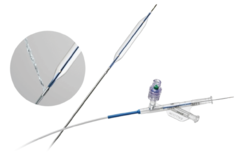
Stent
-never touch the tipe where the stent it. You must be careful as some stents cannot get wet prior to going in the body. Always flush the straight back port as this is where the wire will come out of. The surgeon will use the other buttons to deploy the stent.
