AP Bio Metabolism, Respiration, & Photosynthesis
 Call Kai
 Learn
 Practice Test
 Spaced Repetition
 Match
 Flashcards
 Knowt Play
1/194

There's no tags or description
Looks like no tags are added yet.
195 Terms
Ch 8: Which statement is true of metabolism in its entirety in all organisms?
Metabolism consists of all the energy transformation reactions in an organism.
Ch 8: Which is an example of potential rather than kinetic energy?
A molecule of glucose.
Ch 8: Most cells cannot harness heat to perform work because ________.
Temperature is usually uniform throughout a cell.
Ch 8: A decrease in entropy is associated with which type of reaction?
Dehydration.
Ch 8: Which term precisely describes breaking down large molecules into smaller ones?
Catabolism (catabolic pathways).
Ch 8: Which statement about anabolic pathways is true?
They consume energy to build up polymers from monomers.
Ch 8: Which statement describes the first law of thermodynamics?
Energy cannot be created or destroyed.
Ch 8: What is an important consequence of the first law of thermodynamics for living organisms?
An organism ultimately must obtain all of the necessary energy for life from its environment.
Ch 8: How does the decrease in entropy of growing organisms relate to the second law of thermodynamics?
Organisms cause a greater increase in entropy in their environment than the decrease associated with their increased complexity.
Ch 8: Which statement is a logical consequence of the second law of thermodynamics?
Each chemical reaction in an organism must increase the total entropy of the universe.
Ch 8: Which statement is consistent with the second law of thermodynamics?
A constant input of energy is required to maintain the high level of cellular organization.
Ch 8: Which type of reaction would decrease entropy within a cell?
Anabolic reactions.
Ch 8: How does the evolution of life relate to the second law of thermodynamics?
It has occurred in accordance with the laws of thermodynamics and resulted in a substantial increase in planetary entropy.
Ch 8: In the expression ΔG = ΔH - TΔS, what does ΔG represent?
The change in free energy.
Ch 8: Which statement is true for a system at chemical equilibrium?
The system can do no work.
Ch 8: Which statement is true for all exergonic reactions?
The reaction proceeds with a net release of free energy.
Ch 8: A chemical reaction that has a positive ΔG is best described as ________.
Endergonic.
Ch 8: Which statement describes an example of a reaction that may be at chemical equilibrium in a cell?
A chemical reaction in which neither reactants nor products are being produced or consumed in any metabolic pathway.
Ch 8: The relationship between catabolism and anabolism is most similar to the relationship between ________.
Exergonic and endergonic.
Ch 8: Why do hydrolysis reactions occur more readily in solution than dehydration reactions?
Hydrolysis reactions are exergonic and increase entropy of the system.
Ch 8: Which statement describes a central role that ATP plays in cellular metabolism?
ATP provides energy coupling between exergonic and endergonic reactions.
Ch 8: Why is the ΔG of ATP hydrolysis in a cell about twice as great as in a test tube?
Reactant and product concentrations in the test tube are different from those in the cell.
Ch 8: Which molecule is most similar in structure to ATP?
An RNA nucleotide.
Ch 8: Which statement describes a common characteristic of catabolic pathways?
They are exergonic and provide energy that can be used to produce ATP from ADP and Pi.
Ch 8: When work is done by an organism, what happens to the generated heat?
It is lost to the environment.
Ch 8: When ATP releases energy, what happens to the resulting inorganic phosphate in the cell?
It may be used to form a phosphorylated intermediate.
Ch 8: How is ATPase acting in a resting muscle cell maintaining low cytosolic calcium against a high SR concentration?
ATPase activity must be pumping calcium from the cytosol to the SR against the concentration gradient.

Ch 8: What is the most correct interpretation of the ATP cycle figure?
ATP is a molecule that acts as an intermediary to store energy for cellular work.
Ch 8: How do cells use the ATP cycle?
Cells use the cycle to recycle ADP and phosphate.
Ch 8: Which statement about enzyme function is true?
Enzymes increase the rate of chemical reactions by lowering activation energy barriers.
Ch 8: Compared to an uncatalyzed reaction, the same reaction with a catalyst will have ________.
The same ΔG.
Ch 8: Which aspect of enzyme structure is best described by a clasping handshake analogy?
The specific manner in which an enzyme binds substrate.
Ch 8: What characteristic is most likely associated with an enzyme that catalyzes two different chemical reactions?
Either the enzyme has two distinct active sites or the substrates involved have very similar structures.
Ch 8: What is the name of the thermodynamic barrier that must be overcome before products form in a spontaneous reaction?
Activation energy.
Ch 8: If you double the amount of enzyme in a reaction with a ΔG of -20 kcal/mol, what will be the new ΔG?
-20 kcal/mol.
Ch 8: What is a primary function of the active site of an enzyme?
It catalyzes the reaction associated with the enzyme.
Ch 8: Which statement describes a key component of the induced fit hypothesis?
Binding of substrate to the active site changes the shape of the active site of an enzyme.
Ch 8: Which condition may be overcome by increasing substrate concentration with a fixed amount of enzyme?
Competitive inhibition.
Ch 8: In carboxypeptidase, zinc is present in the active site and functions as ________.
A cofactor necessary for enzyme activity.
Ch 8: How does a noncompetitive inhibitor decrease the rate of an enzyme-catalyzed reaction?
By binding to an allosteric site, thus changing the shape of the active site.
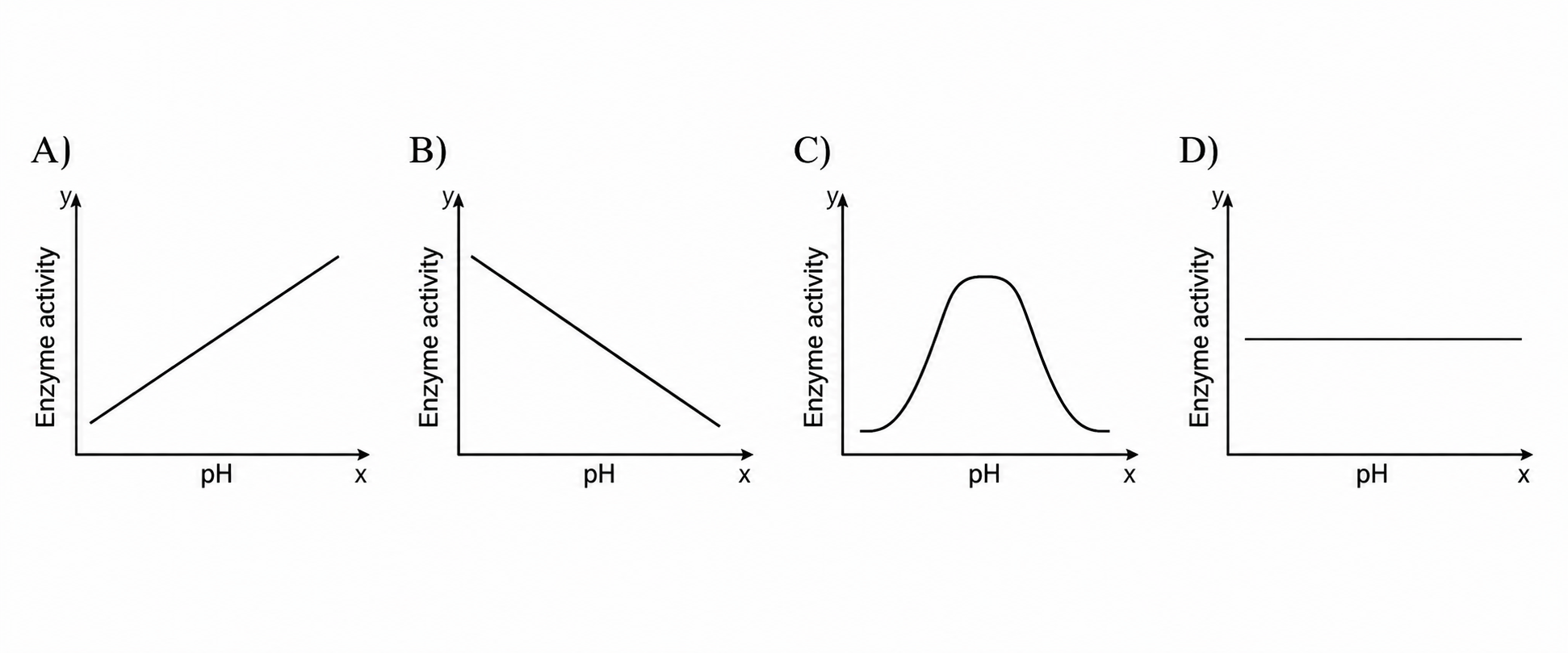
Ch 8: Which pH profile curve most likely describes catalase in human cells?
Curve C.
Ch 8: How might a change of one amino acid distant from the active site alter enzyme substrate specificity?
By changing the three-dimensional conformation of the enzyme.
Ch 8: For an enzyme-catalyzed reaction at 1.0 micromolar reactant concentration, what treatment causes the greatest rate increase?
Doubling the enzyme concentration.
Ch 8: In an enzyme reaction rate graph, why does the reaction rate plateau at higher reactant concentrations?
Most enzyme molecules are occupied by substrate at high reactant concentrations.

Ch 8: Which curves represent temperature and pH profiles of an enzyme from a bacterium in mildly alkaline hot springs (70°C+)?
Curves 3 and 5.

Ch 8: Which curves are most likely associated with an enzyme isolated from a strongly acidic human stomach?
Curves 1 and 4.

Ch 8: Which term best describes the forward reaction in the energy state figure for A + B ↔ C + D?
Exergonic, ΔG < 0.

Ch 8: In the energy states figure for A + B ↔ C + D, which value would be the same in catalyzed and uncatalyzed reactions?
d (overall free energy change).

Ch 8: Which represents the activation energy required for the enzyme-catalyzed reaction?
b.

Ch 8: Which represents the activation energy required for the non-enzyme-catalyzed reaction?
c.
In a metabolic pathway, succinate dehydrogenase catalyzes the conversion of succinate to fumarate. The reaction is inhibited by malonic acid, a substance resembling succinate but cannot be acted upon by succinate dehydrogenase.
Ch 8: What role do the molecules play in the reaction?
Succinate is the substrate, and fumarate is the product.
In a metabolic pathway, succinate dehydrogenase catalyzes the conversion of succinct to fumarate. The reaction is inhibited by malonic acid, a substance resembling succinate but cannot be acted upon by succinate dehydrogenase.
Ch 8: What role does malonic acid play with respect to succinate dehydrogenase?
Malonic acid is a competitive inhibitor.
Ch 8: Designing a drug to fit into the active site of HIV protease to block it is an example of ________.
Competitive inhibition.
Ch 8: In the pathway X → Y → Z → A, product A binds remotely to the enzyme converting X to Y to decrease activity. What is substance X?
A substrate.
Ch 8: In the same pathway, with respect to the enzyme converting X to Y, substance A functions as ________.
An allosteric inhibitor.
Ch 8: What is the regulatory mechanism where the end product of a metabolic pathway inhibits an early enzyme?
Feedback inhibition.
Ch 8: A newly purified protein has a substrate-binding pocket and a regulatory molecule indentation. What does this suggest?
It is probably an enzyme that is regulated by noncompetitive inhibition.
Ch 8: Which statement describes cooperativity associated with enzyme regulation?
Binding a substrate to one subunit of a tetramer stimulates faster binding of substrate to each of the other three subunits.
Ch 8: Besides allosteric regulation, how else do cells control enzymatic activity?
Localization of enzymes into specific organelles or membranes.
Ch 8: What purpose may be served by plasma membrane localization of protein kinases?
They can more readily encounter and phosphorylate other membrane proteins.
Ch 8: For living organisms, what is an important consequence of the first law of thermodynamics?
The organism must ultimately obtain all the necessary energy for life from its environment.
Ch 8 EOC: Catabolism is to anabolism as ________ is to ________.
Exergonic; endergonic.
Ch 8 EOC: Most cells cannot harness heat to perform work because ________.
Temperature is usually uniform throughout a cell.
Ch 8 EOC: Which metabolic process can occur without a net influx of energy?
C6H12O6 + 6O2 → 6CO2 + 6H2O.
Ch 8 EOC: If an enzyme solution is saturated with substrate, the most effective way to obtain a faster yield is to ________.
Add more of the enzyme.
Ch 8 EOC: Some bacteria are metabolically active in hot springs because ________.
Their enzymes have high optimal temperatures.
Ch 8 EOC: If an enzyme is added to a solution where substrate and product are in equilibrium, what will occur?
Nothing; the reaction will stay at equilibrium.
Ch 9: In which reactions of cellular respiration and fermentation does substrate-level phosphorylation occur?
In both glycolysis and the citric acid cycle.
Ch 9: What happens to a molecule that functions as the reducing agent in a redox reaction?
It loses electrons and loses potential energy.
Ch 9: What happens when electrons are passed from one atom to a more electronegative atom?
The more electronegative atom is reduced, and energy is released.
Ch 9: In the reaction C6H12O6 + 6 O2 → 6 CO2 + 6 H2O + Energy, ________.
C6H12O6 is oxidized and O2 is reduced.
Ch 9: What happens to a glucose molecule when it loses a hydrogen atom in an oxidation-reduction reaction?
The glucose molecule is oxidized.
Ch 9: When a molecule of NAD+ gains a hydrogen atom, the molecule becomes ________.
Reduced.
Ch 9: Which statement about NAD+ is true?
NAD+ is reduced to NADH during glycolysis, pyruvate oxidation, and the citric acid cycle.
Ch 9: The oxygen consumed during cellular respiration is directly involved in ________.
Accepting electrons at the end of the electron transport chain.
Ch 9: Why are carbohydrates and fats frequently considered high-energy foods?
They contain many electrons associated with hydrogen atoms.
Ch 9: When an athlete exhausts their ATP supply, what is likely to happen?
Catabolic processes are activated that generate more ATP.
Ch 9: Substrate-level phosphorylation accounts for approximately what percentage of ATP formed in glycolysis?
100%.
Ch 9: Why are only two molecules of NADH formed during glycolysis instead of a dozen?
Most of the free energy available from the oxidation of glucose remains in pyruvate.
Ch 9: Starting with one molecule of glucose, glycolysis results in the net production of ________.
2 NADH, 2 pyruvate, and 2 ATP.
Ch 9: In glycolysis, for each mole of glucose oxidized to pyruvate, ________.
Two molecules of ATP are used, and four molecules of ATP are produced.
Ch 9: Which metabolic poison would most directly interfere with glycolysis?
An agent that closely mimics the structure of glucose but is not metabolized.
Ch 9: During which metabolic process is most of the CO2 from glucose catabolism released?
The citric acid cycle.
Ch 9: Following glycolysis and the citric acid cycle, where is most of the energy from original glucose stored?
NADH.
Ch 9: Which electron carrier(s) function in the citric acid cycle?
NADH and FADH2.
Ch 9: If you add a citric acid cycle intermediate to yeast culture medium, what happens to ATP and CO2 production?
The rates of ATP production and carbon dioxide production would both increase.
Ch 9: Carbon dioxide is released during which stages of cellular respiration?
Oxidation of pyruvate to acetyl CoA and the citric acid cycle.
Ch 9: If glucose is the sole energy source, what fraction of exhaled CO2 is generated by oxidation of pyruvate to acetyl CoA?
1/3.
Ch 9: For each mole of glucose oxidized by cellular respiration, how many moles of CO2 are released in the citric acid cycle?
4.
Ch 9: If pyruvate oxidation is blocked, what happens to oxaloacetate and citric acid levels in the citric acid cycle?
Oxaloacetate will accumulate and citric acid will decrease.
Ch 9: Starting with citrate, what products result from three acetyl CoA molecules entering the citric acid cycle?
3 ATP, 6 CO2, 9 NADH, and 3 FADH2.
Ch 9: Which products result from pyruvate being converted to acetyl CoA?
Acetyl CoA, NADH, and CO2.
Ch 9: Which molecule is formed by the removal of CO2 from a molecule of pyruvate?
Acetyl CoA.
Ch 9: Which event takes place in the electron transport chain?
The harnessing of energy from high-energy electrons derived from glycolysis and the citric acid cycle.
Ch 9: Which statement about the electron transport chain is true?
It consists of a series of redox reactions.
Ch 9: Which process is driven by chemiosmosis?
Oxidative phosphorylation.
Ch 9: Which sequence describes the path by which electrons travel downhill energetically in aerobic respiration?
Glucose → NADH → electron transport chain → oxygen.
Ch 9: Where are the proteins of the electron transport chain located?
Mitochondrial inner membrane.
Ch 9: During aerobic respiration, which molecule directly donates electrons to the ETC at the lowest energy level?
FADH2.
Ch 9: What is the primary role played by oxygen in cellular respiration?
It serves as the final acceptor for electrons from the electron transport chain.