13- Enzyme Inhibition
 Call Kai
 Learn
 Practice Test
 Spaced Repetition
 Match
 Flashcards
 Knowt Play
1/69

There's no tags or description
Looks like no tags are added yet.
70 Terms
What two aspects of enzyme activity can an inhibitor alter?
Substrate binding and the enzyme's ability to convert substrate into product (turnover number)
How could an inhibitor interfere with catalysis without preventing substrate binding?
It could allow the substrate to bind but reduce the enzyme–substrate complex's ability to form product.
Irreversible inhibitor
A substance that causes inhibition that cannot be reversed
Usually involves formation or breaking of covalent bonds to or on the enzyme (modifies the enzyme)
What is another name for irreversible inhibitors?
Inactivators
Reversible inhibitor
A reversible inhibitor binds to an enzyme to inhibit it but can later dissociate, allowing the enzyme to regain activity
Usually interact with enzymes through noncovalent interactions, such as hydrogen bonds, ionic attractions, and hydrophobic interactions
What are the 3 types of inhibition?
Competitive
Uncompetitive
Mixed or Noncompetitive
What two places may an inhibitor bind?
At the same binding site as one of the substrates
The inhibitor must structurally resemble the substrate
At an alternative site, affecting catalytic activity without affecting substrate binding
What is competitive inhibition?
A competitive inhibitor competes with the substrate for the same binding site on the enzyme
E + I ⇌ EI
What is structural mimicry?
When an inhibitor resembles a substrate closely enough to bind at the enzyme's substrate-binding site
How do competitive inhibitors affect a reaction?
Enzymes are temporarily occupied by inhibitors, so there are fewer free enzymes available to form an ES complex
What does KI represent?
The inhibitor dissociation constant, which describes the binding of inhibitor to enzyme.
Formula for KI:
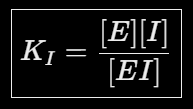
What does a small KI indicate?
The inhibitor binds tightly to the enzyme
What does a large KI indicate?
There is weak binding between the inhibitor and the enzyme
It is easy for EI to dissociate
Why does competitive inhibition increase apparent KM?
The inhibitor occupies free enzyme, so a higher substrate concentration is needed to achieve a given velocity.
What is apparent KM?
Apparent KM is the KM value you observe experimentally when something else, such as an inhibitor or another molecule, affects the enzyme's behavior.
Abbreviations for apparent KM:
KM, app or αKM
KM, app = αKM
Michaelis-Menten equation with apparent KM:

What does α mean in terms of apparent KM?
Alpha is a factor that tells you how much a competitive inhibitor increases the apparent KM
It depends on the inhibitor concentration and how strongly the inhibitor binds to the enzym
Formula for α (apparent KM)

How do you overcome the effects of a competitive inhibitor?
Increase [S]
This allows the substrate to outcompete the inhibitor for the binding sit
What is trypsin's biological function?
It is a digestive enzyme that cleaves peptide bonds in proteins
Why can benzamidine act as a competitive inhibitor of trypsin?
Benzamidine resembles the arginine side chains of Trypsin, so it can occupy the trypsin's substrate-binding pocket
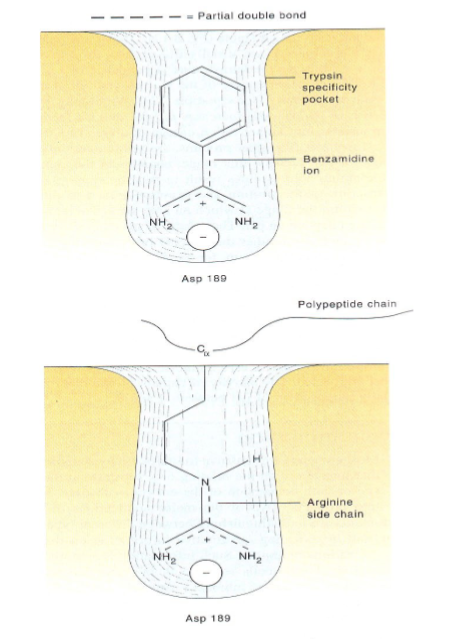
Why does benzamidine not behave like a normal substrate when occupying the trypsin's substrate-binding pocket?
It lacks the normal peptide-bond arrangement needed for the usual cleavage reaction
Looks like a substrate but doesn’t act like a substrate!
Why does competitive inhibition leave kcat unchanged in the basic model?
The inhibitor affects substrate access, not the catalytic turnover of enzyme molecules that have bound substrate
For a reversible competitive inhibitor, the enzyme returns to its normal catalytic activity once the inhibitor detaches.
How does competitive inhibition affect apparent kcat/ KM?
t decreases the apparent value because apparent KM increases while kcat stays the same.
What happens to the slope of a Lineweaver–Burk plot during competitive inhibition?
It increases
because the apparent KM increases, while Vmax stays the same
REMEMBER: Slope= KM/ Vmax
What happens to the y-intercept during competitive inhibition?
It stays the same because Vmax is unchanged.
REMEMBER: y-intercept= Vmax

Why is competitive inhibition called an intersecting pattern?
The lines with and without inhibitor meet at the same y-intercept.
What happens to the x-intercept during competitive inhibition?
It moves closer to 0 (more and more negative as α increases)
REMEMBER: x-intercept = -1/ αKM for competitive inhibitors and -1/ KM for no inhibition

Formula for finding KI of competitive binding by comparing KM with and without an inhibitor:
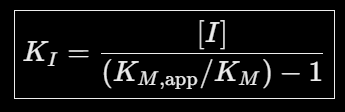
Formula for finding KI of competitive binding by comparing Lineweaver–Burk slopes with and without an inhibitor:

What is uncompetitive inhibition?
An uncompetitive inhibitor binds to the enzyme–substrate complex, ES, but does not bind to the free enzyme in the basic model.
ES + I ⇌ ESI
What happens to Vmax during uncompetitive inhibition?
It decreases
Why? The inhibitor binds to the enzyme–substrate complex (ES), preventing it from producing product.
What happens to KM during uncompetitive inhibition?
It decreases
Why? The inhibitor binds to ES and traps it as ESI, stabilizing the substrate-bound state and decreasing the apparent KM, even though product formation is inhibited.
Why can high substrate concentrations not overcome uncompetitive inhibition?
The inhibitor binds the ES complex, so increasing substrate does not prevent inhibitor binding to that complex
Why does Vmax/ KM remain unchanged in pure uncompetitive inhibition?
The inhibitor does not affect ES complex formation
Michaelis-Menten equation for uncompetitive inhibition:
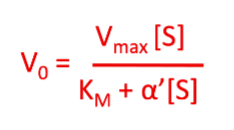
What is α’ regarding uncompetitive inhibition?
Alpha prime (α’) tells you how much an uncompetitive inhibitor affects the enzyme's kinetics by binding to the enzyme–substrate complex (ES).
α’ formula:

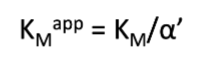
KM, app formula for uncompetitive inhibition:
Vmax, app for uncompetitive inhibition:

Why does uncompetitive inhibition reduce apparent kcat?
Some enzyme–substrate complexes are trapped as inactive ESI rather than producing product
What happens to kcat/KM in pure uncompetitive inhibition?
It remains unchanged in the basic model because ES must be formed prior to the inhibitor binding
Why can uncompetitive inhibition become more pronounced as substrate concentration increases?
More ES complexes form, creating more targets for the inhibitor.
Formula for finding KI of uncompetitive inhibition by comparing y-intercepts”

Formula for finding KI of uncompetitive inhibition by comparing x-intercepts”

What is Mixed or Noncompetitive Inhibition
An inhibitor can bind to both the free enzyme, E, and the enzyme–substrate complex, ES

What is mixed inhibition?
An inhibitor binds both free enzyme (E) and enzyme-substrate complex (ES) with different affinities
What is pure noncompetitive inhibition?
An inhibitor binds both free enzyme (E) and enzyme-substrate complex (ES) with the same affinities
What happens to Vmax during mixed inhibition?
Decreases
The inhibitor reduces the amount of enzymes available to produce product
What happens to KM during mixed inhibition?
Can increase or decrease depending on whether the inhibitor prefers E or ES
Prefers ES —> KM decreases
Prefers E —> KM increases
What happens to Vmax during pure noncompetitive inhibition?
It decreases because the inhibitor reduces the enzyme's ability to produce product.
What happens to KM during pure noncompetitive inhibition?
It stays the same because the inhibitor binds E and ES equally well.
Michaelis- Menten equation for mixed or non-competitive inhibition:

α formula for mixed or non-competitive inhibition:
KI: inhibitor binding to free enzyme
KI’: inhibitor binding to the enzyme–substrate complex

KM, app formula for mixed or non-competitive inhibition:

Vmax formula for mixed or non-competitive inhibition:

Finding KI of mixed or noncompetitive inhibition by comparing slopes:

Finding KI of mixed or noncompetitive inhibition by comparing y-intercepts:

What is the general Lineweaver–Burk pattern for mixed inhibition?
The lines intersect to the left of the y-axis

Why is pure noncompetitive inhibition considered a special case of mixed inhibition?
It occurs when the inhibitor's affinity for free enzyme and ES is exactly equal
What happens to Vmax when an irreversible inhibitor inactivates some enzyme molecules?
It decreases because fewer functional enzyme molecules remain
What happens to KM when an irreversible inhibitor inactivates some enzyme molecules?
The surviving active enzymes retain their original substrate-binding properties
Why can irreversible inhibition resemble pure noncompetitive inhibition on a Lineweaver–Burk plot?
Both can decrease Vmax while leaving KM unchanged
How do irreversible inhibitors modify an enzyme?
Many irreversible inhibitors form a covalent bond with the enzyme
This changes the enzyme chemically and prevents it from functioning normally.
Why can’t you distinguish Lineweaver-Burk plots of irreversible inhibitors from the noncompetitive inhibition?
Lineweaver-Burk plots of irreversible inhibitors cannot be distinguished from the noncompetitive inhibition pattern because of the loss of active enzyme
What happens to enzyme activity after an irreversible inhibitor is removed from the enzyme’s binding site?
With an irreversible inhibitor, removing free inhibitor generally does not restore activity because the enzyme has already been chemically modified or inactivated
This is time-dependent (how long was the inhibitor bound?)
How does TPCK inactivate chymotrypsin?
It forms a covalent bond with His 57, preventing the enzyme from functioning normally
Why is TPCK an example of irreversible inhibition?
It chemically modifies the enzyme, causing lasting inactivation under normal conditions.