PSYC 383 Midterm 3
 Call Kai
 Learn
 Practice Test
 Spaced Repetition
 Match
 Flashcards
 Knowt Play
1/40

There's no tags or description
Looks like no tags are added yet.
41 Terms
What is chronopharmacology?
The study of how biological timing and circadian rhythms influence drug action and how drugs affect the body's circadian clock.
What are the three essential defining criteria of a true circadian rhythm?
It has an endogenous period of approximately 24 hours.
It persists in constant environmental conditions (free-running).
It is entrainable by external environmental cues (zeitgebers).
In circadian biology, what is a 'zeitgeber'?
An external environmental cue (German for 'time giver') that synchronizes or entrains an organism's endogenous biological clock to a 24-hour daily cycle.
Which hormone exhibits a sharp surge peak around 6 AM to 8 AM in humans?
Cortisol
What is an actogram?
A graphic display used to visualize physiological events over consecutive days, typically double-plotted over 48 hours to assess circadian rhythmicity.
How does a phase advance differ from a phase delay in circadian rhythms?
A phase advance shifts the biological clock earlier in time (e.g., waking earlier), whereas a phase delay shifts the biological clock later in time (e.g., sleeping later).

What directional phase shift occurs when light pulses are presented during the early subjective night?
Phase Delay
According to the light Phase Response Curve (PRC), what effect does light exposure during the middle of the subjective day (around CT 6) have on circadian phase?
No effect (this period is known as the 'dead zone').
What evolutionary purpose is served by endogenous circadian clocks in organisms?
They allow organisms to anticipate predictable daily environmental changes (such as light/dark cycles, food availability, and predator exposure) rather than merely reacting to them.
Where is the master circadian pacemaker located in mammals?
In the Suprachiasmatic Nucleus (SCN) of the anterior hypothalamus
What key finding from SCN transplantation experiments proved that the SCN generates circadian period length?
When an SCN tissue graft is transplanted into an SCN-ablated host animal, the restored circadian period adopts the period length of the donor genotype, not the host.

How does complete SCN ablation affect the 24-hour sleep-wake pattern?
It completely abolishes the 24-hour circadian organization of sleep, replacing consolidated sleep-wake cycles with short, fragmented bouts distributed evenly across the day and night.
What is Food Anticipatory Activity (FAA)?
A daily rhythm of increased locomotor activity and metabolic preparation occurring 1 to 3 hours prior to a scheduled daily feeding window.

What distinct behavioral surge occurs prior to hour 6 in the bottom panel?
Food Anticipatory Activity (FAA)
How do we know that Food Anticipatory Activity (FAA) is driven by a mechanism separate from the main light-entrained circadian clock?
FAA persists even after complete surgical ablation of the SCN
What is the core biochemical mechanism underlying molecular circadian clocks?
A intracellular Transcription-Translation Feedback Loop (TTFL)
Which protein heterodimer binds E-box elements to activate transcription of Per and Cry genes?
BMAL1 and CLOCK (or NPAS2)

What role do PER and CRY proteins play in the circadian Transcription-Translation Feedback Loop (TTFL)?
They accumulate in the cytoplasm, form heterodimers, translocate to the nucleus, and repress CLOCK/BMAL1-mediated transcription until PER and CRY degrade, restarting the ~24-hour cycle.
Are peripheral tissue clocks dependent on the SCN to generate their circadian oscillations?
No; individual cells and peripheral tissues possess autonomous clock machinery. The SCN functions to synchronize peripheral clocks, preventing them from drifting out of phase with each other.
Which peripheral organ exhibits the highest proportion of rhythmic protein-coding genes?
The liver (up to 43% of overall protein-coding genes exhibit rhythmic expression across peripheral tissues)
What is the distinction between chronopharmacokinetics (PK) and chronopharmacodynamics (PD)?
Chronopharmacokinetics (PK) refers to daily rhythms in drug Absorption, Distribution, Metabolism, and Excretion (what the body does to the drug). Chronopharmacodynamics (PD) refers to daily rhythms in drug target sensitivity, receptor density, and physiological responsiveness (what the drug does to the body).
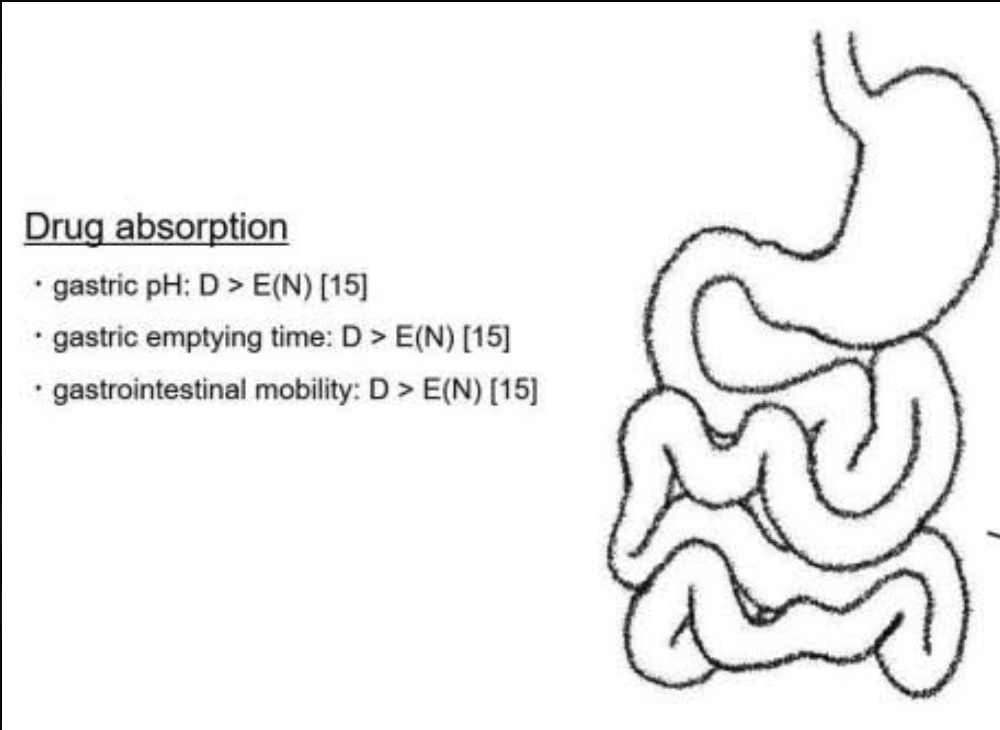
How do gastric pH, gastric emptying time, and GI motility during daytime (D) compare to evening/night (E(N))?
They are all greater during daytime than evening/night (D>E(N)).
Why are lipophilic drugs typically absorbed faster when administered during the daytime?
Daytime is accompanied by higher gastric motility, increased gut blood flow, faster gastric emptying, and enhanced lipid absorption.
What pharmacokinetic process in the central nervous system has been shown to be clock-controlled in Drosophila?
Blood-Brain Barrier (BBB) efflux transport.
How does the circadian clock regulate hepatic drug metabolism?
By controlling rhythmic expression levels and catalytic activity of liver cytochrome P450 (CYP) enzymes and metabolic conjugating agents like glutathione (GSH).
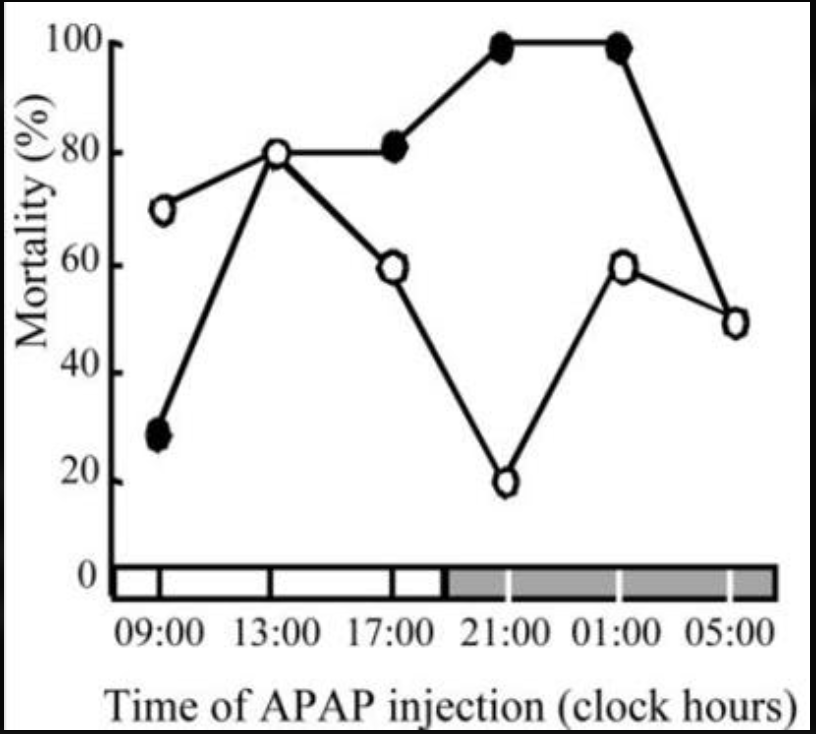
Why is acetaminophen (APAP) toxicity and mortality significantly higher during nighttime injections in wild-type mice?
Nighttime corresponds to the nadir (trough) of hepatic glutathione (GSH) levels, reducing the liver's capacity to detoxify toxic reactive APAP metabolites.
What happens to the diurnal rhythm of acetaminophen (APAP) toxicity in liver clock knockout mice?
The time-of-day rhythm in APAP toxicity is completely lost.
Which class of drugs is most heavily impacted by time-of-day administration differences?
Drugs with short elimination half-lives
Why are short-acting HMG-CoA reductase inhibitors (statins) prescribed to be taken in the evening?
Hepatic cholesterol synthesis and HMG-CoA reductase enzyme activity peak naturally during the night.
Why is asthma symptom exacerbation classically nocturnal?
Airway resistance increases at night due to circadian dips in plasma cortisol and epinephrine paired with increased parasympathetic tone and airway inflammation.
What is the primary anatomical pathway transmitting photic (light) information from the retina to the SCN?
The Retinohypothalamic Tract (RHT).
Which specialized retinal cells directly sense light to entrain the SCN clock?
Intrinsically photosensitive Retinal Ganglion Cells (ipRGCs), containing the photopigment melanopsin (not classical rods and cones).
What is the principal neurotransmitter released by RHT nerve terminals onto SCN neurons?
Glutamate
How do NMDA receptor pharmacological agonists and antagonists affect photic phase shifts in the SCN?
NMDA receptor agonists induce phase shifts mimicking light pulses, whereas NMDA receptor antagonists block light-induced phase shifts.
How does acute ethanol (alcohol) exposure alter light-induced circadian phase shifts?
It inhibits/blocks light-induced phase advances in a dose-dependent manner.
What is a non-photic phase shift mechanism?
A circadian phase shift triggered by behavioral arousal, physical activity, food timing, or neurochemical cues rather than direct light input.
What is the MASCO in circadian neurobiology?
The Methamphetamine-Sensitive Circadian Oscillator, a non-SCN oscillator driving daily behavioral rhythms in response to scheduled methamphetamine administration.
Which clock gene knockout selectively abolishes cocaine Conditioned Place Preference in mice?
Per1 knockout
How does caffeine consumption affect the human central circadian clock?
Caffeine induces a phase delay of approximately 40 minutes
What is a 'chronobiotic' drug?
A substance capable of resetting or shifting the phase of the biological clock (e.g., exogenous melatonin).
When evaluating whether a pill taken at 8 AM vs. 8 PM acts as the 'same drug', what two primary clock-driven variables must be considered?
Daily variation in drug absorption, metabolism, distribution, and excretion (PK).
Daily variation in receptor expression, target site abundance, and tissue sensitivity (PD).