Bio2 ch33- Invertebrates
 Call Kai
 Learn
 Practice Test
 Spaced Repetition
 Match
 Flashcards
 Knowt Play
1/37

There's no tags or description
Looks like no tags are added yet.
38 Terms

Based on the phylogenetic tree shown here, identify the taxon most closely related to Lophotrochozoa.
a) Xenacoelomorpha
b) Cnidaria
c) Deuterostomia
d) Ecdysozoa
D
A blastocoelom refers to a
a) functional body cavity lined with tissues derived only from mesoderm.
b) functional body cavity lined with tissues derived only from endoderm.
c) functional body cavity lined by tissues derived from mesoderm and endoderm.
d) body cavity that does not function properly.
C
Which of the following phyla diverged earliest during animal evolution?
Porifera
Cnidaria
Echinodermata
Ctenophora
Porifera
Which of the following feeding strategies is most likely to be used by aquatic organisms?
a) fluid feeding
b) deposit feeding
c) mass feeding
d) filter feeding
D
Which of the following is a characteristic of cnidarians?
Mesoderm
A separate mouth and anus
Radula
Gastrovascular cavity
Gastrovascular cavity
Which of the following statements describes why healthy corals appear brightly colored?
a) They build their skeletons from colorful minerals.
b) They host symbionts with colorful photosynthetic pigments.
c) They secrete colorful pigments to protect themselves from ultraviolet light.
d) They secrete colorful pigments to attract mates.
B
Which sponge cell is most structurally and functionally similar to the cnidocyte of a cnidarian?
amoebocyte
pore cell
choanocyte
epidermal cell
choanocyte
If you brush your fingers along the tentacles of a sea anemone, which of the following are you most likely to find upon microscopic examination of your fingers?
spines
spicules
nematocysts
teeth marks
nematocysts
Which of the following characteristics is exhibited by most hydrozoans?
a) polyp form only
b) bilateral symmetry
c) lack of symmetry
d) both polyps and medusa forms
D
Which one of these mollusc groups is classified as suspension feeders?
bivalves
gastropods
cephalopods
chitons
bivalves
Some species of rotifers consist solely of females. Their method of reproduction is described as __________.
sperm-stealing
fragmentation
parthenogenesis
binary fission
parthenogenesis
Members of the phylum Mollusca __________.
a) are soft-bodied and often covered by a shell
b) have tentacles surrounding a central mouth/anus
c) have closed circulatory systems
d) are filter feeders
A
Which of the following statements is true of annelids?
a) They perform gas exchange across their skin.
b) They have a nerve net.
c) They have a gastrovascular cavity.
d) They have hemocoel.
A
Against which of the following structures do the circular and longitudinal muscles of annelids work?
cuticle
hydrostatic skeleton
endoskeleton
shell
hydrostatic skeleton
While sampling marine plankton in a lab, a student encounters large numbers of fertilized eggs. The student rears some of the eggs in the laboratory for further study and finds that the blastopore becomes the mouth. The embryo develops into a trochophore larva and eventually has a small, additional coelom and a blastocoelom. To which group of organisms did these eggs likely belong?
nematodes
echinoderms
arthropods
molluscs
molluscs
Which structure do sea slugs use to feed on their prey?
a) an incurrent siphon
b) a mantle cavity
c) a radula
d) nematocysts
C
Which of the following characteristics of parasites explains how parasitism has become so widespread among living organisms?
a) Parasites, unlike predators, feed on almost all the tissues of their host.
b) Parasites do not generally kill their hosts; thus they can feed on the same host throughout the host's normal life span and do not have competition from decomposers.
c) Parasites generally kill their host and can feed for a very long time because they are much smaller than their host.
d) Parasites almost always predigest their hosts' tissues and, therefore, spend less energy and require fewer structural adaptations.
B
You are a research chemist who wishes to develop a chemical adhesive that will work under water. Which of the following organisms would give you the best clue about where to start?
sea wasps
trematodes
mussels
lobsters
mussels
Sexual reproduction leads to increased genetic variation, but male bdelloid rotifers have never been observed. Which of the following are correct statements with regard to evolution in bdelloid rotifers?
a) As we learn more about bdelloid rotifers, we find males in more and more species.
b) Bdelloid rotifers have lost the ability to reproduce sexually only recently.
c) Protists infect bdelloids and bring DNA from other rotifers with them.
d) Bdelloid rotifers gain genetic variation by absorbing DNA from the external environment.
D
Scientists have concluded that bdelloid rotifers have likely been asexual for 100 million years. What evidence supports this conclusion?
a) The observation that all 360 species of bdelloid rotifers reproduce only by parthenogenesis
b) The comparison of the DNA of bdelloids and that of sexually reproducing rotifer species
c) The identification of bdelloid rotifers from 35-million-year-old amber resembling only the female form, with no evidence of males
B
What structure is responsible for gas exchange in most spiders?
a) tracheal tubes
b) chelicerae
c) book lungs
d) Malpighian tubules
C
Which phylum is characterized by animals that have a segmented body?
Platyhelminthes
Mollusca
Arthropoda
Cnidaria
Arthropoda
What would be the most effective method of reducing the incidence of blood flukes in a human population?
a) avoid contact with rodent droppings
b) carefully wash all raw fruits and vegetables
c) reduce the population of the intermediate snail host
d) reduce the mosquito population
C
You find a multi-legged animal in your garden and want to determine if it is a centipede or a millipede. Which of the following characteristics would allow you to make this distinction?
a) poisonous claws
b) egg-laying
c) molting
d) presence of body segments
A
Which of the following senses would be most directly affected by removing or damaging an insect's antennae?
hearing
smelling
seeing
mating
smelling
Which of the following statements correctly describes one difference between nematodes and arthropods?
a) nematodes shed their cuticle when they grow but arthropods do not
b) nematodes have an open circulatory system and arthropods have a closed circulatory system
c) arthropods have an open circulatory system while nematodes do not have a circulatory system
d) arthropods shed their cuticle when they grow but nematodes do not
C
Which of the following adaptations led to an explosion in insect evolution?
a) tracheal system
b) exoskeleton
c) flight
d) terrestrial living
C
Which of the following structures in insects functions in gas exchange?
antennae
compound eyes
spiracles
chelicerae
spiracles
The increase in plant species diversity is correlated with which of the following events?
a) the evolution of flight in insects
b) invasion of marine habitats by insects
c) the evolution of complete metamorphosis in insects
d) a massive increase in species diversity of insects
D
Which of the following are thought to be most closely related to humans?
sea stars
ants
earthworms
snails
sea stars
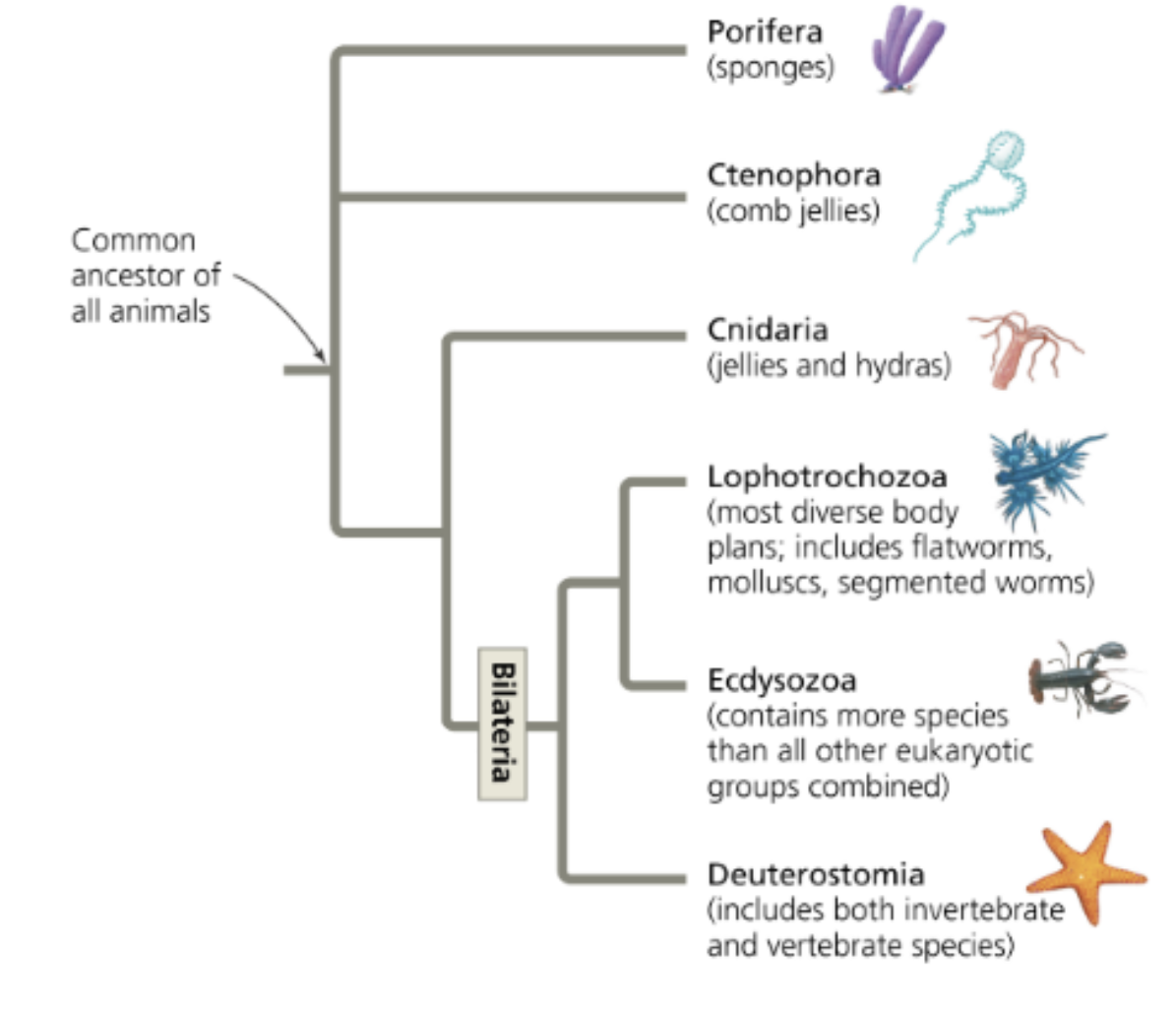
Based on the figure below, which of the following clades is most closely related to the
Cnidaria?
a) Bilateria
b) Porifera
c) Ctenophora
d) All of these clades are equally closely related to the Cnidaria.
A
Which of the following combinations correctly matches a phylum to its description?
a) Cnidaria——flatworms, gastrovascular cavity, does not have a coelom or a blastocoelom
b) Platyhelminthes——radial symmetry, polyp and medusa body forms
c) Echinodermata——bilateral symmetry as a larva, water vascular system
d) Nematoda——segmented worms, closed circulatory system
C
Which of the following animal groups is entirely aquatic?
Mollusca
Nematoda
Crustacea
Echinodermata
Echinodermata
What evidence suggests that vertebrates are more closely related to echinoderms than are any other invertebrate phyla?
a) Shared DNA sequences
b) Shared morphology
c) Shared patterns of development
A
Select the correct statement(s) about invertebrate taxa.
Select all that apply.
a) Tapeworms lack a mouth and gastrovascular cavity.
b) Ectoprocts lack a distinct head.
c) Rotifers are smaller than many protists.
All of the above
Select the correct statement(s) describing nematodes.
Select all that apply.
a) All nematodes live in soil.
b) Nematodes lack a circulatory system and circular body wall muscles.
c) Some nematodes play important roles in nutrient cycling.
B and C only
Some invertebrates combine morphological simplicity with features of great structural or biochemical complexity. Select all correct examples of this statement.
Select all that apply.
a) Trematodes are acoelomates that have effective defenses against attack by their hosts' immune system.
b) Cnidarians are diploblasts that produce complex, capsule-like organelles.
c) Sponges lack true tissues but have more variation in cell type than animals in any other phylum.
A and B only
Nematodes and arthropods are the largest ecdysozoan phyla.
Which of the following statements are true?
Select all that apply.
a) Both nematodes and arthropods have segmented body plans.
b) Arthropods possess an open circulatory system.
c) Nematodes possess a closed circulatory system.
d) Nematodes are acoelomate, whereas arthropods are coelomate.
e) Both nematodes and arthropods possess an external covering, or cuticle.
f) Both nematodes and arthropods must molt in order to increase in size.
g) Some nematodes are parasitic on humans.
h) Arthropods are named for their jointed appendages.
i) The cuticle in nematodes lengthens as the animal grows.
B, E, F, G, and H only