Structure exam 2
 Call Kai
 Learn
 Practice Test
 Spaced Repetition
 Match
 Flashcards
 Knowt Play
1/17

There's no tags or description
Looks like no tags are added yet.
18 Terms
Classify a fold that has an interlimb angle of 45º, has an axial plane that dips 75º, and a hinge line that plunges 20º.
Tight, steeply inclined, gently plunging fild
If a fault has a throw of 5 m, heave of 7 m, and strike-slip offset of 0 m, what is the total offset? What kind of fault is this?

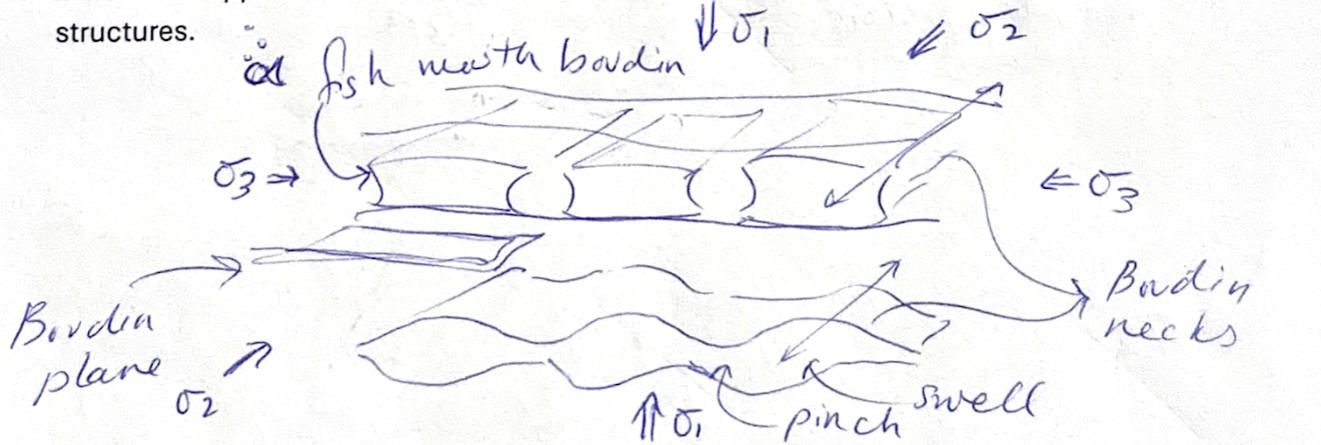
Draw labeled sketches of fish-mouth boudins and pinch-and-swell boudins. Include the approximate orientations of the stress axes needed to form these structures.
What is the lithostatic stress at a point 5 km deep, under 3 km of sandstone (2300 kg/m³) and 2 km of granite (2600 kg/m³)? Show your work for credit.

___________________________ is used to describe the total accumulated strain
A Finite strain ellipsid
___________________________ occurs when the stress, infinitesimal, and finite strain axes are all parallel during deformation.
Coaxial deformation
Elastic rheology _______________________, ________________________, and ___________________________
is non-permanent, has stretched linearly proportional to strain, and immediately responds to stress
___________________________ describes when a material become more difficult to deform as deformation progresses.
Strain-hardening
__________________________ is associated with _____________________ pressures and causes shear zones to form.
Von Mises failure, High
You map a normal fault in the field with an orientation of 060/65, with slickenlines with a pitch of 85 SW. Plot and label this fault and the slickenlines on a stereonet. (2 pts) What are the orientations of the principal stress axes needed to form this fault? Plot and label them on the stereonet. (6 pts)
σ₁:___________
σ₂:___________
σ₃:___________
σ₁: 83→ 291
σ₂: 04 → 062
σ₃: 06 → 152
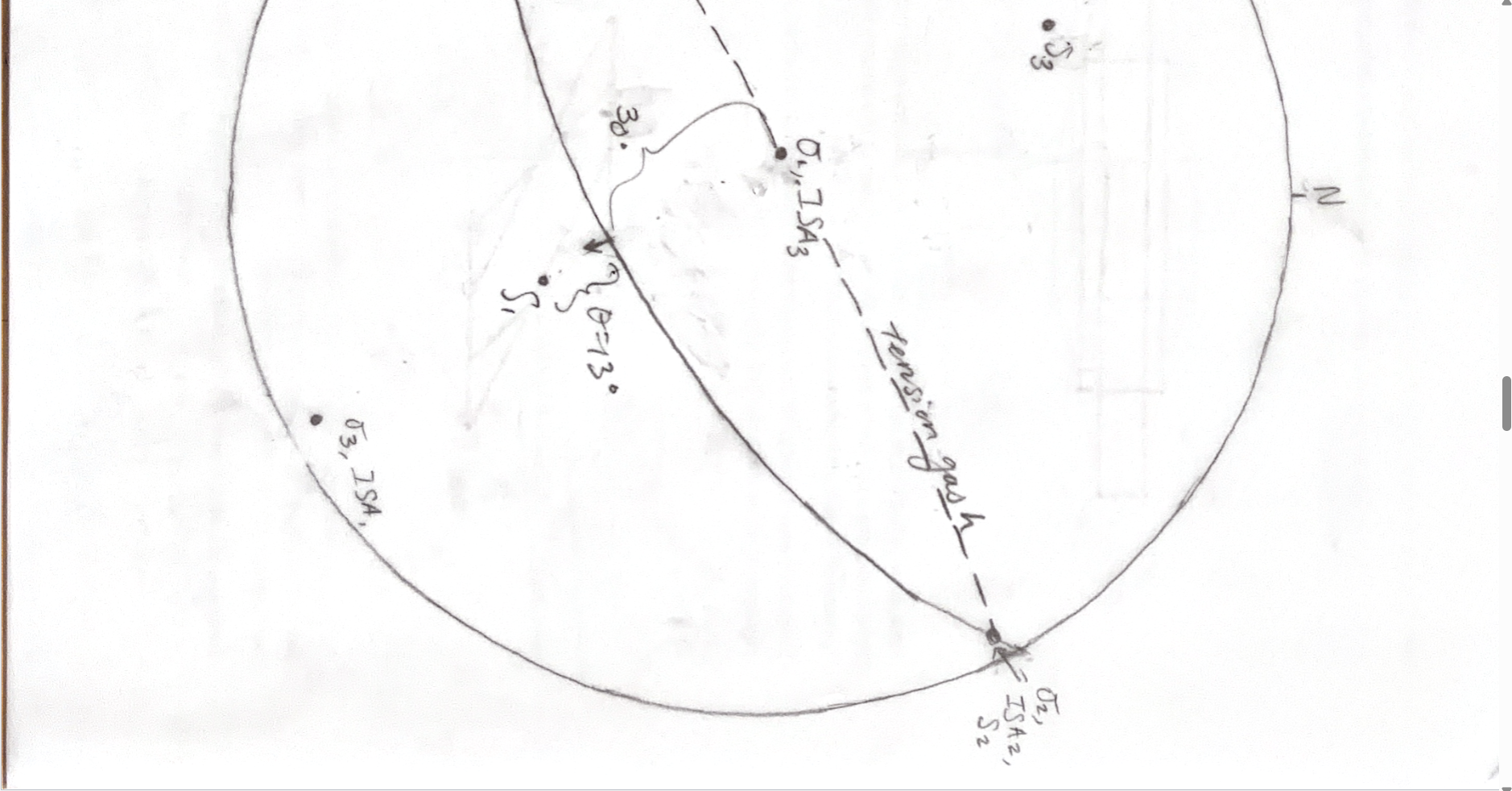
You map a normal fault in the field with an orientation of 060/65, with slickenlines with a pitch of 85 SW. What are the orientations of the infinitesimal strain axes associated with this fault? Plot and label them on the stereonet. (6 pts)
ISA₁: __________________
ISA₂: __________________
ISA₃: __________________
ISA₁: 06 → 152
ISA₂: 04 → 062
ISA₃: 83→ 291

You map a normal fault in the field with an orientation of 060/65, with slickenlines with a pitch of 85 SW. Assume ɣ = 2. What are the orientations of the finite strain axes associated with this fault? Plot and label them on the stereonet. (6 pts)
S₁: __________________
S₂: __________________
S₃: __________________
S₁: 53 →157
S₂: 04 → 062
S₃: 37 → 329

You map a normal fault in the field with an orientation of 060/65, with slickenlines with a pitch of 85 SW. What orientation would a tension gash form in for these stress orientations? Report the orientation below and plot it on your stereonet. Describe how you know. (5 pts) Tension gash:________________
Tension gash: 242/85 NW


The map shows two faults. Outline the faults in blue. From the map alone, how can you tell that these are faults?
They cross-cut other geological features, forming triple junctions and offsetting features
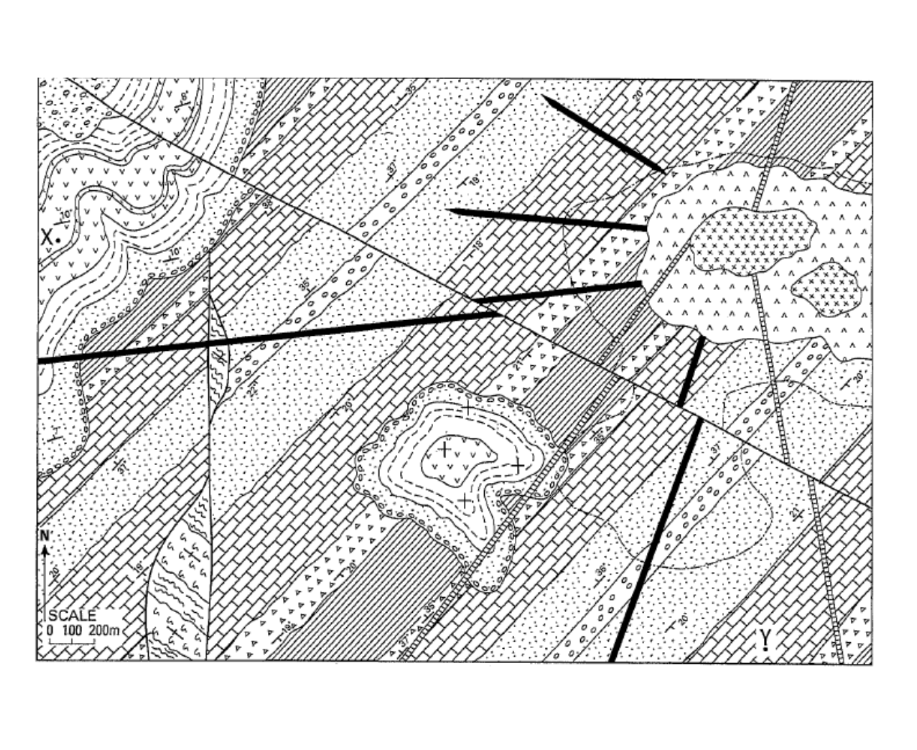
What are the dips of the basalt and quartz porphyry intrusions? How do you know?
90° → They are ignoring other features present and do not bend with changes in topography

What is the strike and dip of the NW-SE striking fault? What is the offset of the NW-SE striking fault? How do you know for both? What kind of fault is this?
~ 120/90, offset= ~100m → For dip =fault ignores topography, and can measure azimuth relative to north from the map. For offset = find an offset contact, and measure the offset distance.

What other structures are present on this map (hint, there are four other major structures)? How do you know? Either trace the structures or include the relevant map symbols
One Unconformity: dips of sequences of layers change, with boundary determinable by triple junction, with no offset
Three folds (1 syncline, 2 anticlines): repeating strata with opposing dips

Make a cross-section of the map from X-Y. Include azimuths, proper formatting of contacts and form lines, dip ticks, a title, and a horizontal scale bar.
