Geoscience Midterm 1
 Call Kai
 Learn
Learn Practice Test
 Spaced Repetition
 Match
Match Flashcards
 Knowt Play
1/40

Earn XP
Description and Tags
Midterm's learning objectives/Vocab/Slides Lecture 5-6
Name | Mastery | Learn | Test | Matching | Spaced | Call with Kai | Chat |
|---|
No analytics yet
Send a link to your students to track their progress
41 Terms
How long would it take a tectonic plate to circumnavigate the globe at a velocity of 4 cm/yr?
A. 1,000,000 years
B. 10,000,000 years
C. 100,000,000 years
D. 1,000,000,000 years
E. 10,000,000,000 years
D. The plates are moving ~2-20 cm/yr/
Which of the following does plate tectonics not
directly explain?
A. Volcanism
B. Seismicity
C. Landsliding
D. Seafloor topography
Landsliding.
Select all the false statements about the force of gravity.
A. It is stronger around more massive objects
B. It increases with the square of the distance between two objects
C. It is an attractive force, not a repulsive force
D. It decreases with an object's electric charge
E.It is responsible for the formation of stars out of gas and dust
B. It increases with the square of the distance between two objects
D. It decreases with an object's electric charge
A geologist sees a sandstone layer shaped into the form of a S and infers that this region must have undergone deformation after the sandstone layer formed. The geologist is using:
A. The principle of inclusion
B. The principle of cross-cutting relationships
C. The principle of faunal succession
D. The principle of superposition
E. The principle of original horizontality
E. The principle of original horizontality
How are most elements lighter than iron formed?
By nuclear fusion in stars
In supernovas
Under high pressure in planets
By radioactive decay
In protoplanetary disks
During the moon-forming collision
By nuclear fusion in the stars
The most primitive human remains are no more than about 5 million years old. From the perspective of the present day, how much of Earth's history had passed before humans first appeared?
A. 50%
B. 90%
C. 99%
D. 99.9%
E. 99.99%
D

Place the items in this figure into chronological order from oldest to youngest.
(oldest) Limestone
Sandstone
Gravel
Faulting
Erosion
Shale
(Youngest) Basalt
Select all the correct statements about elements in our solar system.
A. Lighter elements tend to be less abundant than heavier elements
B. Even-numbered elements tend to be slightly more abundant than odd-numbered elements
C. Hydrogen is the most abundant element
D. Iron is less abundant than the next lighter element and the next heavier element
E. Beryllium is the least abundant element lighter than iron
B,C,E
If Earth didn't have a moon, which of the following would occur? Select all correct answers.
A. Larger ocean tides
B. Larger range of tilt of Earth's axis of rotation
C. Larger variations in climate over geologic time
D. More volcanism
E. More earthquakes
B,C
Read the article on the End Permian extinction posted in the Canvas module. What does the article suggest initiated this extinction?
A. An asteroid impact
B. Lava spreading over continental and ocean crust
C. Cooking of coal inside the crust by volcanic intrusions
D. A global glaciation
E. The breakup of Pangea
C

What does this image show?
The four types of fossils that we commonly use as evidence for moving continents. Wegener cited both Glossopteris and Mesosaurus along with other creatures not shown here.
Why are there so many different kinds of rocks?
Rather than being permanent objects with fixed identities, rocks can be broken down, buried, melted, compressed, heated, and formed again. Over millions or billions of years, the same material can pass through several different geological environments. A rock can move from one category to another through the rock cycle.

What controls how different rock types form?
The rock cycle controls how different rock types form. This occurs through extreme heat, pressure. cooling, erosion, weathering, compaction & cementation

The rock forming minerals are the minerals commonly found in the
most common igneous, metamorphic and sedimentary rocks. Finish the chart.
Olvine, Pyroxene, amphibole, plagioclae feldspar, potassium feldspar, mica, quartz, calcite, Gypsum
What are the two key formation processes for igneous rocks?
Extrusive / volcanic: Magma cools after erupting at the earth’s
surface or seafloor
2. Intrusive / plutonic: Magma cools within the crust. The igneous rocks cool underground. Tend to have large crystals.

What are metamorphic fiaces?
A common combination of minerals associated with a given pressure/temperature history.

Composition and crystal size offers clues about the origin of igneous rock. Would a rock with: More felsic (lighter colored, more viscious magma, more evolved magma and large crystals, be granite or gabbro? What does intrusive mean?
Granite- more felsic, viscious magme, more evolved magma. Intrusive means the magma cooled within the surface, underground, and means granite will have larger crystals.
Magmas grow more “evolved” (more different from the mantle) by
fractional melting and fractional crystallization. This determines which rock
types form in eruptions and in the crust. Fill in the blanks.
1. Mantle of the earth is ultramafic, but …
2. Potassium feldspar (K-spar) and quartz are easier to melt: “1._____”
3. In a cooling intrusive magma body, mafic minerals are the first to crystallize and settle out: “2. ______”
4. Mafic minerals are also ___ at the land surface, tending to weather to clays
1.Fractional melting
Fractional crystalization
Less table
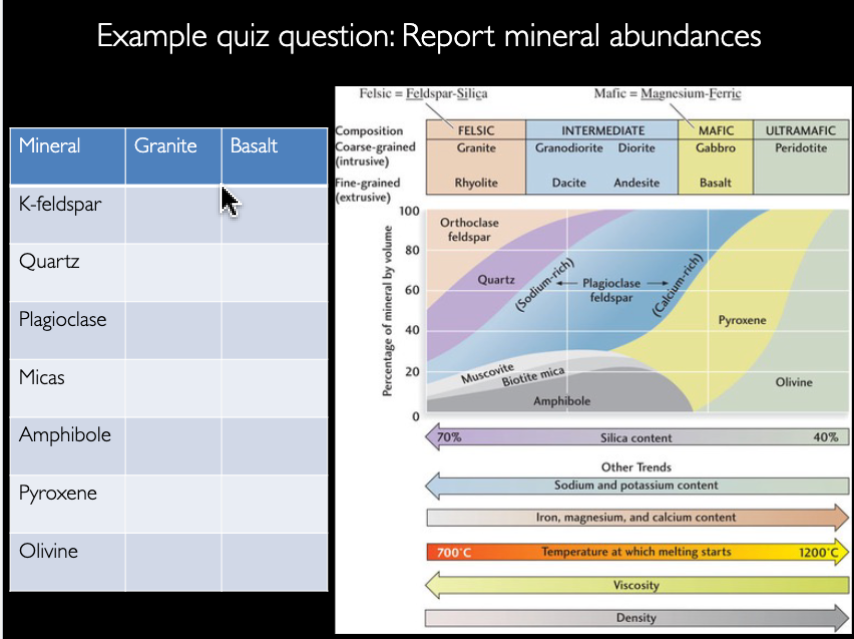
Report the mineral abundances

Sedimentary rocks form from particles or precipitates. Physical and chemical weathering work together to break down and transform rocks. This produces smaller rocks (sediments) and chemically altered water. What are the three main types of physical weathering?
Frost Wedging
Root Growth
Pressure Release
Sedimentary rocks form from particles or precipitates. Physical and chemical weathering work together to break down and transform rocks. This produces smaller rocks (sediments) and chemically altered water. What is the definition of physical weathering?
Disintegration of rock into smaller particles
Sedimentary rocks form from particles or precipitates. Physical and chemical weathering work together to break down and transform rocks. This produces smaller rocks (sediments) and chemically altered water. What are the three main types of chemical weathering?
Dissolution, oxidation (rusting), hydrolysis
Sedimentary rocks form from particles or precipitates. Physical and chemical weathering work together to break down and transform rocks. This produces smaller rocks (sediments) and chemically altered water. What is the definition of chemical weathering?
Transformation of mineral chemistry by the environment. Air and water and key players.
In sediment transport, what the fluid (usually water) couldn’t carry will be deposited and become rock. What type of energy creates sand?
A. High energy
B. Moderate Energy
D. Very low Energy
A- Wrong. Rounded, poorly sorted = high energy (gorge floods, fast rivers)
B. Correct. Sand = moderate energy (rivers, beaches)
C. Wrong. Slit/clay - very low energy
What is the definition of lithification?
Compact (pressure) and cementation (precipitates) turn sediment into sedimentary rock.
Characteristics of chemical sedimentary rocks
Consist of ONLY precipitates
Most common minerals are halite (NaCl), gypsum, and calcite
Speed of formation controls crystal size
Many sea-dwelling organisms use chemical tricks to precipitate their
(calcite) shells, so these are considered a chemical sedimentary rock
Characteristics of metamorphic rocks
Metamorphic rocks form due to large temperatures and pressures, but without
melting.Key features:
• Recrystallization / grain
rearrangement
• Foliation / wavy
appearance or banding
What observations support continental drift?
Correlation of geological features across distant continents
Deposits with glacial erosion found in Antarctica, Austrailia, South Africa, Southern India
Species that evolved to look the same but on different continents
What evidence was against Wegener’s observation of similar species on different continents?
drastically different current climates
Current differences in species across continents
Why didn’t the continental drift hypothesis catch on?
Wegener and others assumed that continents plowed through oceanic crust, but geophysicists correctly noted that this was physically impossible
British gravity surveys near the Himalayan mountain range showed smaller deflection of plumb line than expected: continents have deep roots (isostasy)
Skepticism also surrounded the idea of subsolidus convection as a driving force
Which of the following were criticisms of continental drift theory in the early 20th century?
A. Over mountain chains, the gravity field should have been perturbed more than it was
B. Disbelief that the mantle could convect
C. Continents would buckle if they plowed through the seafloor
D. B and C
E. A, B, and C
E
What observations support seafloor spreading?
Mapping the seafloor during WWII revealed long volcanic mountain chains (aka mid-ocean ridges)
Sonar: Measures depth to a reflector
Magnetometer: Measures magnetic field
Magnetic stripes:
Oscillating magnetic polarity in the seafloor could be produced by basalt erupting at the ridge and spreading away (Morley-Vine-Matthews, 1963)
Seafloor gets older with distance from mid-ocean ridges. Midocean ridges have has plenty of earthquakes
Why do mountain belts exist? And why are most (but not all) of them on the edges of continents?
Many mountain belts mark the boundaries of lithospheric plates, and these boundaries in turn intersect other such boundaries. Consequently, there exist very long mountain systems where a series of convergent plate boundaries continue from one to the next.
Why is the Earth’s surface mainly at two elevations?
This distinction arises from the varying densities of the oceanic and continental crusts, which influence tectonic plate interactions and result in thicker continental crust, leading to higher average elevations.
Why do earthquakes and volcanoes mostly occur in narrow bands?
They mainly occur in narrow bands along tectonic plate boundaries – the edges where the Earth’s plates meet and interact.
Why do some continental edges appear to fit together?
Is evidence that large continental assemblage, the Pangaea exsisted
Why do the oceans have so little sediment?
During the Triassic deep-ocean sediments were laid down and subsequently disappeared through the subduction of oceanic plates, so very little is known of the Triassic open ocean
Why is the Atlantic Ocean shallowest in the center?
The Atlantic Ocean is shallowest in the center because it is a massive underwater mountain range where tectonic activity pushes the seafloor upward, creating peaks that sit thousands of feet higher than the surrounding seabed and even break the surface as islands like the Azores.
Why are species so much different in Australia than elsewhere?
Australia's unique flora and fauna have been shaped by its geographical isolation, long periods of geographic isolation, tectonic stability, and unique climate change patterns.
Plate tectonics: putting it all together
• Earth’s outer shell – the lithosphere – consists of rigid plates.
• Plates slide on the underlying asthenosphere.
• As the plates move they carry continents and ocean floor
• Where continental and oceanic plates converge, the oceanic plate
subducts beneath the continent, and a trench forms.
• Where plates diverge, mantle melt rises into the gap, forming new
crust.
• Where plates slide past each other, strike-slip faults form.