Congestive Heart Failure
 Call Kai
 Learn
 Practice Test
 Spaced Repetition
 Match
 Flashcards
 Knowt Play
1/97

There's no tags or description
Looks like no tags are added yet.
Name | Mastery | Learn | Test | Matching | Spaced | Call with Kai | Chat |
|---|
No analytics yet
Send a link to your students to track their progress
98 Terms
What will happen to CO with HCM?
Decreases, heart walls get thick so the chambers get smaller
What is the equation for CO?
CO = SV x HR
What is the equation for MAP?
MAP = CO x SVR
What is the #1 heart priority?
Maintain normal system arterial pressure
What are the 3 heart priorities?
Maintain normal systemic arterial pressure
Maintain normal tissue blood flow
Maintain normal systemic and pulmonary capillary pressures
What valves open at the end of isovolumetric contraction?
Aortic and Pulmonic
How do hearts usually like to fail and present?
Backwards failure first
Respiratory signs and ascites
What happens later in the heart disease process?
Forward failure when very bad
Low cardiac output
Exercise intolerance, syncope, pre-renal azotemia, cyanosis
What happens to the heart when there is volume overload?
Larger chamber and thinner walls
What happens to the heart when there is pressure overload?
Heart has to fight against a higher pressure —> muscle thickens, smaller chambers
What is an example of a pump failure?
DCM, heart cannot beat
What are some general appearances of an animal with CHF?
Anxious/restless
Open mouth breathing
Orthopnea and elbows abducted
Dyspnea
Tachypnea
Hyperpnea
If you see an animal with dyspnea in CHF what would you be thinking?
Pulmonary edema present, cannot tap it, need to do thoracic xrays
If you see an animal with tachypnea —> short and shallow breaths, what are you thinking?
Restrictive breathing pattern —> THORACOCENTESIS!!
In what animals can you see jugular pulse changes?
Mainly large animals, good monitoring indicator of heart disease
Due to increased venous pressures —> Right sided heart failure
What is an important thing to know about your patient in relation to heart disease?
History!
Vaccination status, travel hx, diet, etc
What clinical signs of heart disease would the owners see?
Syncope, exercise intolerance, cough, dyspnea, abdominal distention, cyanosis
What clinical signs of heart disease would the veterinarians see?
Pulse abnormalities, murmurs, arrhythmias, jugular pulses
What diseases might cause an animal to cough?
Mainstem bronchi compression —> enlarged heart
CHF
Resp + parasitic diseases
Non cardiac diseases
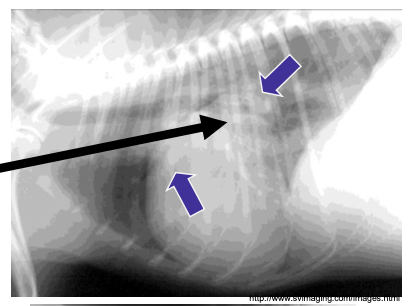
What is this?
Mainstem bronchi compression

What is this?
CHF —> alveoli have fluid in them
What are the clinical signs of syncope?
***Exertion or excitement
***Rear limb weakness
Hypoxia
Fainting
Sudden collapse
Lateral recumbency
Micturition
Vocalization
Stiffening of the forelimbs and opisthotonus
What clinical signs are generally not seen with syncope and align more with seizures?
Tonic/clonic motion
Facial fits
Defecation
Aura
Post-ictal dementia
Neurologic deficits
What are the important aspects of a physical exam for an animal with suspected CHF?
Pay close attention to MM and CRT
Abdominal palpation —> fluid wave
Jugular pulses
Palpate the chest —> precordium
Arterial pulse abnormalities
Palpate thyroid
Retinal exam —> hemorrhage and detachment (hypertension)
What is the equation for determining pulse pressure?
Psystolic - Pdiastolic
What are the different heart sounds categories?
Normal, abnormal, extra, murmers
What are the heart rate and rhythm categories?
Normal, tachycardias, bradycardias, gallops, arrhythmias
What are some abnormal lung sounds you can hear?
Crackles, wheezes, rales, decreased

What’s going on here?
Pulmonary edema, caused by canine or feline left sided backwards heart failure
Would hear crackles, dyspneic, NO thoracocentesis
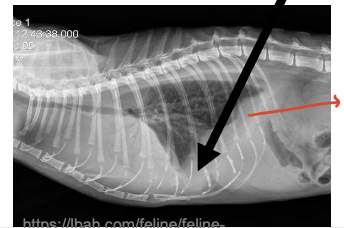
What’s going on here?
Pleural effusion (more common in cats)
Either left or right sided backwards heart failure
Tachypneic, thoracocentesis!!

What’s going on here?
Hepatic congestion/ascites
Right sided backwards heart failure (any species)
What reason could produce a holosystolic or pansystolic regurgitation or plateau murmer? Sound is flat
Mitral/tricuspid insufficiency
VSD
What reasons could produce a crescendo-decrescendo ejection murmer?
Aortic/pulmonic stenosis
What reasons could produce a diastolic decrescendo?
Rare and quiet
What reasons would cause a continuous (machinery) murmer?
PDA —> tiny puppies common
Murmur grade when it is very soft, intermittent
1
Murmur grade when it is a soft murmur, can hear consistently in a quiet room
2
Murmur grade when it is a moderate intensity mrumur
3
Murmur grade when it is a loud murmur
4
Murmur grade when it is a loud murmur with a precordial thrill
5
Murmur grade when it is a very loud murmur, can hear with stethoscope off of the body wall
6
What is an arrhythmia?
Structural or pathophysiologic remodeling
Conduction abnormalities
Automaticity errors
What are potential causes of arrhythmias?
Genetic factors
environmental stresses
ischemia
modulated by neuroendocrine factors
some expected in athletes —> horses
What are the basics of a cardiac workup?
Thoracic radiographs
Cardiac ultrasound/echo
Arterial BP
EKG
What is the first line cardiac workup in large animals?
Chemistry bloodwork —> lots of electrolyte changes
What does a doppler evaluate?
Systolic pressure
What organs are at risk with an elevated BP?
Brain, kidneys, heart, eyes, vessels
Evidence of target organ damage in the kidney?
Progression of CKD
Evaluate creatinine, proteinuria, GFR
Evidence of target organ damage in the eyes?
Retinopathy
Acute blindness, detachment, vessel tortuosity, perivascular edema, papilledema, hyphema, secondary glaucoma
Evidence of target organ damage in the brain?
Encephalopathy or stroke
Localize to CNS, neuro exam, MRI
Evidence of target organ damage in the heart and vessels?
Left ventricular hypertrophy or cardiac failure
Heart size, rhythm, murmurs, hemorrhage
Auscultation, radiography, US, EKG
What diagnostic will tell us if we have CHF?
Thoracic radiographs!!!!
What can we see on thoracic radiographs?
Cardiomegaly —> chamber enlargement
Vascular abnormalities
CHF
Lungs
Pleural space
What is the VHS?
Vertebral heart score
VHS for normal dogs 8.7-10.7
What is the VLAS?
Vertebral left atrial size
Ventral central carina to the caudal border of the LA
Should be <2.3 vertebral bodies
What is the VLAS used for?
MMVD in dogs
Why do we see LA enlargement in dogs with MMVD?
Insufficiency enlarges the atria due to increased fluid flowing back into the atria from the ventricle

What can we see here?
Cardiomegaly

What can we see here?
Pleural space
If you have a dog in respiratory distress with B-lines and LA enlargement what are you doing?
Treat for CHF
If you have a dog in respiratory distress with ascites and RA enlargement what are you doing?
Treat for CHF
If you have a dog with ascites and RV hypertrophy what are you thinking?
Pulmonary hypertension
If you have a cat in respiratory distress that has B-lines, LA enlargement, pleural/pericardial effusion what are you doing?
Treat for CHF
What do the B-lines represent?
Wet lungs
What will an EKG help us assess?
PQRST complexes
evaluation of wave forms and patterns
rhythm disturbances
Measurements may help with disease estimation
What are the 5 questions you must ask yourself when evaluating an EKG?
rate
rhythm
P in front of every QRS? QRS after every P?
Morphology
Measurements
What is the benefit of doing an echo?
Non-invasive imaging of the heart chambers, vessels, and valves
Measurements
Doppler —> evaluates flow and pressure and valves
What are some serum test cardiac markers?
NT-pro-BNP and Cardiac troponins
What does the NT-pro-BNP test assess?
Ventricular stretch
CATS better
may help you rule OUT cardiac disease in a dog
What does the cardiac troponins test assess?
High sensitivity tropnonin I
Myocardial damage
Monitor over time
What would you use cardiac catheterization and cardiac CT for?
Diagnostic: Complicated congenital abnormalities, evaluating pressures
Therapeutic: Pre-surgical/ballooning, pulmonic stenosis in bulldogs
Research: cardiac therapeutics
What are the basic concepts to remember about cardiac disease?
Bad hearts get big just in different ways
You can pace a heart to death, Increased rate = sooner death
Hearts like to fail BACKWARDS
What happens to the heart when there is increased PRESSURE?
Concentric hypertrophy
Fibers added in parallel
ex: HCM
What happens to the heart when there is increased volume?
Eccentric hypertrophy
Fibers added in series
Ex: DCM
What are the neurohormonal activation compensatory mechanisms?
Increased sympathetic tone
Decreased parasympathetic tone
Activation of RAAS and ADH/VP
What are the different anatomic diagnosis of cardiac disease that can all progress to CHF?
Pericardial, myocardial, valvular, endocardial, vascular, electrical
What are the physiological diagnosis for cardiac disease?
CHF, shock, hypotension, syncope, arrhythmia, shunting, valvular disease (regurgitation and stenosis), hypertension, myocardial failure (systolic or diastolic failure)
What is a systolic failure?
Hard time for the heart to squeeze —> need positive inotropic drug
What is a diastolic failure?
Hard time for the heart to relax —> need increased lucitropy —> B-blocker
What are the general therapeutics for CHF?
Controlling edema and effusions, opposing the effects of neuroendocrine activation
Improving cardiac output
Reduce cardiac workload
Supporting myocardial function
managing arrhythmias
Frequent reassessment****
What emergency therapy option is good for low stress?
Oxygen
What emergency therapy option would you use if a restrictive breathing pattern is observed?
Thoracocentesis
What drug would you use to decrease preload?
Diuretic drug —> Furosemide (2 mg/kg IV)
What drugs would you use if you need an anxiolytic/sedative?
Opioids ± ace
Diazepam
What drugs would you use if you needed volume redistribution?
Venodilators —> Nitroglycerin ointment, nitroprusside ICU
What drugs would you use to decrease afterload?
Vasodilators —> ARBs, ACE inhibitors (enalapril, benazapril), Amlodipine (antihypertensive), hydralazine
What drugs would you use to increase contractility if myocardial failure?
PIMOBENDAN!!!!
Dobutamine —monitor ECG
InAmrinone
What drugs would you use for HCM in cats?
Calcium channel blocker —> Diltiazem
B-blockers
What chronic therapies need to be implemented for a patient with CHF?
Regular mild to moderate activity —> no strenuous or burst exercise
Diet and weight management —> WSAVA approved diets
Diuretics —> Furosemide, Spironolactone
What must be done 3 days after putting a patient on furosemide?
Recheck!! Renal parameters must be checked
What is the purpose of adding spironolactone to therapy?
Potassium sparing drug, aldosterone antagonist
What positive inotropic drug is used for chronic therapy?
Pimobendan!! —> phosphodiesterase III inhibitor, ionodilator
Digoxin —> less commonly used, anti- and pro-arrhythmic
What would you use ACE inhibitors for?
Enalapril and benazapril
Mainly for neuroendocrine modulating effects
Arterial dilator
Caution in renal failure
What are examples of vasodilators?
Angiotensin receptor blockers
Hydralazine —> arterial effects
Amlodipine —> calcium channel blocker
Where does amlodipine work?
Periphery
Anti-hypertensive, hits receptors in the vasculature —> great for primary hypertension
Where does diltiazem work?
Centrally hits receptors in the AV node
Slows conduction at the AV node —> great for supraventricular tachycardia
When would you use B-blockers?
HCM/HOCM
Arrhythmias
Afib
ARVC/Boxers
What is a good calcium channel blocker?
Diltiazem —> great for cats, tells AV node to chill out