CHEM 1120 Exam 4
 Call Kai
 Learn
 Practice Test
 Spaced Repetition
 Match
 Flashcards
 Knowt Play
1/46

Earn XP
Description and Tags
Ch. 18, 19, 20
47 Terms
First law of thermodynamics
Energy is conserved in chemical processes
Second law of thermodynamics
Every spontaneous energy transaction requires the dispersal (or spreading out) of energy
Energy dispersal = entropy
Thermodynamics and Spontaneity
Thermodynamics preditcs whether a process will occur under the given conditions
Processes that will occur are called spontaneous
Nonspontaneous processes require energy input from outside
Spontaneity
Determined by comparing the chemical potential energy of the system before the reaction with the free energy of the system after the reaction
If the system after the reaction has less potential energy than the system before the reaction, the reaction is thermodynamically favorable
Spontaneity ≠ fast or slow
Reversibility of Processes
Any spontaneous process is irreversible because there is a net release of energy when it proceeds in that direction
It will only proceed in one direction
A reversible process will proceed back and forth between the two end conditions
Any reversible process is at equilibrium
This results in no change in free energy
If a process is spontaneous in one direction, it must be nonspontaneous in the opposite direction
Spontaneous processes and energy
Spontaneous processes occur because they release energy from the system
Most spontaneous processes go from higher to lower potential energy
Exothermic
But some spontaneous processes go from lower to higher potential energy
Endothermic
Factors affecting whether a reaction is spontaneous
Enthalpy change, △H, is the difference between the sum of the internal energy and PV work energy of the reactants, and that of the products
Entropy change, △S, is the difference between the randomness of the reactants relative to the products
Enthalpy change, △H
Generally measured in kJ/mol
A reaction is generally exothermic if the bonds in the products are stronger than the bonds in reactants
Exothermic = energy released, -△H
A reaction is generally endothermic if the bonds in the products if weaker than the bonds in the reactants
Endothermic = energy absorbed, +△H
The enthalpy change is favorable for exothermic reactions and unfavorable for endothermic reactions
Entropy, S
Entropy is a thermodynamic function that increases as the number of energetically equivalent ways of arranging the components increases
Units of J/mol
S = k ln(W)
k = Boltzmann constant = 1.38 × 10⁻²³ J/K
W is the number of energetically equivalent ways a system can exist, or microstates
Random systems require less energy than ordered systems
Entropy and the first & second laws of thermodynamics
△Euniv = 0 = △Esyst + △Esurr
the total energy of the universe cant change, but can be transferred
△Suniv = △Ssyst + △Ssurr
for reversible processes, △Suniv = 0
for irreversible processes, △Suniv > 0
If the entropy of the system decreases, the entropy of the surroundings must increase
For a spontaneous process, when △Ssyst is negative, △Ssurr must be large and postive
Macrostates and Probabiliy
The macrostate with the highest entropy also has the greatest dispersal of energy

Changes in Entropy, △S
Entropy change is favorable when the result is a more random system
△S is positive
Changes that increase entropy:
Reactions whose products are in a more random state
Solid < Liquid < Gas
Reactions that have more product molecules than reactant molecules
Increase in temperature
Solids dissociating into ions upon dissolving
Heat exchange and △Ssurr
When a system process is exothermic, it adds heat to the surroundings, increasing the entropy of the surroundings
When a system process is endothermic, it takes heat from the surroundings, decreasing the entropy of the surroundings
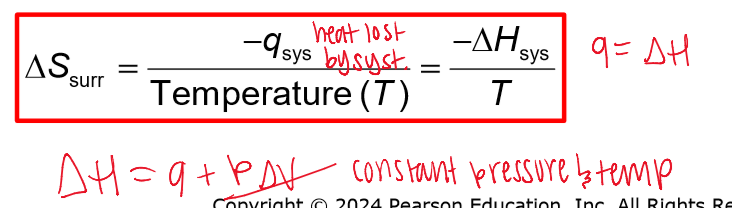
Quantifying entropy changes in the surroundings
qsurr = -qsys
The entropy change of the surroundings is proportional to the amount of heat (q) gained or lost
The entropy change in the surroundings is also inversley proportional to the temperature
At constant temperature and pressue , the relationship is as follows:
△Ssurr = △Hsys / T
Gibbs free energy and spontaneity
Gibbs free energy, G, is the maximum amount of work energy that can be released to the surroundings by a system for a constant temperature and pressure system
Often called chemical potential because it is analogous to the storing of energy in a mechanical system
△Gsys = △Hsys - T△Ssys
△Suniv is positve when spontaneous, so △G is negative
△G will be negative and spontaneous when:
△H is negative and △S is positive (exothermic and more random)
△H is negative and large and △S is negative but small
△H is positive but small and △S is postive and large
When △G = 0 the reaction is at equilibrium
△G will be positive and unspontaneous when:
△H is negative and small and △S is negative and large
or high temp
△H is positive and △S if positive and small
or low temp
△H is positive and △S is negative
When △G = 0 the reaction is at equilibrium
Standard States
The standard state is the state of a mterial at a defined set of conditions:
Gas: pure gas at 1 atm pressure
Solid or liquid: pure in most stable form at 1 atm pressure and temp of interest
Solution: concentration 1 M
The third law of thermodynamics
The absolute entropy of a substance is the amount of energy is has due to dispersion of energy through its particles
For a perfect crystal at absolute zero, the absolute entropy is 0 J/mol K
Therefore every substance that isnt a perfect crytsal has some energy from entropy, so its always positive
△S: Change in entropy and chemical reactions
When final condition is more random than intial condition, △Ssys is positive and entropy change is favorable for the process to be spontaneous
When final condition is more orderly than the inital condition, △Ssys is negative and entropy chnage is unfavorable for the process to be spontaneous

Relative standard entropies
States:
Gas > Liquid > Soild
Molar Mass:
The larger the molar mass, the larger the entropy
Allotropes (dif arrangement of same atom):
The less constrained the structure, the larger entropy
Molecular Complexity:
Larger, more complex molecules generally have larger entropy
Dissolution:
Dissolved solids generally have larger entropy
The standard entropy change △S°
The standard entropy change is the difference in absoulte entropy between the reactants and products under standard conditions
The standard enthalpy of formation △Hf° of a pure element is 0 kJ/mol, however, the absoulte entropy at 25 C is always positive

Calculating △G°
At 25 C or 298 K use the following equation
At temperatures other than 25 C, assuming the change in △H° and △S° is negligible, △G° = △H° - T△S°
Or △Gtotal° = △Grxn1° + △Grxn2° + …

Standard free energies of formation
The free energy of formation △Gf° is the change in free energy when 1 mole of a compound forms from its consitutent elements in their standard states
The free energy of formation of pure elements in their standard states is zero

△G° Relationships
If a reaction can be expressed as a series of reactions, the sum of the △G values of the individual reactions is the △G of the total reaction
△G is a state function
If a reaction is reversed, the sign of its △G value reverses
If the amount of materials is multiplied by a factor, the value of △G if mutipled by the same factor
The value of △G of a reaction is extensive (depends on amount)
What is free energy?
Free energy is the maximum amount of energy released from a system that is available to do work on the surroundings
For many exothermic reactions, some of the heat released as a result of the enthalpy change goes into increasing the entropy of the surroundings, so it isnt available to do work
Even some of this free energy is generally lost to heating up surroundings
Free energy of an exothermic reaction
△G° is less than △H° because some of the released heat energy is lost to increase the entropy of the surroundings
Free energy and reversible reactions and real reactions
The change in free energy is a theoretical limit upon the amount of work that can be done
If the reaction achieves its theoretical limit, it is a reversible reaction
In a real reaction, some (if not most) of the free energy is lost as heat
Therefore, real reactions are irreversible
△G under nonstandard conditions
△G = △G° only when the reactants and products are in their standard states
Their normal state at that temp
1 atm
1 M
Under nonstandard conditions: △G = △G° + RT ln(Q)
Q is reaction quotient
At equilibrium △G = 0
△G° = -RT ln(K)
△G° and K
Because △Grxn = 0 at equilibrium
△G° = -RT ln(K)
When K<1, △G° is positive and the reaction is spontaneous in the reverse direction under standard conditions (nothing will happen with no products)
When K>1, △G° is negative and the reaction is spontaneous in the forward direction under standard conditions
When K=1, △G° is 0 and the reaction is at equilibriu under standard conditions
Why is the equlibrium constant temperature dependent?
The eqution is in y = mx+b
The graph of ln K vs inverse T is a straight line with slope (-△H°/R) and y-intercept (△S°/R)

Oxidation-reduction (redox)
Reactions where electrons are transferred from one atom to another are called oxidation-reduction reactions
Atoms that lose electrons are oxidized, atoms that gain electrons are being reduced.
Oxidation occurs when:
the oxidation number of an element increases;
an element loses e-
a compound adds oxygen
a compound loses hydrogen
a half-reaction has e- as products
Reduction occurs when
the oxidation number of an element decreases;
an element gains e-
a compound loses oxygen
a compound gains hydrogen
a half-reaction has e- as reactants
Half-reactions
The redox reaction is split into two separate half-reactions
An oxidation reaction (e- as products)
A reduction reaction (e- as reactants)
Balancing redox reactions
Assign oxidiation states
Write oxidation and reduction half-reactions, including e-
Balance half-reactions by mass
First balance elements other than H and O
Add H2O where O is needed
Add H+ where H is needed
If the reactuon is carried out in a basic solution, neutralize H+ with OH-
Balance half reactions
Balance charge by adjusting electrons
Balance electrons between half reactions
Add half reactions together
Check by counting atoms and total charge on both sides
Electrochemistry
The study of redox reactions that produce or require an electric current
The conversion between chemical energy and electrical energy is carried out in an electrochemical cell
Spontaneous redox reactions take place in a voltaic cell (also known as a galvanic cell)
Nonspontaneous redox reactions can be made to occur in an electrolytic cell by the addition of electrical energy
Voltaic Cells: Spontaneous redox reacrions
Electrical current: the amount of electric charge that passes a point in a given period of time
A spontaneous redox reaction doesnt require external energy to proceed
△G is negative
Voltaic cells produce an electrical current, but to use it, we must separate the place where oxidation is occurring from where reduction is occurring
Anode is oxidized
Cathode is reduced
Electrochemical cells
Oxidation and reduction half-reactions are kept separate in half-cells of an electrochemical cell
Electrons flow through a wire along with ions (electrolyte) flowing through a solution via the salt bridge
The flow of e- requires as conductive solid electrode to allow the transfer of electrons either through an external circuit or metal/graphite electrode
An electrochemical cell requires the exchange of ions between the two half cells of the system via a salt bridge
Voltage and current
Voltage is the difference in potential energy between the reactants and products, also called the potential difference.
1 V = 1 J/C (C=Coulomb, charge of e-)
The amount of force pushing the e- through the wire is called the electromotive force, emf
Current is the number of electrons that flow through the system per second
Unit= ampere
1 A of current = 1 coulomb of charge flowing per second
Electrode surface area dictates the number of electrons that can flow
Larger batteries produce larger currents
Cell potential
The difference in potential energy between the anode and the cathode in a voltaic cell is called the cell potential.
The cell potential depends on the relative ease with which the oxidizing agent is reduced at the cathode and the reducing agent is oxidized at the anode
The cell potential under standard conditions is called the standard emf, E°cell
25 C, 1 atm for gases. 1 M conc for solutions
E°cell = E°ox + E°red
Electrons flow from the anode to the cathode
When two half cells are connected, the electrons will flow so that the half reaction with the stronger tendency will occur
Electrodes of an Electrochemical Cell
Anode:
Electrode where oxidation occurs
Anions attracted to it
Connected to a positive end of a bettery in a electrolytic cell
Loses weight in electrolytic cell
Cathode:
Electrode where reduction occurs
Cations attracted to it
Connected to negative end of battery in an electrolytic cell
Gains weight in an electrolytic cell
An inert electrode doesnt participate in the reaction, but just provides a surface for the transfer of e- to take place on
Cell Notation
Shorthand description is a voltaic cell is
electrode I electrolyte II electrolyte II electrode
oxidation is on the left, reduction is the right
Standard reduction potential
The standard half reaction for the reduction of H+ to H2 is assigned a potential difference of 0 V
The standard hydrogen electrode, SHE
Half cell potentials
SHE is 0 V
Half reactions with a stronger tendency toward reduction than the SHE have positive E°
Half reactions with a stronger tendency toward oxidation than the SHE have negative E°
Cell potential for any electrochemical cell is
E°cell = E°ox + E°red
Cell potential is positive for spontaneous reactions and negative for nonspontaneous reactions
Cell