M7 Clegg- Evolutionary Ecology II: Eco-evolutionary feedbacks
 Call Kai
 Learn
 Practice Test
 Spaced Repetition
 Match
 Flashcards
 Knowt Play
1/4

There's no tags or description
Looks like no tags are added yet.
5 Terms
what are eco-evolutionary dynamics?
eco-evolutionary dynamics- reciprocal interactions between the ecology of populations, communities and ecosystems, and the evolution of organismal traits on the same time scale (though term has been used very broadly)
eco-evo can arise at all scales (genes, individuals, populations, communities, ecosystems) → applies to many ecological ideas/processes
an eco-evo feedback is when an organism alters its environment (biotic/abiotic) → changes the selection landscape it experiences → corresponding genetic response → changes the effect of the organism on its environment (loop)
these feedbacks only occur when both eco → evo change and evo → eco change occur
the prevalence of eco-evo feedbacks in nature is assumed, but more empirical examples are required but difficult to find
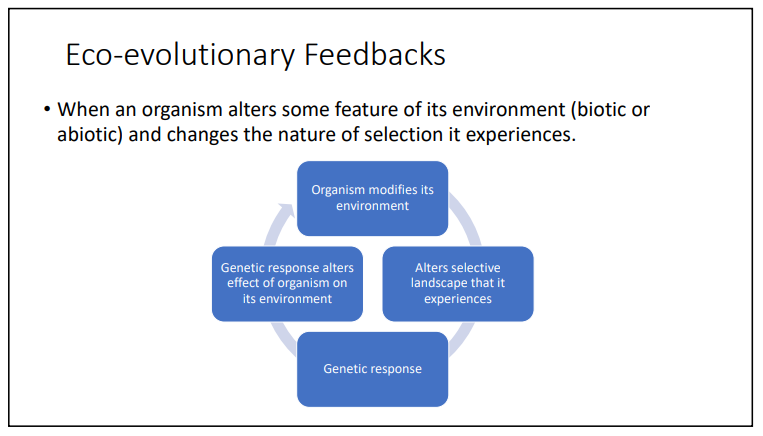
what is necessary for a species to have eco-evo feedbacks?
strong effect of phenotype on the environment:
niche construction + ecosystem engineers- eg. beaver dams, earthworms changing soil composition
keystone species
these species can change their environment through habitat modification, changing nutrient cycling, and consumption of resources
however, how much of an impact a species has is dependent on stability + size of the population and its effect size, as well as the ecological context- eg. high vs low diversity, different abiotic environments
strong effect of environment on phenotypes:
different ecological variables generate large selection coefficients for certain phenotypes
however, this relies on sufficient genetic variation and trait hertiability to respond (eg. no evolution in single clonal algal populations), as well as congruent timescales of this change (eg. no eco-evo feedbacks in anadromous alewives)
the prevalence of eco-evo feedbacks in nature is assumed, but more empirical examples are required but difficult to find
how do alewives demonstrate eco-evolutionary feedbacks?
do trinidadian guppies demonstrate eco-evolutionary feedbacks?
what data is required to empirically demonstrate eco-evolutionary feedback?
