Neuronal Signal Transmission and Nervous System Structure - Chapter 6 Part 1-2
 Call Kai
 Learn
Learn Practice Test
 Spaced Repetition
 Match
Match Flashcards
 Knowt Play
1/50

There's no tags or description
Looks like no tags are added yet.
Name | Mastery | Learn | Test | Matching | Spaced | Call with Kai | Chat |
|---|
No analytics yet
Send a link to your students to track their progress
51 Terms
What is the primary role of synapses in the nervous system?
Synapses facilitate communication between neurons by transmitting signals.

What are the two types of potentials discussed in neuronal signaling?
Graded potentials and action potentials.
Define depolarization in the context of membrane potential.
Depolarization refers to the membrane potential moving from the resting membrane potential (RMP) to less negative values.

What does repolarization refer to?
Repolarization refers to the membrane potential returning to the resting membrane potential (RMP).

What is hyperpolarization?
Hyperpolarization refers to the membrane potential moving away from the resting membrane potential in a more negative direction.
What are graded potentials?
Graded potentials are changes in membrane potential confined to a small region of the plasma membrane, with varying magnitudes.
What distinguishes action potentials from graded potentials?
Action potentials are large, rapid alterations in membrane potential that can change by as much as 100 millivolts.

What is excitability in neurons?
Excitability is the ability of neurons and muscle cells to generate action potentials.
What is the all-or-none rule in action potentials?
Action potentials either occur fully or not at all; there is no partial action potential.

How do local anesthetics affect action potentials?
Local anesthetics block voltage-gated Na+ channels, preventing action potentials from being generated.
What is tetrodotoxin and how does it affect nerve conduction?
Tetrodotoxin is a potent toxin that binds to voltage-gated Na+ channels, preventing the Na+ component of the action potential.
What are the two types of refractory periods?
Absolute refractory period and relative refractory period.

What occurs during the absolute refractory period?
During the absolute refractory period, no second action potential can be generated regardless of stimulus strength.
What is the relative refractory period?
The relative refractory period is when a second action potential can be generated only if the stimulus strength is significantly greater than usual.
How do refractory periods affect action potential frequency?
Refractory periods limit the number of action potentials that can be produced in a given time, typically allowing up to 100 per second.

What is the significance of refractory periods in action potential propagation?
Refractory periods help separate action potentials and determine the direction of propagation along the axon.
What is the role of glial cells in the nervous system?
Glial cells support, protect, and maintain the health of neurons.
What are the main functional classes of neurons?
Sensory neurons, motor neurons, and interneurons.
What is the resting membrane potential?
The resting membrane potential is the electrical potential difference across the plasma membrane of a resting neuron.
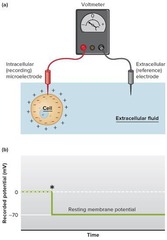
What factors contribute to the resting membrane potential?
Ion concentration gradients, particularly of Na+ and K+, and the permeability of the membrane to these ions.

What is synaptic integration?
Synaptic integration is the process by which multiple synaptic potentials combine within a postsynaptic neuron.
What are neurotransmitters?
Neurotransmitters are chemical messengers that transmit signals across synapses from one neuron to another.
What is the function of the autonomic nervous system?
The autonomic nervous system regulates involuntary bodily functions, including heart rate and digestion.
What is the central nervous system composed of?
The central nervous system is composed of the brain and spinal cord.
What is the role of the peripheral nervous system?
The peripheral nervous system connects the central nervous system to the limbs and organs.
What are the two major anatomical divisions of the nervous system?
The central nervous system (CNS) and the peripheral nervous system (PNS).
What is the functional unit of the nervous system?
The individual cell, or neuron.
What is axonal transport?
The movement of substances and organelles between the soma and the axon terminals.

What type of transport do kinesins facilitate?
Anterograde transport, moving materials from the cell body toward axon terminals.
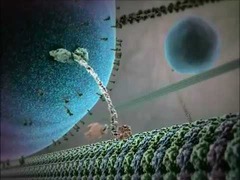
What type of transport do dyneins facilitate?
Retrograde transport, moving materials from axon terminals toward the cell body.
What is the role of Schwann cells in the PNS?
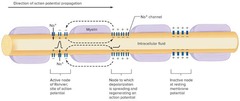
They form individual myelin sheaths surrounding segments of axons, speeding up conduction of electrical signals.

What are the Nodes of Ranvier?
Gaps between regions of the myelin sheath that permit the exchange of ions across the cell membrane.
What are the three classes of neurons based on function?
Afferent neurons, efferent neurons, and interneurons.

What do afferent neurons do?
Transmit information into the CNS from receptors at their peripheral endings.
What do efferent neurons do?
Transmit information out of the CNS to effector cells, such as muscles and glands.
What is the primary function of interneurons?
To integrate groups of afferent and efferent neurons into reflex circuits.
What are the characteristics of multipolar neurons?
They have many processes and account for 99% of neurons, primarily in the CNS.

What are bipolar neurons associated with?
Special senses, such as vision and hearing.
What do unipolar neurons carry?
General senses, with cell bodies located in ganglia.
What is the function of astrocytes in the CNS?
They help regulate the composition of extracellular fluid and sustain neurons metabolically.

What role do microglia play in the CNS?
They perform immune functions and may contribute to synapse remodeling and plasticity.
What do ependymal cells do?
They line the fluid-filled cavities within the brain and spinal cord and regulate cerebrospinal fluid.
What is neural plasticity?
The brain's ability to modify its structure and function in response to stimulation or injury.
What occurs during axon regeneration in the PNS?
If axons are severed, they can repair themselves and restore significant function if the damage occurs outside the CNS.
What is a primary problem following spinal injuries?
Apoptosis of nearby oligodendrocytes, resulting in loss of the myelin sheath.
What are researchers attempting to do to repair nervous system damage?
They are creating supportive environments for axonal regeneration and supplying neurotrophic factors.
What factors can cause permanent damage to the developing fetal nervous system?
Alcohol, drugs, radiation, malnutrition, and viruses.
What is the role of cell adhesion molecules (CAMs) in neural development?
They influence the route that axons follow during development.
What happens to the axon segment separated from the cell body after injury?
It degenerates, while the segment still attached to the cell body gives rise to a growth cone for regeneration.
What is the significance of myelin sheaths?
They act as electrical insulators, preventing ions from crossing the cell membrane and conserving energy.
What is the primary function of oligodendrocytes?
To form the myelin sheath of CNS axons.