Singly Bonded Functional Groups
 Call Kai
 Learn
 Practice Test
 Spaced Repetition
 Match
 Flashcards
 Knowt Play
1/33

There's no tags or description
Looks like no tags are added yet.
34 Terms
Alkene to halogenoalkane
HCl / HBr / HI
Alcohol to halogenoalkane
SOCl2 or PBr3
What are the uncharged nucleophiles?
Ammonia
Water
Dimethylsulfide
Trimethylphosphine
What are the uncharged electrophiles
Carbonyl (C=O)
Aluminium trichloride
Boron trifluoride
Nitrile to amine
LiAlH4 (reduction)
Retrosynthetic analysis
Reverse of synthesis and is used for planning a synthesis
Halogenoalkane to primary alkyl amines
React with N=N=N then LiAlH4
SN1 reactions
2 steps
Tertiary (and secondary) halide
Intermediate
First step is RDS
Rate = k[X]
SN2 reactions
1 step process
Primary (and secondary) halide
Transition state
Rate = k[RX][Nu]
Why can’t tertiary halides use SN2
Steric Hinderance
What are the stereochemical implications for an SN1 reaction?
Racemic mixture is formed as it is planar about the carbocation, so the nucleophile has an equal chance of attacking above or below
What are the stereochemical implication for an SN2 reaction?
Back side attack always leads to an inversion of the chrial centre. SN2 is stereospecific
Stereospecific
A reaction that has a well defined, 100% predictable stereochemistry outcome.
Protic
Able to form hydrogen bonds
Aprotic
Unable to form hydrogen bonds
Is SN1 favoured by polar or non-polar solvents?
Polar
Is SN2 favoured by protic or aprotic solvents?
Aprotic as they do not solvate the Nu. The bare unsolvated anions have a higher ground state energy so reaction is faster.
Regioselectivity
Where one reaction site is preferred over another
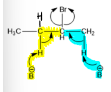
Which is formed in higher amounts?
Yellow as it is more highly substituted at the double bond as it is more stable
E1
2 step process
Intermediate
In competition with SN1
First step is RDS
When is SN1 favoured over E1
If Nu is a poor base
When is E1 favoured over SN1
If Nu is a strong base
E2
B- and RX involved in RDS
Rate = k[B-][RX]
Why is E2 stereospecific
The H lost and the X are anti-periplanar
Anti-periplanar
The H and X are on opposite sides but all atoms are on the same plane
When do primary halides undergo SN2/E2?
SN2 with a good Nu-. E2 with a strong, sterically hindered base
When do tertiary halides undergo any?
E2 in presence of a base, Mix of E1 and SN1 under neutral conditions
When do secondary halides undergo any?
Products from all 4 mechanisms can be found, but E2 predominates with a strong base, SN2 with a good Nu
Alkenes to Alcohol
H3O+ (dilute acid)
Carboxylic acid / aldehyde / ketone to alcohol
LiAlH4 or NaBH4 (to make secondary alcohols)
Ether characteristics
generally unreactive so often used as solvents
no reaction with dilutre acids, bases or nucleophiles
can be cleaeved by strong acid
highly volatile and flammable
Acyl chlorides + Primary/Secondary amine
Amide
Aldehydes + amine
Amide