sep 29 history w/watson Unit 1 Part 1 everything!!
 Call Kai
 Learn
Learn Practice Test
 Spaced Repetition
 Match
Match Flashcards
 Knowt Play
1/63

There's no tags or description
Looks like no tags are added yet.
Name | Mastery | Learn | Test | Matching | Spaced | Call with Kai | Chat |
|---|
No analytics yet
Send a link to your students to track their progress
64 Terms
Cultural Diffusions
the spread of cultural beliefs, ideas, values, technologies, and practices from one group of people to another
Nirvana
This is one of the Buddhist basic beliefs of Buddhism
Achieve Wisdom to Achieve Nirvana
Nirvana is a state of peace of mind
Confucius
This is apart of Confucianism
Was a teacher who attempted to restore social order in China
During his 40-year career he edited and wrote many of the ancient Chinese writings
Educated all, not just the aristocrats
confucianism
More philosophy than religion
Everyone should be educated
Guidelines for ethical behavior
People should be inspired by princely ideas or to be unselfish
Christianity
The prophet Jesus fulfilled God's promise of God to the Jews
The crucifixion of Jesus
The apostles spread ( people who send it out)
Beliefs
Jesus was the son of God
Humility, charity and love
Jesus was crucified and rose from dead
Jesus was the messiah (Christos)
People are “saved” when they belief in Christ
India’s Caste System
rigid social classes
you are born into what class you are.
Sunni
is like a type of muslim
they believed that leadership should be elected from those most capable of the job
The word Arabic comes from a word meaning “one who follows the traditions of the Prophet”
majority 85% of Muslims all over the world
Shia / Shitte Muslims
believed that leadership should be passed directly to the relatives of the Prophet
Sunni vs Shia
Origins:
Division dates back to the death of the Prophet Muhammad
The original division was over the question of leadership following Muhammad’s death
Hinduism
Areas practiced – India & worldwide
Worlds Oldest religion
Rebirth is determined by Dharma and karma. The wheel of rebirth is called samsara.
Dharma, the “right way of living,”
Karma, the idea that all your actions come back, determines rebirth
Symbol
Aum Symbol
Three chief gods
Brahma – creator
Vishnu – the preserver
Shiva - destroyer
Ganges River
is revered in Hinduism as the holiest of all rivers

Aum Symbol
The Mandukya Upanishad is entirely devoted to the explanation of the syllable.
Syllable represents the three stages of life – birth, life and death
Syllable used in meditation
Complex meaning and usage
What are Vedas in hinduism
Collection of hymns and ceremonies.
Hinduism + Reincarnation
this is one of their basic beliefs
the continuous cycle of birth, death, and rebirth driven by the soul's actions and accumulated karma
In Hinduism the goal is to reach ___.
The goal is to reach the status of Brahman.
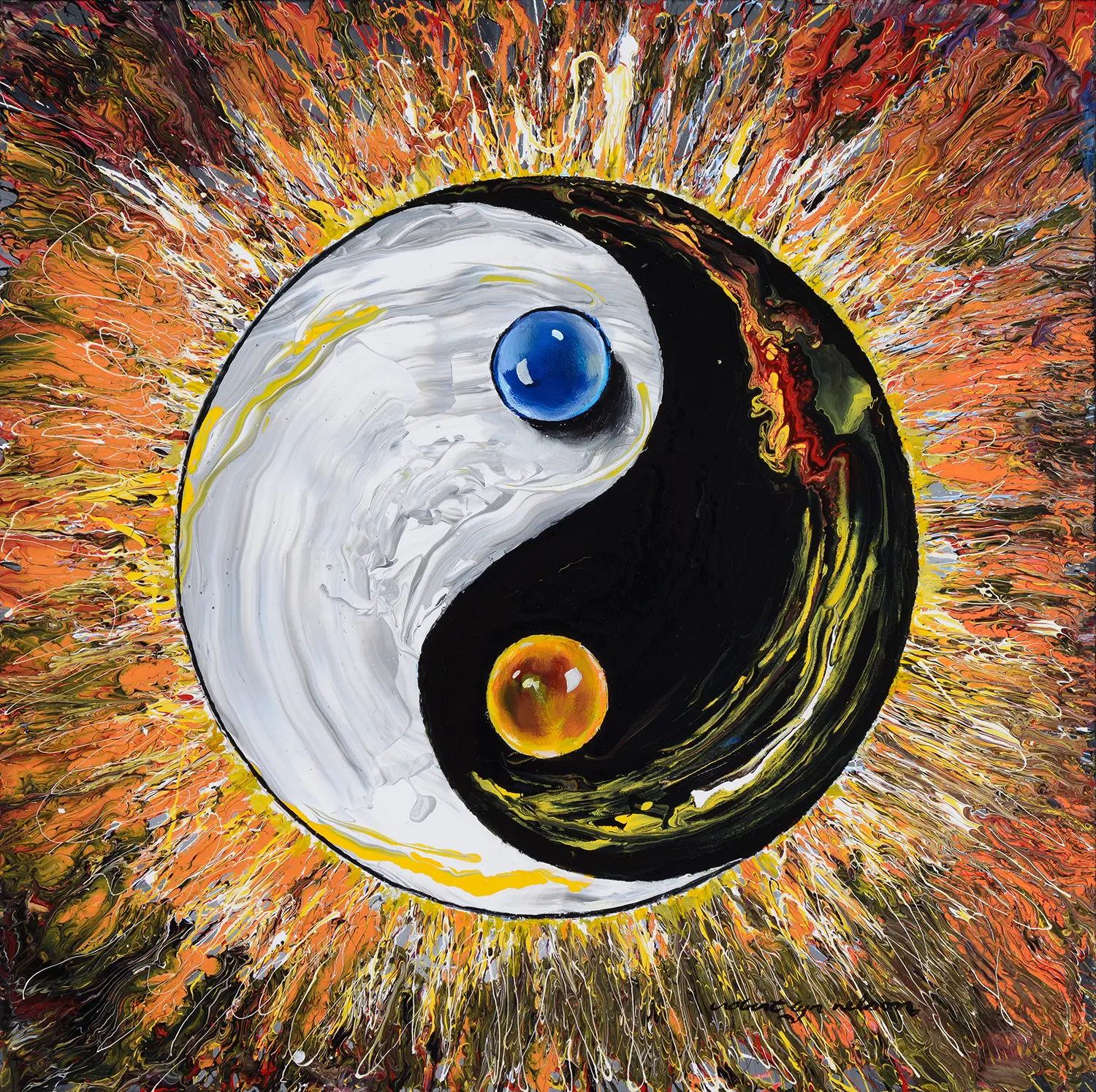
Daoism Taoism
Starting Point
3rd century China
Lao-tzu or Old Master
Beliefs
Tao means the way
Ultimate law of the universe
Source of all things & nature
Suffering, pain, bloodshed & chaos is a result of unnaturalism
Taught harmony with nature
Do as little as possible to cause change
Taoism Writings
Tao Te Ching (English – Classic Way of Power)
Attributed to Lao Tzu – 81 sections
Handbook for ideal ruler
Chuang-tzu
Conversations between Lao and Confucius
Includes fables, parables & anecdotes to teach lessons about life and the Tao
Taoism areas
Started in China – spread to Asia
Over centuries Confucianism, Taoism & Buddhism intermixed in Area

Islam
Starting Point
Muhammad – considered a prophet equal to Moses or Jesus
Islam – means peace through submission
2nd largest religion

Islam Belief + what are the Five Pillars of Islam
Believe Muhammad received revelation from God by the Angel Gabriel
Only one God – Allah
Pray five times daily
Charity to others
Fasting – Ramadan
Pilgrimage to Mecca

Islam symbol
Symbols
Moon and Star (adopted from flag of Ottoman empire during its rule of the predominantly Muslim areas)
Mecca
Muslims and the Quran they believe that
Their religious book is the Quran, and they believe that this is the only book free of human corruption and is the finest work of literature in Arabic

Buddhism
Siddhartha Gautama, or Enlightened one (Buddha)
Basic beliefs
Buddha – man who awaken to see new way
Let go of worldly cares
Achieve wisdom to achieve Nirvana
Reincarnation – but not set caste
Buddhism and their sacred writings ( Four Noble Truths )
Ordinary life is full of suffering
Suffering is caused by our desire to satisfy ourselves
The way to end suffering is to end desire for selfish goals and to see others as extensions of ourselves
The way to end desire is to follow the Middle Path
Buddhism and the 8 steps to enlightenment ( Eightfold Path)
Follow the Middle Path
Right View – we need to know the four Noble Truths
Right intention – We need to decide what we really want
Right Speech – we must seek to speak truth and to speak well of others
Right Action – “Do not kill. Do not steal. Do not lie. Do not be unchaste. Do not take drugs or drink alcohol.”
Right livelihood – We must do work that uplifts our beings
Right Effort – “Forward looking gaze will not relax until he comes out of the mud.”
Right mindfulness – We must keep our minds in control of our senses
Right concentration – we must meditate to see the world in a new way
Buddhism wheel of dharma
is the circular part and the spinning part is for the circle of life.
Judaism Starting point + Basic Beliefs
Starting point
Started by Israelites
Prophets
Basic Beliefs
Chosen people of a single god
God created all things
God made a covenant with the people
Written laws for all people
Monotheistic
What are Judaism writings + area practiced
Ten Commandments
Torah
Areas Practiced
14 million throughout the world
Highest number in Israel & US

Judaism Symbol
Temple in Jerusalem
Six pointed star – Star of David
Synagogue is a place of worship
filial piety (Confucius)
the core Confucian virtue of showing respect, devotion, care, and appropriate deference to one's parents, elders, and ancestors. Confucius taught that it is the root of all moral behavior and the foundation of a peaceful society
Confucius Writings
Analects or Conversations
Analects – collection of sayings and proverbs
Set guidelines for Civil Service Exam
Chinese Civil Service Exam
came from confucianism
The Chinese Civil Service Exam was a standardized, merit-based testing system used in Imperial China to select government officials and bureaucrats based on their knowledge of Confucian classics, rather than their wealth or family lineage
Mandate of Heaven (gain/loss/means)
The Mandate of Heaven is an ancient Chinese belief that the gods give a ruler the power to be king—but only if they are a good, fair person.
🟢 Gaining the Power
If you are a good leader who helps the people, the gods approve of you. You get to be the king.
🟡 Keeping the Power
You have to keep being a good leader and rule fairly. If you do, the kingdom stays peaceful.
🔴 Losing the Power
If you become greedy, cruel, or a bad leader, the gods get angry and take your power away. The gods show their anger by sending natural disasters like earthquakes, floods, or famines. When that happens, the people have the right to fight back, kick you out, and pick a new leader.

Arab Dhows
are traditional wooden sailing vessels with triangular lateen sails that have been used for trade and fishing across the Red Sea and the Indian Ocean for centuries.
Arab Dhows usages
Trade:
Merchants used them to carry heavy goods like fruit, fresh water, dates, spices, and timber.
Fishing and Pearling: Smaller dhow types were essential for catching fish and diving for pearls.
Travel: They connected coastal communities in Arabia, India, Persia, and East Africa.
Monsoons winds
predictable seasonal winds over the Indian Ocean that reverse direction twice a year, serving as the primary environmental engine for maritime exchange
They were predictable
Lower risks
Cheaper trade
More trade could happen
Indian Ocean Trade
the world's largest sea-based exchange system from c. 1200 to 1450, connecting East Africa, the Middle East, South Asia, Southeast Asia, and East Asia.
DID NOT include EUROPe
3rd largest ocean in the world.
Covers about 20% of the world’s ocean surface.
Located between Africa, Asia, Australia, and Antarctica.
Has an M-like shape.
the the port of Guangzhou (Canton).
This port was where foreign merchants were not allowed to be mixing with the Chinese. Nevertheless, this area has become a popular place where Muslims, Christians, Zorostrias, Jews, and Buddhists along with many others had lived and where they had areas of worship. |
Explain the “major changes” in the western end of the Indian Ocean region.
After 632 CE, Islamic empires like the Umayyads and Abbasids expanded from Spain to China.
Islam and Arabic spread across the Indian Ocean region and into West Africa, helped by Sufi missionaries/brotherhoods and trade.
Muslim merchants and pilgrims connected different regions, especially through the yearly pilgrimage to Makkah.
The Indian Ocean trade grew wealthy, creating high demand for goods.
Crops and products spread from East to West, including sugar, rice, wheat, fruits, and vegetables.
The main trade routes connected through the Persian Gulf and Red Sea.
Explain the “major changes” in the eastern end of the Indian Ocean region.
Tang & Song dynasties → China’s trade and economy grew
Maritime trade → Increased across the Indian Ocean
Trade bureaus + Imperial Navy → Protected trade from pirates
China imported → Spices and cotton
China exported → Tea and porcelain (“china”)
Buddhism → Spread in China
Ming Dynasty → Zheng He led voyages across the Indian Ocean
Main change → China became more connected to Indian Ocean trade
Silk Road (why this name)
named after the highly profitable and prized trade in Chinese silk that drew ancient civilizations together across Eurasia
astrolabe
a portable, handheld scientific instrument used by sailors and astronomers to measure the altitude of the sun or stars above the horizon to calculate latitude.
Ancient Greece
compass
a navigational instrument featuring a magnetized needle that aligns with Earth's magnetic field to indicate direction (pointing toward magnetic north),
Invented in China (with roots in the Han dynasty, but adapted for marine navigation during the Song dynasty in the 11th century).
Silk Road (importance)
What they were: A web of interconnected land-based trade paths rather than a single physical road.
Time frame of peak focus: Especially emphasized from c. 1200 to c. 1450 (Unit 2: Networks of Exchange), driven by state stability like the Mongol Empire.
Key goods: Luxury items like Chinese silk, porcelain, spices, and textiles, meant primarily for elites.
silk road Importance and Historical Significance
Economic Growth: Stimulated luxury production and led to the rise of major trading cities like Kashgar and Samarkand.
Commercial Innovations: Boosted the use of caravanserai (roadside inns), paper money, banking houses, and bills of exchange, which made long-distance trade safer and more efficient.
Cultural and Biological Diffusion: Facilitated the spread of religions (Buddhism, Islam), technologies (gunpowder), and devastating diseases (the bubonic plague) across continents
khanates
The Mongols had divided into 4 khanates (Yuan Dynasty, Golden Horde, Chagatai Khanate, Ilkhanate)
The khanates maintained security along the Silk Roads, creating an era of safe trans-Eurasian trade and cultural exchange known as the Pax Mongolica.
Nomadic Roots: The term originated among Mongolic and Turkic nomadic societies on the Eurasian Steppe.
Tribal Loyalty: Power was based on personal loyalty from warrior subjects and tribute collection rather than rigid bureaucratic or divine-right systems.
Political Status: They were equivalent in political rank to feudal monarchies or chiefdoms.
middle kingdom
China was curious about exploring other lands and wanted to demonstrate its stunning shipbuilding technology and power.
China was the center of civilizations
Forbidden City
A massive walled imperial palace complex in Beijing, China, built by the Ming Dynasty
Legitimizing Power: Constructing an enormous, elaborate palace complex demonstrated that the emperor possessed vast wealth, centralized administrative control, and divine approval (the Mandate of Heaven).
Administrative & Political Center: It served as both the home of the emperor and the bureaucratic heart of the Chinese state, housing Confucian scholar-bureaucrats.
Exclusivity and Control: It was called "forbidden" because ordinary citizens were barred from entering without explicit imperial permission. This strict physical boundary reinforced the emperor's elevated, sacred status at the center of the universe
24 Chinese emperors lived there
The foundation of the palace was Feng Shui
The design represents the universe
It was unknown and restricted to the population
1925; the imperial palace was turned to a museum.
There was a room that was dedicated to the water goddess
Hall of Supreme Harmony( good for ceremonies where the dragon throne is)
Ceramics gallery 429 pieces ( Hall of literally glory)
Garden; surrounded by tress
Palace of Heavenly Purity
Ming Emperors built this
Built for the residence of emperor and family
Buildings were painted red wood and yellow ceramics
The rooms are all laid out how it would reflect the traditional Chinese view of the world
Women lived in the western side of this
Today it holds the biggest collection of imperial treasures and artworks in China.
forbidden city reflected what goal of the ming dynasty
Restoring Tradation.
They had built this place in correlation with how the Chinese traditionally view the world.
There are many artifacts there
The foundation of the Palace was Feng Shui
They had built a room dedicated to the water goddess.
Admiral Zheng He
Technological Transfers: His fleets relied on compasses, astrolabes, and monsoon wind patterns, highlighting interregional exchange.
Zheng He was an Admiral of the Ming Dynasty.
The Ming Dynasty restored Chinese rule in 1368 CE.
In 1405 CE, the Ming began the Ming Voyages, led by Zheng He.
Zheng He led five major maritime voyages.
His fleets included hundreds of huge “treasure ships.”
The voyages traveled to ports across the Indian Ocean, from one end to the other.
These voyages show that China was heavily involved in Indian Ocean maritimetrade and exploration during this period.
Simple summary: Zheng He was a Ming Chinese admiral who began leading large maritime voyages in 1405, sending huge fleets across the Indian Ocean to visit many foreign ports.
Genghis Khan
Genghis Khan rose to power before the height of the Mongol Empire.
He conquered large areas of Eurasia, bringing many regions under Mongol control.
Control of Silk Road trade was an important part of his rule.
He dealt with trade disputes along the Silk Road.
Under Mongol rule, the Silk Road flourished partly because the Mongols promoted trade and improved infrastructure, making travel safer.
The Mongols sometimes forcibly relocated skilled craftsmen to different parts of the empire to provide goods and services. For example, craftsmen from Europe and the Middle East were moved to Mongolia and northern China.
Genghis Khan's conquests helped create the conditions for the Pax Mongolica, a period when trade and communication across much of Eurasia became easier and safer.
Simple summary: Genghis Khan helped expand Mongol control across Eurasia and promoted control and protection of the Silk Road. This encouraged trade, communication, and cultural exchange between Europe and Asia.
Mongol dynasty overview
Main idea: The Mongols were not only conquerors. Their empire also connected large parts of Europe and Asia, promoted trade along the Silk Roads, encouraged cultural exchange, and helped create a period of increased interaction known as the Pax Mongolica.
Mongol Dynasty / Empire
The Mongol Empire became the largest contiguous land empire in world history.
It began expanding rapidly in the 13th century under Chinggis (Genghis) Khan.
The Mongols eventually divided their empire into four major sections:
Yuan Dynasty — China, Mongolia, Korea, and Tibet, ruled by Khubilai Khan.
Chagatai Khanate — Central Asia.
Ilkhanids — Persia/West Asia.
Golden Horde — Russia and surrounding areas.
Trade and the Pax Mongolica
The Mongols strongly supported international trade.
They created the Pax Mongolica, which provided greater security for travelers and merchants across much of Eurasia.
A network of postal stations provided travelers with food, horses, and lodging.
The Mongols increased the use of paper money and reduced some trade barriers.
These policies helped connect Europe and Asia and increased the exchange of goods, people, technology, and ideas.
Cultural and Religious Exchange and Mongols Dynasty
The Mongols encouraged religious tolerance and supported Buddhism, Islam, Nestorian Christianity, and other religions.
They recruited foreign artisans, scientists, physicians, and scholars into their empire.
Chinese artistic styles influenced Persian art, while Persian scientific and medical knowledge reached China.
Mongol Decline
By about 1260, internal struggles and disagreements over succession contributed to the division of the empire.
Military failures, including unsuccessful invasions of Japan and Java, drained Mongol resources.
In China, expensive public works and taxation contributed to economic problems.
Floods and peasant rebellions weakened Mongol control.
In 1368, the Ming Dynasty overthrew the Mongols and restored native Chinese rule.
song dynasty
Trade grew rapidly under the Song Dynasty.
Maritime trade became especially important.
China traded with the Indian Ocean region.
China imported: spices and cotton.
China exported: silk and porcelain (“china”).
Tea + porcelain became important luxury exports.
New rice from Southeast Asia increased food production and nutrition.
Technology and transportation improved, helping move goods to ports.
The Mongol invasion in the 13th century disrupted China and ended the Song Dynasty.
Large Populations Center or Urban Center
Surrounded by rural areas that are supplied with agriculture
Wealth from exporting minerals to surrounding cultures.
As per a muslim travel writer, Kaffa, was a celebrated port and there had been a great harbour ( around 200 ships/ warships/ trading vessels)
Daidu : this was a big postal-station system
Monumental Architecture + Unique art styles
building of large monuments + structure to preserve their legacy
how they build religious centers
egypt pyrimads
Yurts
ceramics along with fine textiles
Shared communication strategies
spoken languages
Alphabets
Numeric System
Signs
Symbols
This allows for infrastructure for technology, trade, cultural exchange, and government to develop
Yam: This was a postal relay system, they would use a special badge of authority that they called paidze to send a message quickly to far places. This paidze had allowed the carrier to many forms of aid, for example exchanging tired riding animals in replacement for a rested one.
There had been food trading and is now why in Persian diets rice is a staple.
There was a coin made that had the Kahns on one side and the Bank of St George of Genoa on the other side.
Byzantium: this is how the Golden Horde was persistent in keeping ties with Genoa and that had helped them keep alliances with Egypt ( Mamlunks) and they used Byzantium to communicate.
Systems for administering territories.
a government administration or bureaucracy
legal codes; these were used in Europe until 18 century
taxes for building or maintaining public work buildings.
Kaff- was purchased by Genoa traders in a part of Black sea from the Golden Horde. This was a great trading settlement. There had been more or less a monopoly on international trade in the Black sea region.
They had guarded the Silk Road to make sure that it would be useful for their travelers.
It was safe to travel day and night.
Legal code,
this was a series of moral injunctions along with laws.
Complex Division of Labor
different people perform specialized tasks
Farmers produce crops.
Khans had the weavers from the middle east moved against will to Mongolia and Northern China in order to satisfy the Mongolians' liking of middle eastern luxury textiles styles.
They had also moved around administrators, since they were not good at keeping track of things of those nature they would move them around as they see fit.
Some chinese painters were sent to persia ( they produces a different kind of a textile)
Requited some Persian doctors to China ( they were doing great things, they impressed the Mongols.)
Division of People into Social and Economic Classes
division by income and work
USA: is wealth vs poor
Middle East: nobility vs. commoners.
The Mongols had divided into 4 khanates (Yuan Dynasty, Golden Horde, Chagatai Khanate, Ilkhanate)
Genghis Khan had promoted people based on merit rather than family position, and he had brought lower class people to his own tribe while getting rid of their leader of the clans.
They tried to improve the social status of the merchants.