2.2.1 geomorphic processes
 Call Kai
 Learn
Learn Practice Test
 Spaced Repetition
 Match
Match Flashcards
 Knowt Play
1/29

There's no tags or description
Looks like no tags are added yet.
Name | Mastery | Learn | Test | Matching | Spaced | Call with Kai | Chat |
|---|
No analytics yet
Send a link to your students to track their progress
30 Terms
What are geomorphic processes?
Natural mechanisms of weathering, erosion and deposition that result in the modification of sediment and landforms on Earth.
What is regolith?
By-products of weathering of the parent rock, including broken rocks and other minerals.
What are the 3 main rock types and how are they formed?
Igneous → crystallisation + solidification of magma/lava
Sedimentary → deposition → compaction + cementation → lithification
Metamorphic → existing rocks altered by heat and/or pressure without melting

How do intrusive and extrusive igneous rocks differ?
Intrusive: slow cooling underground → large crystals, coarse-grained
Extrusive: rapid cooling at surface → small crystals, fine-grained
What are the 3 types of sedimentary rocks?
Clastic/mechanical → deposited rock fragments
Chemical → precipitation/crystallisation of dissolved minerals
Organic → accumulated organic material
What is weathering and how does it differ from erosion?
Weathering = alteration of the physical/chemical nature of rocks in situ.
Erosion = removal and transport of material.
What is chemical weathering?
Breakdown of rocks through alteration of their chemical composition by agents such as water, oxygen and acids.
How does solution/dissolution occur and what controls it?
How does carbonation weather rocks such as limestone?Soluble minerals dissolve in water/acidic water → solution.
Rate ↑ with:
↑ surface area : volume ratio
↑ mineral solubility
Suitable pH
How does carbonation weather rocks such as limestone?
CO₂ + H₂O → carbonic acid (H₂CO₃)
→ reacts with CaCO₃
→ soluble bicarbonates form
→ minerals removed in solution.
Note: carbonation can be greater at lower temperatures because CO₂ is more soluble in cold water.
How does hydrolysis weather and produce corestones?
Water reacts with feldspar → clay minerals (e.g. kaolinite) + dissolved materials → rock weakens.
In jointed granite:
water enters joints → joint intersections/corners weather fastest → edges become rounded → corestones form.
How do oxidation and reduction differ?
Oxidation: oxygen added → oxides/hydroxides form; expansion may stress and weaken rock.
Reduction: oxygen removed under anaerobic/waterlogged conditions → compounds become more soluble/mobile.
What is physical weathering?
Breakdown of rocks by physical/mechanical forces into smaller units without significant chemical alteration.
How does pressure-release weathering occur?
Erosion/uplift removes overlying material
→ pressure ↓
→ rock decompresses + expands
→ tensile stress
→ joints/fractures form.
May cause exfoliation, where outer rock layers peel off parallel to the surface.
How does freeze-thaw weathering occur and when is it most effective?
Water enters cracks → freezes → expands by ~9% → pressure widens cracks → repeated cycles break rock apart.
Most effective when:
Temperature repeatedly crosses 0°C
Moisture is available
Existing cracks/weaknesses are present
How does salt weathering occur and where is it most effective?
Saline water enters pores → evaporation → salt crystals form/grow → pressure on rock → disintegration.
Most effective in hot arid environments due to high evaporation + low rainfall.
How does thermal weathering occur and what affects its effectiveness?
Repeated heating/cooling → expansion + contraction → stress → cracking.
Favoured by:
Large diurnal temperature range
Little cloud cover
Sparse vegetation
Dark/heterogeneous rocks
Evaluation: heating/cooling alone may cause little breakdown; moisture + chemical weathering can enhance it.
What are the main natural controls of weathering?
Climate, vegetation, topography, rock characteristics, altitude and aspect.
How does vegetation influence weathering?
Decomposition → organic acids → chemical weathering ↑
Vegetation → infiltration ↑ → water for chemical weathering ↑
Roots widen cracks → root wedging
How do temperature and precipitation control weathering?
↑ temperature → chemical reactions ↑.
Van’t Hoff’s Law: reaction rate ↑ about 2.5× per 10°C rise.
↑ precipitation → more water/reactants → generally chemical weathering + weathering depth ↑.
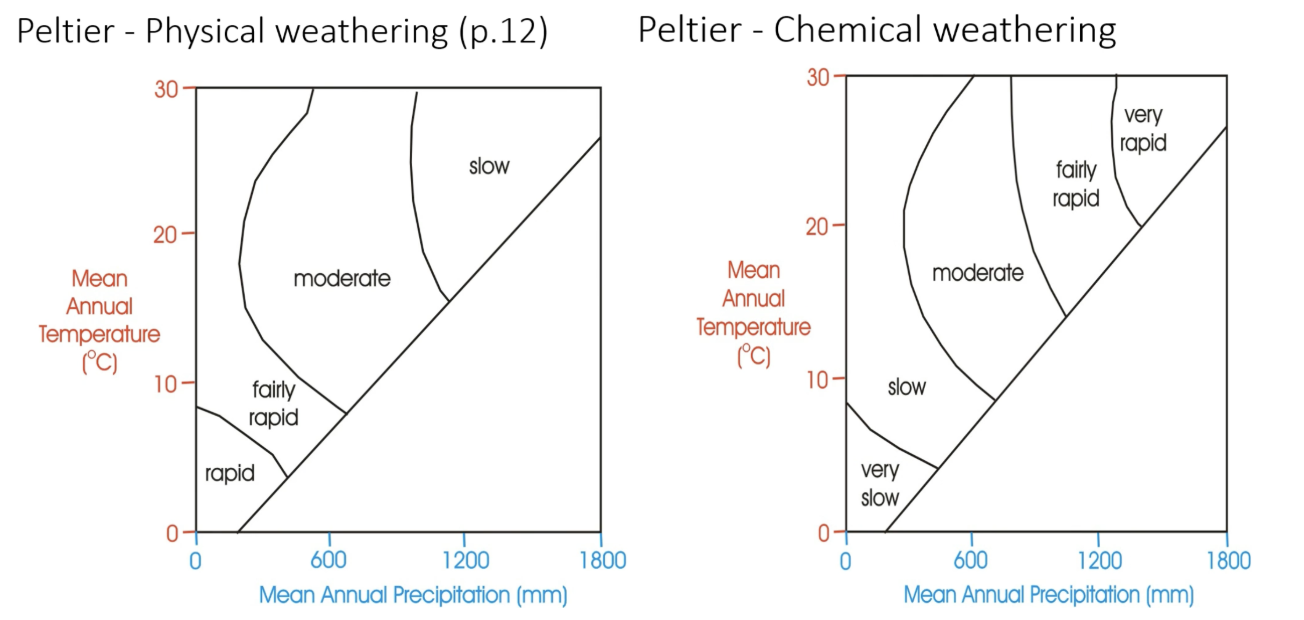
What does Peltier’s Diagram show and what are its limitations?
Shows how temperature + precipitation affect weathering intensity.
Warm + wet → strongest chemical weathering
Physical weathering in the model considers ONLY freeze-thaw
Limitations:
Does not account for other physical weathering processes
Does not fully account for local factors such as water chemistry/pH and mineral-specific responses
What does Strakhov’s Model show about climate and regolith depth?
↑ temperature + ↑ precipitation → deeper regolith
Humid tropics → deepest regolith
Deserts → shallow regolith
Exception: deep regolith may develop where relief is gentle because weathered material is not efficiently removed.

How does slope steepness influence weathering?
Gentle slopes: regolith accumulates → protects underlying rock → further weathering may slow.
Steep slopes: mass movement removes regolith → exposes fresh rock → continued weathering.
What 3 rock characteristics control weathering?
Strength/hardness
Chemical composition
Rock structure
How do rock strength and chemical composition affect weathering?
Hard/strong rocks → generally more resistant to physical weathering.
More reactive minerals → greater chemical weathering.
Basic minerals generally more reactive than acidic minerals.
Exception: feldspar is susceptible to hydrolysis.
How does rock structure affect weathering?
Joints + bedding planes are zones of weakness.
More joints
→ surface area ↑ + water/air penetration ↑
→ chemical + physical weathering ↑.
How do altitude and aspect influence weathering?
Altitude:
Higher altitude → lower temperatures → freeze-thaw ↑ where temperatures repeatedly cross 0°C.
Extremely high altitude → temperatures may stay below 0°C → freeze-thaw ↓.
Aspect: slope orientation controls exposure to sun, wind and precipitation.
In the Northern Hemisphere:
North-facing slopes → less direct sunlight → cooler + moister → greater freeze-thaw potential.
South-facing slopes → more direct sunlight → warmer + drier → greater thermal weathering potential.
How can human activities increase weathering?
Tourism: physical damage + erosion expose rock
CS: Uluru, Australia → tourists climbing and urinating on sandstone contributed to weathering.
Construction: mining, quarrying and cutting slopes exposes rock; explosives create fractures
Agriculture: irrigation/tilling alter infiltration
Deforestation: solar exposure + temperature fluctuations ↑ → thermal weathering ↑
Pollution: acid rain → carbonation/hydrolysis ↑
How does the Taj Mahal demonstrate human-enhanced weathering?
Acid rain → marble discolouration + pitting + weakening.
Acid rain can reach pH 4.2, compared with normal rain at ~pH 5.6.
How does silicate weathering regulate atmospheric CO₂?
Atmospheric CO₂ dissolves in water → carbonic acid
→ reacts with silicate rocks
→ bicarbonates transported to oceans
→ incorporated into sediments/limestone
→ CO₂ stored long-term.
Why can natural silicate weathering not offset current anthropogenic CO₂ emissions?
Silicate weathering/carbon burial is too slow.
Fossil-fuel CO₂ emissions occur hundreds–thousands of times faster than natural carbon burial.
Enhanced weathering: crush + spread silicate rocks → surface area ↑ → weathering ↑ → atmospheric CO₂ removal ↑. 2.2.1 geomorphic processes