Immunology Test #1
 Call Kai
 Learn
Learn Practice Test
 Spaced Repetition
 Match
Match Flashcards
 Knowt Play
1/161

There's no tags or description
Looks like no tags are added yet.
Name | Mastery | Learn | Test | Matching | Spaced | Call with Kai | Chat |
|---|
No analytics yet
Send a link to your students to track their progress
162 Terms
Innate Immunity is ___-specific natural immunity present at ___, with ___ delay, and no ___.
non; birth; no; memory
Adaptive immunity is ___ immunity that is learned, has ___, and is ___. It ___ delay.
acquired; memory; specific; has
Innate immunity has 4 external defenses:
___
___ membrane surfaces
___ action of ___
___ in tears and saliva
skin; mucosal; flushing; urine; lysozyme
Internal defenses of Innate Immunity:
___: participates in the phagocytosis and destruction of foreign organisms
___ + ___: hypersensitivity and protect against parasitic infections
___ Cells: lyse virally infected and tumor cells via release of perforin and granzyme
___ factors: work together to help body react to foreign antigens/pathogens
Phagocytes; basophils; eosinophils; NK; soluble
Skin has highly saturated ___ ___ content that inhibits bacteria/fungi. It’s ___ flora inhibits potential pathogen colonization.
fatty acid; normal
Mucosal membrane surfaces is anything with a mucous-y membrane. It prevents pathogen from ___ to cell surface.
attaching
Bladder is ___, the flushing action of urine flushes ___ out of body.
sterile; toxins
Lysozymes in tears and saliva are ___ antimicrobial agents that starts the ___ of basic pathogens (not very strong, can destroy ___ pathogens)
basic; breakdown; weak
What cells are phagocytes? Which is the most effective?
Neutrophils, macrophages, monocytes, and dendritic cells; neutrophils
Basophils/Mast Cells are associated with ___ and their granules affect ___.
hypersensitivity; vasodilation
Eosinophils protect against ___ infections and ___ allergic response (also participates in ___ phagocytosis)
parasitic; dampens; weak
NK Cells lyse virally infected and tumor cells via release of ___ and ___. Performs ADCC: ___ ___ ___ ___ ___.
perforin; granzyme; Antibody Dependent Cell mediated Cytolysis
Soluble Factors work together to help body ___ to foreign antigens/pathogens
react
Enzymes, Acute-phase proteins, Complement, and Cytokines are all examples of ___ ___.
soluble factors
What organs are involved in the Primary Lymphoid?
Fetal liver, bone marrow, and thymus
What organs are involved in the Secondary Lymphoid?
Spleen, Lymph Nodes, and MALT (Mucosal Associated Lymphoid Tissue)
The primary lymphoid serves as a place for cells to ___.
mature
The secondary lymphoid is a special site for lymphocyte-antigen ___, it also ___ antigens, and exports immune response ___ to the systemic circulation.
interactions; traps; products
Where do T cells develop?
Thymus
Where do B cells develop in a fetus?
Yolk sac, fetal liver + spleen, and then bone marrow
Where do B cells develop in an adult? Where do they finish maturing?
bone marrow; lymph nodes or spleen
Where do NK cells develop? Which progenitor cell does it derive from?
Bone marrow; Lymphoid
Describe T cell development happening in the cortex of the thymus:
Immature → DN → DP → Pos selection → SP
Describe T cell development happening in the medulla of the thymus:
SP → Neg selection → Mature T cell CD4 or CD8 → leaves thymus
T cells are found migrating in the blood and ___ lymphoid organs
secondary
B cells are found migrating the blood and in the ___ or ___ ___.
spleen; lymph nodes
NK cells are found in the ___.
blood
T cells and B cells are both a part of the ___ immunity.
adaptive
NK cells are a part of the ___ immunity.
innate
T cells function in ___ immunity (part of active branch of immunity), as T ___, and ___ cells.
cell-mediated; helper; cytotoxic
What CD markers do all T cells have in common? What is the marker for T helpers? How about Cytotoxic?
CD2 and CD3; CD4; CD8
B Cells function in ___ immunity (part of active branch of immunity), the differentiation into ___ cells to produce antibodies, and can form ___ B cells.
humoral; plasma; memory
B cell markers include CD___, IgM and ___, Fc receptor for ___, receptor for ___, and MHC___.
19; IgD; IgG; complement; II
No prior immunization is required for ___ cells because they are non-specific!
NK
What is the CD marker for NK cells? What immunoglobulin does it have an Fc receptor for?
16; IgG
Neutrophil makes up ___ of circulating nucleated cells and is the most effective ___.
Role in ___ inflammation, ___-lived.
most; phagocyte; acute; short
Basophils have a Fc receptor for ___ heavy chains.
IgE
Mast cells are ___ but in the tissue (thymus, spleen, lung, GI tract, bone marrow).
basophils
Monocytes function in ____ and ___ presentation (MHC___)
phagocytosis; antigen; II
Macrophages are ___ but in the tissue.
monocytes
Dendritic cells function in ___ and as antigen ___ cells.
phagocytosis; presenting
Small lymphocytes are ___ and ___ cells.
T; B
Large lymphocytes are ___ cells.
NK
Lymphocytes function in cell-mediated immunity (___ cells) and humoral immunity (___ cells). And ___ cells nonspecifically kill virally infected and ___ cells.
T; B; NK; tumor
Immunology – study of how host reacts to the ___ of a ___ substance in body
exposure; foreign
Antigen – foreign substance that can react with ___ or ___ cell, may not evoke ___ response
antibody; T; immune
Antigens must be able to bind ___ antibodies or T cells to produce a response!
enough
Immunogen – macromolecule ___ of triggering an adaptive immune response in ___ host
capable; immunocompetent
All immunogens are antigens, but not all ___ are immunogens.
antigens
Immunity – the condition of being ___ to infection
resistant
Immunogenicity – ___ of immunogen to elicit an immune response (How ___ of a response is this immunogen making?)
ability; strong
Immunogenicity is affected by:
number of ___
___’s and ___’s traits
epitopes; individual; immunogen
more epitopes = more ___ = more cross-linking = more ___!
antibodies; immunogenicity
Individual’s traits that affect Immunogenicity:
___ (Is this an immunocompromised population?)
Overall ___
Dose (___ zone required – how big of dose you must receive)
Route of ___
___ capacity (how well does your body make MHC___? If strong system = strong response)
age; health; goldilocks; inoculation; genetic; II
Immunogen’s traits that affect Immunogenicity:
___ composition and ___ complexity
___ (self vs non-self)
___ size
___ Processing (ability for antigen to be processed)
Chemical; molecular; foreignness; macromolecular; antigen
Chemical composition and molecular complexity is the ___ important immunogen trait for immunogenicity.
___ and ___ are the best (but ___ > polysaccharides)
Nucleic acids and lipids alone ___ immunogenic (must be ___ to something big and complex)
most; proteins; polysaccharides; proteins; not; attached
Foreignness is the immune system’s ability to distinguish ___ vs ___. The larger the taxonomical distance = ___ response.
self; non-self; greater
Molecular weight >___ A.A. is required to activate an immune response.
10,000
Molecular weight >___ A.A. is the ideal size to produce a robust response.
100,000
Antigen processing is where enzymatic digestion creates small ___ that complex to MHC. These peptides are presented to ___/___ cells.
No degradation = no ___ cell response
peptides; lymphs; T; T
Autoantigen - Antigens that belong to the ___, do ___ evoke an immune response under normal conditions
host; not
Alloantigen - Antigens from ___ members of the host’s species, ___ of eliciting an immune response
other; capable
Heteroantigen - Antigens that are from other ___ such as other animals, plants, or microorganisms.
species
Heterophile antigen - Heteroantigens that exist in unrelated plants or animals but are either identical or ___ related in structure so that antibody to one will cross-___ with antigen of the other
closely; react
MHCI is found on ___ nucleated cells. With HLA loci HLA-___, ___, and ___.
all; A; B; C
MHCII is found on ___ ___ ___ (APCs). With HLA loci ___ region: HLA-___, ___, and ___ (DR, DairyQueen DrPepper)
antigen presenting cells; D; DR; DQ; DP
Antigen Presenting Cells include ___ cells, macrophages and monocytes, and ___ cells.
B; dendritic
MHCI’s structure contains a glycoprotein dimer w/ 2 noncovalently linked polypeptide chains: ___ and ___ chain.
alpha; B2-microglobulin
MHCI’s alpha chain has ___ domains.
a1 + a2 - alpha ___ makes up the peptide ___ site.
a3 - ___ portion ___ cell membrane (binds to ___ on T cell)
3; helix; binding; hydrophobic; in; CD8
MHCI’s B2-microglobulin chain is encoded by a gene on chromosome ___.
does not ___ cell membrane
essential for ___ of a-chain/peptide binding pocket
15; penetrate; folding
MHCII’s structure contains 2 noncovalently bound polypeptide chains: ___ and ___ chain. BOTH are inserted ___ membrane!
alpha; beta; in
MHCII’s alpha chain is composed of ___ and ___, as well as the beta chain is composed of B1 and B2.
a1; a2
MHCI’s peptide-binding cleft is formed by ___ and ___.
___ helps the folding of this.
Peptides are __-__ A.A. long.
a1; a2; B2-microglobulin; 8-10

MHCII’s peptide-binding cleft is formed by ___ and ___.
Has a ___ pocket than MHCI! Holds longer peptides ___ A.A. long.
a1; B1; deeper; 13-18

Interaction of T Cells with MHCI:
___ protein degraded by ___ → produces ___
Peptides transported to ___ ___
Peptides bind to MHCI in ___ ___
Peptide-MHCI complex transported to ___ → transported to cell ___
TCR binds antigen (peptide-MHCI complex) + MHCI (___ domain) binds __
Endogenous; proteasome; peptides
Rough ER
Rough ER
Golgi; surface
a3; CD8
Once MHCI’s a3 domain binds CD8, the ___ T cell ___ the infected cell via perforin and granzyme.
Cytotoxic; lyses
Interaction of T Cells with MHCII:
___ protein taken up via ___ or phagocytosis
Antigen processed into ___ in ___
MHCII in ___ ___ – binding blocked by ___ chain
MHCII leaves rough ER through ___ -> ___ with endosome
Endosome ___ invariant chain -> Peptide-MHCII complex bind together in ___ compartment
Peptide-MHCII complex transported to cell ___
TCR binds antigen (Peptide-MHCII complex) + MHCII (___ domain) binds ___
Exogenous; endocytosis
peptides; endosome
Rough ER; invariant
golgi; fuses
cleaves; endosomal
surface
B2; CD4
Once MHCII’s B2 binds to the CD4, T ___ cells are activated → increases T helper cell ___ and trigger B cell ___ via cytokine secretions → increase in B cell ___ and ___ formation.
helper; proliferation; response; proliferation; antibody
CRP, Serum amyloid A, Alpha 1 antitrypsin, Fibrinogen, Haptoglobin, Ceruloplasmin, and Complement C3 are all examples of ___ ___ ___.
acute phase reactants
CRP and Complement C3 both function in ___ and ___ activation
opsonization; complement
Serum amyloid A activates ___ and ___.
monocytes; macrophages
Alpha 1 antitrypsin is a ___ inhibitor.
protease
Haptoglobin binds ____. Fibrinogen functions in ___ formation.
Hemoglobin; clot
Ceruloplasmin binds ___ and oxidizes ___.
copper; iron
5 Steps of phagocytosis:
___ ___ of WBC-foreign
___ of particle and formation of ___
___ of lysosome and phagosome = ____
___
___ of debris
Physical contact; ingestion; phagosome; fusion; phagolysosome; digestion; release
CRP increases ___ to ___ times in response to infection or trauma. The best acute phase reactant to monitor treatment because it has the highest ___ based on infection state.
100; 1000; influx
Label the following phases B-cell development in the bone marrow in the diagram:
Pro-B cell, Pre-B cell, Immature B cell, Mature B cell.
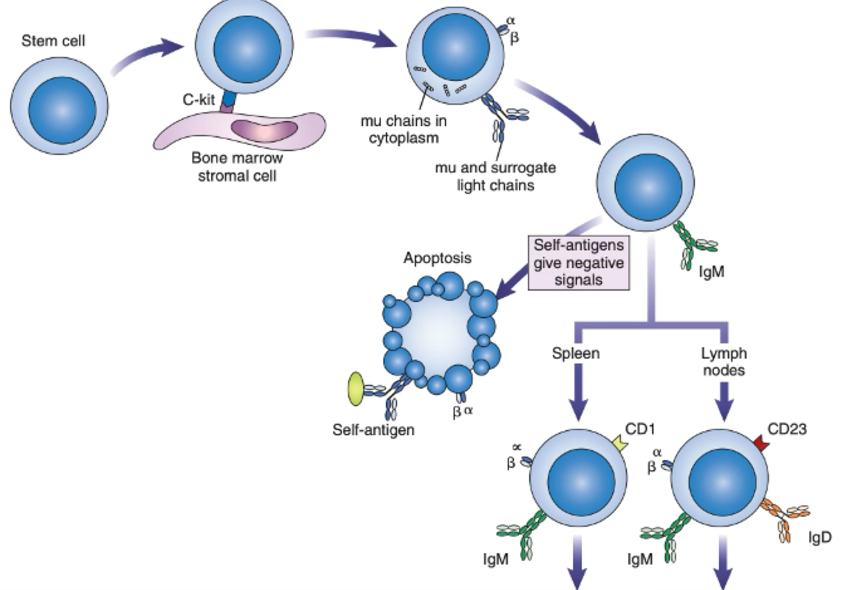
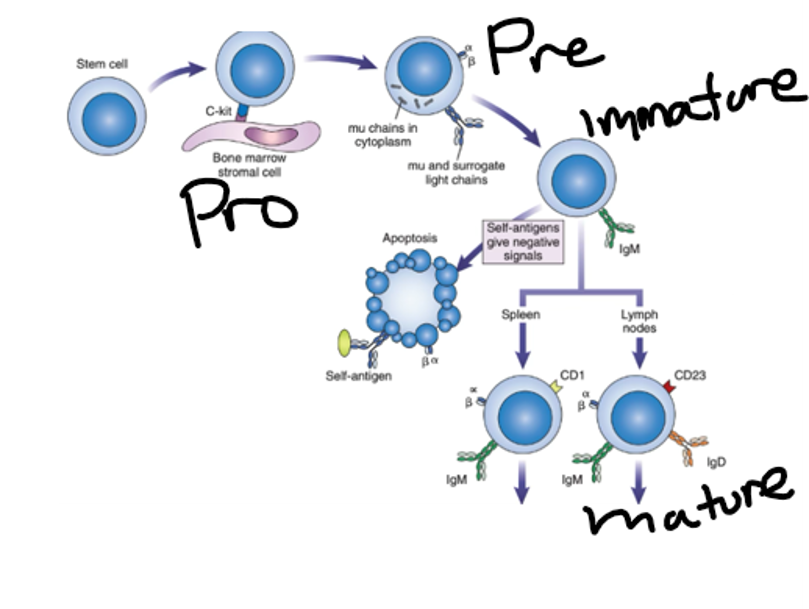
pro, pre, immature, mature
___ B Cells are the precursor of plasma cells.
Plasma cells produce and secrete ___.
Activated; antibodies
Events that occur after Tissue Injury
Resident macrophages and mast cells at the site of infection release ___ that cause vasodilation and induce selectins.
___ loosely bind circulating leukocytes and cause them to roll along the vascular wall. (Rolling ___)
Chemokine-induced ___ on the leukocytes bind firmly to the endothelial cells. (___)
Integrins enable the leukocytes to crawl ___ endothelial cells (___ or extravasation for tissue -> blood)
Leukocytes then follow the chemokine concentration gradient to the site of infection (___)
chemokines; Selectins; Adhesion; integrins; Capture; between; diapedesis; chemotaxis
Chronic Granulomatous Disease is the most ___ neutrophil disease concerning the absence of NADPH causes decreased ___ ___ production.
severe; hydrogen peroxide
Myeloperoxidase deficiency is the most __ inherited neutrophil disorder featuring the absence of __.
common; hypochlorite
Chediak-Higashi Syndrome concerns the failure of lysosome and phagosome to ___.
fuse
Glucose-6-phosphate deficiency causes ___ intracellular killing & ___.
impaired; anemia
___ is the predominant immunoglobulin in secondary response.
IgG
IgG crosses the ___, activates the ___ pathway (takes 2), and can provide newborn ___.
placenta; classical; immunity
IgG has a function in ___ and ___ toxins and viruses.
opsonization; neutralizes
IgG participates in agglutination and ___ reactions in clinical testing.
precipitation
___ is the first immunoglobulin produced in primary response.
IgM
IgM is found as a ___ (___ cell secreted IgM) and as a surface B cell IgM ___.
pentamer; plasma; monomer
Igm is the most ___ class to activate classical complement pathway. It is also the best at ___ reactions.
efficient; agglutination