Chapter 7.3: Sexual Reproduction by Meiosis Halves the Number of Chromosomes and Generates Genetic Diversity
 Call Kai
 Learn
Learn Practice Test
 Spaced Repetition
 Match
Match Flashcards
 Knowt Play
1/6

Name | Mastery | Learn | Test | Matching | Spaced | Call with Kai | Chat |
|---|
No analytics yet
Send a link to your students to track their progress
7 Terms

Meiosis
The type of cell division occurring through two nuclear divisions labeled I and II, together producing four genetically distinguishable haploid gamete cells
Can take from weeks to years in humans
Meiosis I
The first nuclear division of meiosis, where:
Entire replicated homologous chromosomes pair with each other along their entire lengths for exchanges (unlike mitosis, where no pairing takes place)
Homologous chromosome pairs separate and move to opposite poles (unlike mitosis, where only sister chromatids separate)
Chromosome numbers are halved, as Anaphase I divides genetic material into two nuclei without corresponding homologs
Meiosis II
The second nuclear division of meiosis, where:
Chromosomes are not replicated, but condense and attach to kinetochores
Sister chromatids align and separate
The nuclear envelope forms, and chromosomes uncondense
Cytokinesis occurs, forming four distinguishable cells
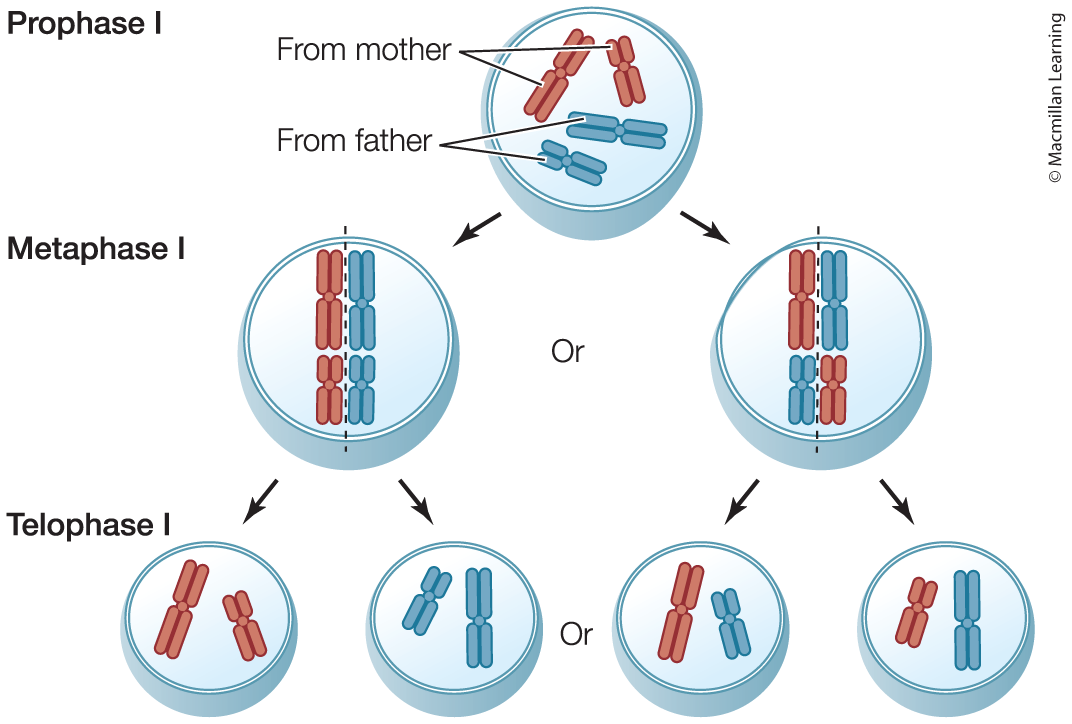
Independent assortment
The independent movement of each of the paternal and maternal chromosomes in a cell for diversity among chromosomes, resulting in:
A 50% chance that a chromosome will face a particular pole
A very high chance of new combinations of genes in gametes
The chance of a gamete having the same chromosomal makeup as one of the parental gametes being (1/2)(n-1), where n is the number in a haploid set

Crossing over
The exchange of genetic information between non-sister homologous chromatids from prophase I to anaphase I
Occurs at X-shaped attachment points called chiasmata

Chiasmata
The points on two non-sister homologous chromatids where crossing over occurs; these can appear in different numbers at any point on a chromosome
Recombinant chromatids
Chromatids that are genetically different from the chromosomes present in the parental gametes, formed as a result of crossing over