Biol 304 Discussion 8
 Call Kai
 Learn
 Practice Test
 Spaced Repetition
 Match
 Flashcards
 Knowt Play
1/76

There's no tags or description
Looks like no tags are added yet.
77 Terms
Is the TATAAT sequence always centered at -10 nucleotides from the start?
Usually, but not always
On which strand is the TATAAT sequence found?
Message (+) strand
How does RNA polymerase bind first during transcription?
Guided by sigma factors, it binds to a promotor on the template strand to synthesize the message strand
On which strand is RNA polymerase found when it is transcribing DNA?
Template (-) strand
Where would you expect DNA to be melted more easily: at -10 or at -35?
-10 because it’s AT rich (less H bonds)
Here is the consensus of the -10 region of a promoter: T80A95T45A60A50T96. If the -10 sequence is CACCAC, will transcription still occur from that promoter?
No since this is a highly conserved region and the given sequence is very different than it should be
When the % of alignment gets close to 100%, what does it mean?
That specific nucleostides are more and more likely to be present at a given position.
Highly conserved
Highly important
What are 4 conserved elements in a bacterial promoter that were discussed?
TTGACA consensus centered @ -35
spacing element (16-18bp) between TTGACA and TATAAT @ -35 to -10
TATAAT consensus centered @ -10
start point @ +1 (90% of time purine)
Does the sequence between -10 & -35 affect levels of transcription?
Does the distance between -10 & -35 affect levels of transcription?
What type of mutation would affect the level of transcription in the region from -35 to -10?
What type of mutation would not affect the level of transcription in the region from -35 to -10?
No;
Yes;
insert/delete;
Base substitute
Which sequence allows RNA pol to initially recognize a promoter? Which sequence provides an unwinding domain?
-35 (TTGACA) (sigma 70 subunit);
-10 (TATAAT) (Beta’ subunit)
What is the name for the structure formed when sigma binds to RNA Pol?
RNA polymerase holoenzyme
When is the sigma factor usually released from RNA Pol?
after initiation (when it clears the promoter)
Can the sigma factor stay associated with RNA Pol?
Yes, but usually releases after promotor clearance
What is the effect of the sigma factor on polymerase binding?
dictates promoter specificity
helps core enzyme bind to a specific site
To what sites does RNA Pol bind when it is not bound to a sigma factor?
loose-binding sites which are randomly chosen (bc it falls off)
What are loose and specific binding sites?
loose: when RNA Pol has bound randomely since no sigma factor is bound
specific: promoter regions & specific genes found by sigma factor bound to RNA pol
Can different sigma factors recognize different promoter sequences?
Yes
What is different about RNA Pol when a specific sigma factor is bound to it?
stable and tight binding to promoter region
it will recognize a specific sequence
What might be the effect if there is a mutation in the DNA binding domain of the sigma factor?
Might not bind -35 or -10
Will not be able to do specific binding (only loose binding)
Is the sigma factor found in eukaryotes?
No
What is one example of sigma factors being "switched?"
When bacteria experience heat shock they will switch from standard sigma 70 factor → heat shock sigma 32 factor
What happens to sigma proteins in the heat shock response?
sigma 70 is unbound (comes off pol) and sigma 32 comes on which activates the heat shock response and expresses chaperone proteins
Which RNA Pol transcribes genes in mitochondria & chloroplasts?
There are special RNA polymerases for each and they have their own.
What is the CTD?
Carboxyl / C- terminal domain
has many repeats of the consensus sequence
Which RNA Pol has a CTD?
DNA Pol II
What sequence is specific to the CTD?
YSPTSPS (consensus sequence)
What can happen to amino acids containing -OH functional groups serine, threonine, tyrosine?
phosphorylation
What is the role of upstream binding factor (UBF) in RNA pol I gene expression?
regulates rRNA gene expression by increasing efficiency of initiation
If boxes such as boxA, boxB, and boxC are found in many eukaryotes are they said to be conserved or have a consensus sequence?
conserved (same across many species)
consensus just tells us % chance sequence will contain certain nucleotides (as it usually contains them)
Which RNA Pol transcribes RNA that will be translated into proteins?
RNA Pol II
What is the core promoter?
Short, minimal, around the startpoint (+1) in DNA
helps w/ transcription initiation
Can transcription initiation occur when only the core promoter is present? What is TBP?
Yes
TBP = "TATA-binding protein"
binds to DNA's minor groove at the TATA box
Are all eukaryotic promoters located before transcription start point? How does this compare to prokaryotic promoters?
No (can be found anywhere near startpoint)
Prokaryotic promoters are always upstream
What is the general purpose of enhancers?
Increase transcription rates by increasing RNA pol to promoter binding efficiency
stimulate transcription by recruiting activators & general binding proteins
Stabilize RNA Poly
What allows more activators to be recruited?
enhancers
What is one characteristic that distinguishes promoters from enhancers?
Promoters: near & fixed position from startpoint
Enhancers: vary in distance & can be located up or downstream
What is one difference between enhancers and activators?
Enhancers: DNA that binds activators (proteins), cis-acting
Activators: proteins, trans-acting
What DNA sequence might prevent enhancer-promoter interaction?
insulator sequences
What is cooperative binding?
When a protein changes to connect more easily to other molecules when one is already bound first
so after 1st binding, 2nd is easier, etc...
When an enhancer is acting on a promoter, is a physical connection required between these 2 sites?
yes
What are CpG islands?
DNA regions with high C & G concentration in regulatory regions
There are a lot of CpG islands before housekeeping genes. What happens when CpG islands are methylated? What hapens when CpG islands are not methylated?
methylated: gene transcription turned off
unmethylated: gene transcription turned on
Can enhancers be found in introns & other DNA sequences that are not expressed?
Yes
central dogma
dna → rna → protein
dna → dna (replication)
dna → rna (transcription)
rna → dna (reverse transcription)
rna → protein (translation)
sense strand synonymous for
non template
coding
message
(+)
= mRNA sequence w/ T replaced w/ U
anti-sense strand synonymous for
template
non-coding
non-message
(-)
complementary to sense
prokaryotic replication vs transcription (table)
template
product
# strands synthesized
major enzyme
types of nucleotides used
enzyme binding site
start site
region of synthesis
primer needed
proofreading
reading direction
direction of synthesis
bubble size
directionality of syn

prokaryotic transcription overview (diagram)

how many RNA polymerase in prokaryotes?
one
what core enzyme makes up prokaryotic RNA pol? + what type of binding for initiation and releasing after promoter clearance?
α2ββ'ω
sigma binding
w= omega
rna pol holoenzyme
α2ββ'ωσ
rna pol subunits + function

consensus sequence
what does the subscript mean?
calculated order of most frequent residues found at each position in a sequence alignment ; the nts are known
subscript = % that a specific nucleotide occurs in all known examples
conserved sequence
similar or identical sequences which occur in DNA
occur across species
TTGACA consensus
centered @ -35
spaced conserved between species
distance between TTGACA and TATAAT = 16-18 bases
TATAAT consensus
centered around -10
prokaryotic promoted diagram

nucleotide changes to consensus sequence affect what?
rate of transcription
incrase/decrease # nucleotides between two consensus sequence affects ___
rate of transcription
nucleotide changes between two consensus sequences will ___
NOT affect transcription (substitutions fine)
insertion/deletion WILL impact!
eukaryotic transcription vs prokaryotic transcription (TABLE)
promoter
enzyme binding to promoter
name of TAATAT consensus
location of TAATAT consensus
# of RNA polys
proteins needed for intiation
does RNA pol bind directly to promoter?

3 classes of eurkaryotic rna pol + functions
rna pol I
synthesis of rRNA (ribosomal rna)
rna pol II
synth of mRNA
rna pol III (3 types)
synth multiple types of rna
each rna pol have same promoters?
NO
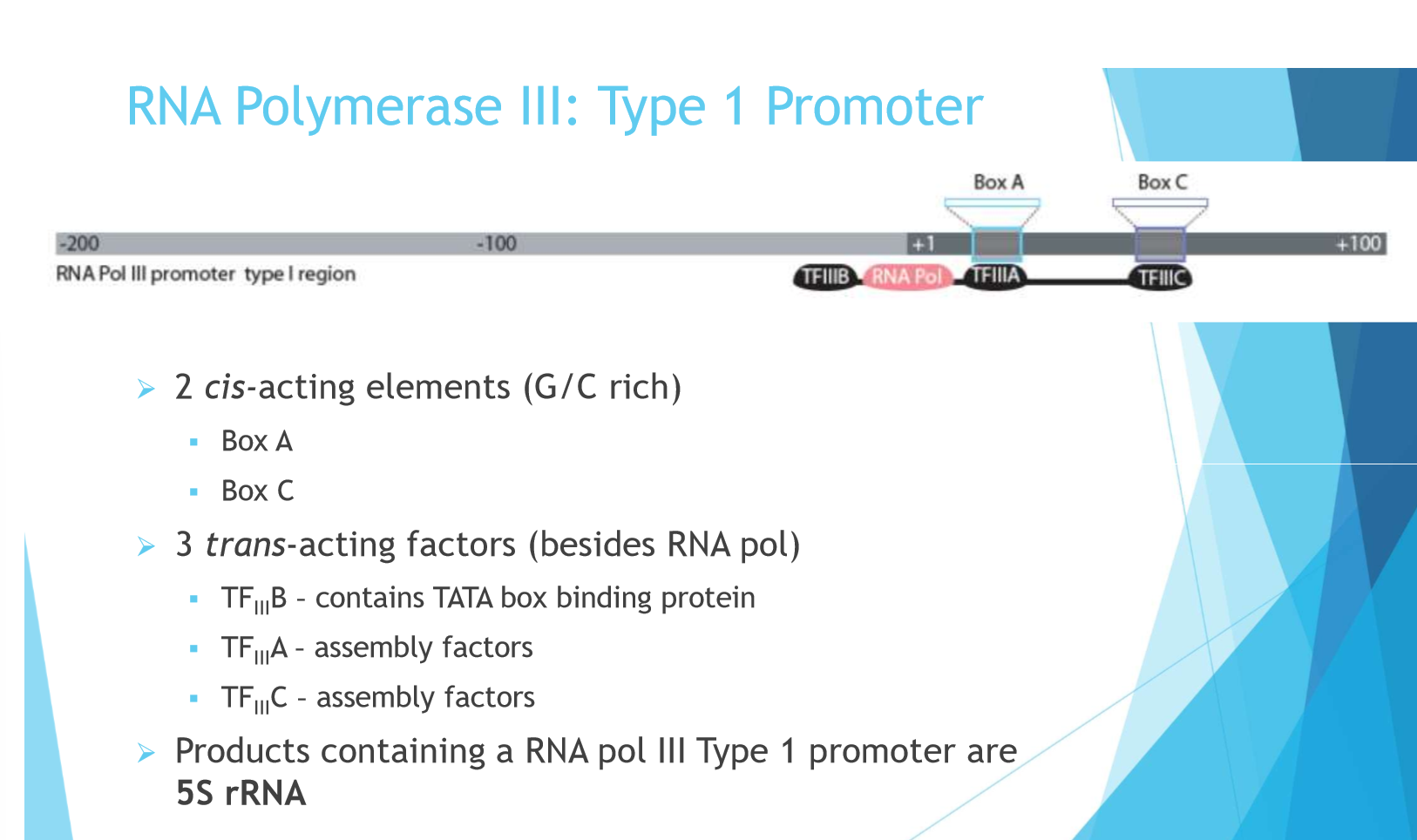
cis-acting elements
dna sequences
(intrinsic/within)
affect same molecule
ex: promoter
trans-acting factor
proteins that bind to cis
(extrinsic/external)
affect different molecule
ex: transcription factors
rna pol I promoter

why must CTD tail be phosphorylated on S and T residues for RNA pol?
to

rna pol II promoter

rna pol III promoters
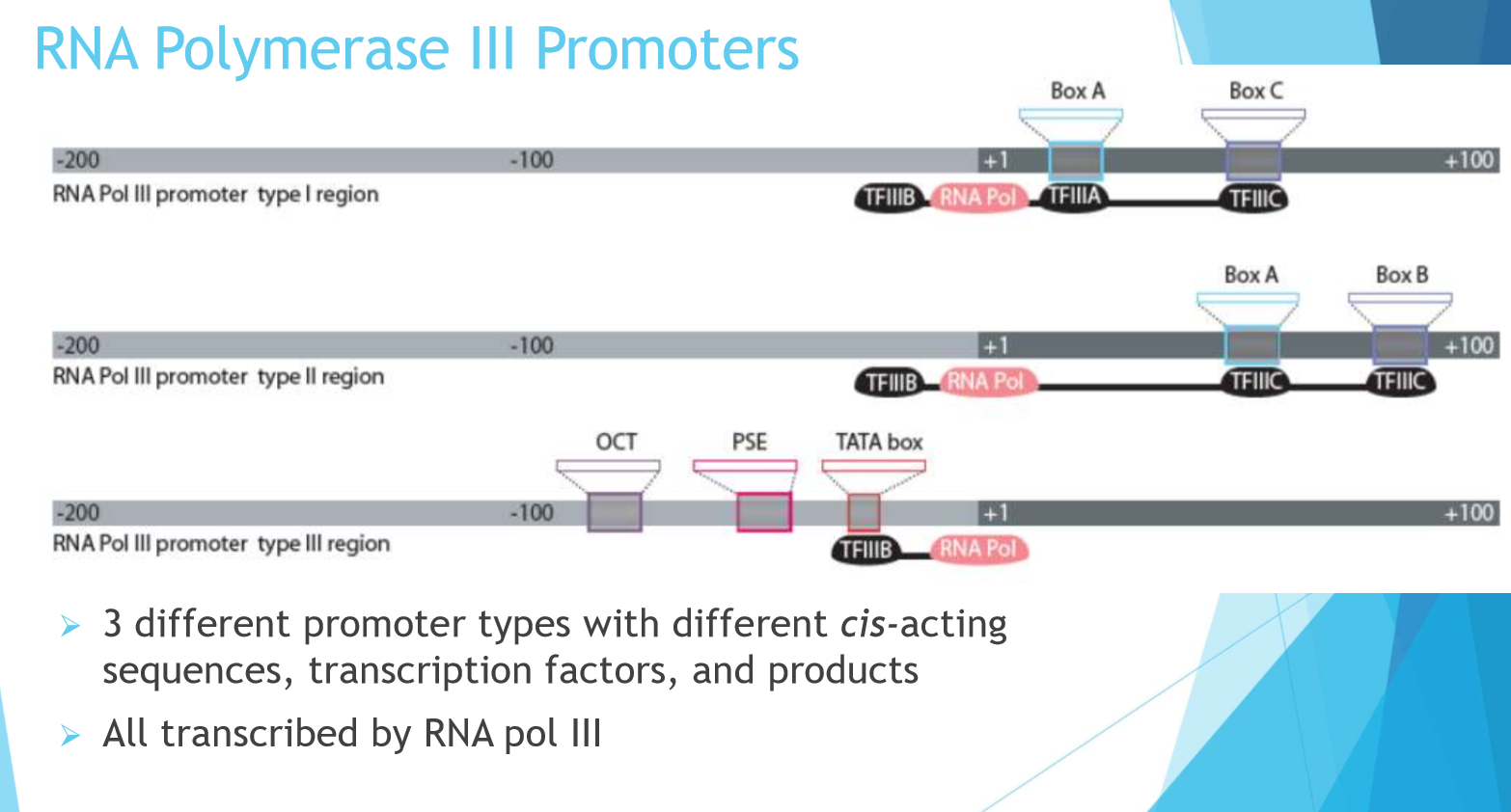
rna pol III type 1 promoter
rna pol III: type 2 promoter

rna pol III: type 3 promoter

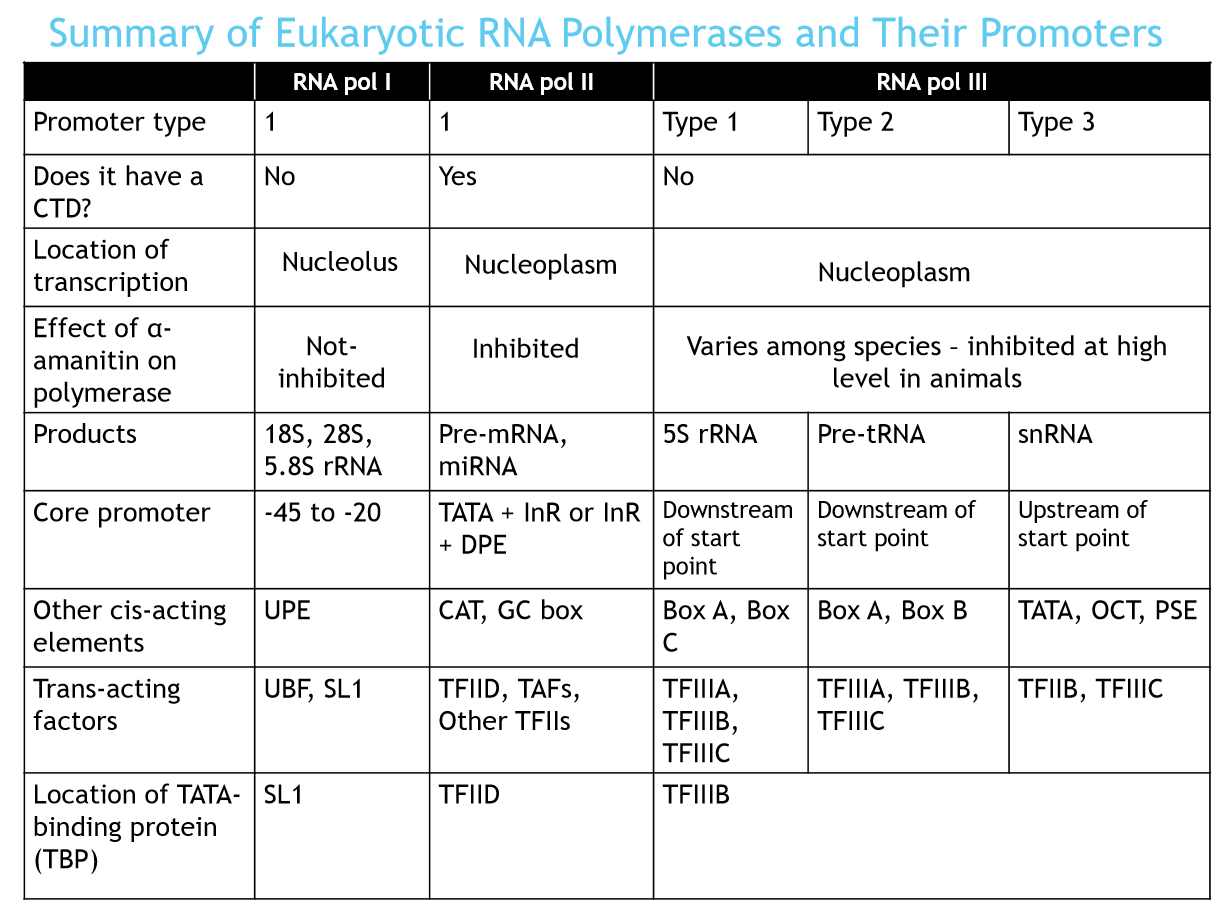
eukaryotic rna pol and promoters (TABLE)
RNA pol I | RNA pol II | RNA pol III (Type 1, 2, 3)
promoter type
has CTD?
location of transcription
effect of alpha-amatin on pol
products
core promoter
other cis-acting elements
trans-acting factors
location of TATA-binding protein (TBP)
enhancer def
stimulates what?
cis or trans?
far or near start point?
dna seq which can greatly increase transcription rates by increasing efficiency by which rna pol binds to a promoter
stimulates transcription initiation
cis-acting elements
farther away from start point (up or downstream)
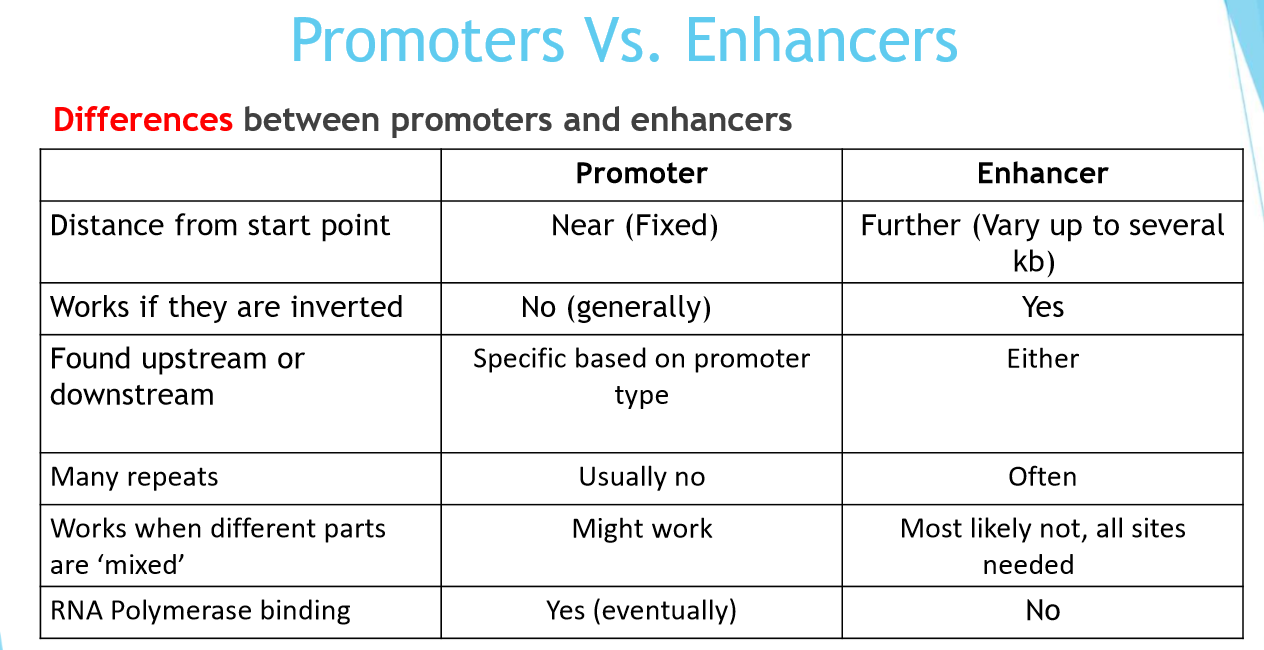
DIFFERENCES promoters vs enhancers (table)
distance from start point
works if they are invered
found up or downstream
many repeats
works when diff parts are ‘mixed’
rna pol binding
SIMILARITIES between promoters and enhancers
dna seq that serve as protein binding sites
have consensus sequences
proteins bound to them interact w. transcription machinery
both can recruit TFs that remodel chromatin