introduction to solid dosage forms - week 9
 Call Kai
 Learn
 Practice Test
 Spaced Repetition
 Match
 Flashcards
 Knowt Play
1/22

There's no tags or description
Looks like no tags are added yet.
23 Terms
solid dosage forms
encompass two types of formulations
tablets
capsuls
constitutes 90% of all dosage forms used to provide systemic administration of therapeutic agents
tablets
tablets designed to:
optimism the absorptions rate of the drug
increase the ease of administration by the patient
control the rate and site of drug absorption
mask the taste of a therapeutic agent
ingredients in tablets (excipients)
contains more than just API (active pharmaceutical ingredients)
excipients help with:
milk the mass. this helps with creating a tablet that can be handled (diluent) as some contain very small amount of API
stick the powders together after compression (binder)
break the tablet apart once it enters an aqueous environment (disintegrating agent)
make granules flow well into the tablet press and then eject from the tablet press (lubricants and glidants)
improve the taste and appearance (flavouring/sweetening agents and colourants)
how are tablets made?
Tablets are made by compressing powder in a die-punch press.
This is a large-scale manufacturing process.
Powder flows into the die, is compressed into a tablet and then ejected.
Good powder flow is essential to produce uniform tablets.
Glossary:
Die: Cavity that holds the powder and shapes the tablet.
Punch: Applies pressure to compress the powder.
Uniform tablets: Tablets with consistent size, weight and drug content.
conventional compressed tablets
make up majority of tablets used in clinical practice
manufactured by a single compression cycle using powders or granules of both API and inactive recipients
multiple compressed tablets
composed of at least two layers
two designs:
multiple-layer
compression coated
severals applications of this type of tablet
allows APIs that are incompatible to be formulated together in a conventional tablet but in separate layers
allows API to be administered at different rates of go to different sites
allows coated tablet production which can help with taste
enteric-coated tablets
Tablets covered with a polymer coating that does not dissolve in the acidic stomach but dissolves in the alkaline small intestine.
Protects the API (active pharmaceutical ingredient) from breaking down in the stomach.
Also protects the gastric mucosa (stomach lining) from irritation caused by certain drugs.
sugar-coated tablets
Conventional compressed tablets covered with multiple layers of sugar solution.
May contain colouring to make them look glossy and attractive.
The coating makes tablets easier to swallow.
Glossary:
- Conventional compressed tablet: Tablet made by compressing powder.
film-coated tablets
Compressed tablets covered with a thin polymer film.
The film forms a skin-like layer around the tablet.
More durable than sugar coatings and quicker to produce.
Glossary:
Polymer: Substance made of repeating chemical units
chewable tablets
intended for children, elderly, and those who have difficulty swallowing
designed to be chewed before swallowing
effervescent tablets
Made by compressing granules containing citric acid and sodium bicarbonate.
When added to water, they react and release carbon dioxide (CO₂) bubbles.
This causes rapid disintegration (breaking apart) of the tablet.
Glossary:
Effervescent: Producing bubbles of gas.
Disintegration: Breaking apart into smaller particles
buccal and sublingual tablets
Buccal: Dissolve slowly between the cheek and gingiva (gums).
Sublingual: Placed under the tongue and dissolve rapidly.
Both allow the API to enter the bloodstream directly through the oral mucosa, avoiding first-pass metabolism.
Glossary:
Oral mucosa: Moist lining inside the mouth.
First-pass metabolism: Drug breakdown by the liver before it reaches the general bloodstream.
vaginal tablets
Ovoid- or pear-shaped compressed tablets inserted into the vagina using a plastic inserter.
Commonly contain antibacterial, antifungal drugs or steroids.
Disintegration must be avoided to help the tablet stay in place.
Can provide local or systemic drug delivery.
Glossary:
Ovoid: Egg-shaped.
Local delivery: Drug acts directly at the site of application.
Systemic delivery: Drug enters the bloodstream and acts throughout the body.
advantages of tablets
Convenient and easy to use.
Cheaper to manufacture than other oral dosage forms.
Physically and chemically stable.
Can have special release profiles (e.g. enteric-coated or sustained-release).
Portable, compact and widely accepted by patients.
More tamper-proof than other oral dosage forms.
Easy and economical to produce, store and transport.
Glossary:
Sustained-release: Releases the drug slowly over time.
disadvantages
some patients experience psychological difficulties in swallowing tablets
preparing tablets extemporaneously is impractical
capsules
solid dosage form designed to contain drug(s) for administration
two types
hard (two-piece) gelatine capsules
soft (one-piece gelatine capsules)
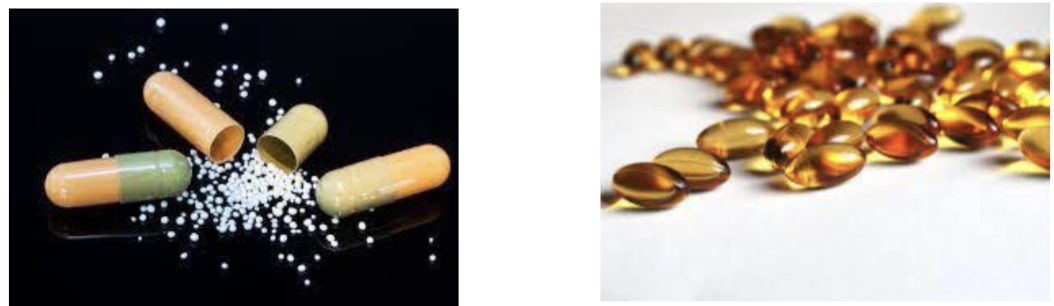
hard capsules
Small shells filled with powder or granules containing medicinal agents and/or inert materials.
Have two parts:
Body: Holds the drug.
Cap: Covers the body (about half its length).
Available in sizes 000 (largest) to 5 (smallest).
Absorb water at high humidity, causing them to become sticky and lose mechanical strength.
Glossary:
Inert materials: Ingredients with no medicinal effect.
Mechanical strength: Ability to maintain shape without breaking
hard capsule advantages
Fewer manufacturing steps than wet granulation for tablets.
Can improve some bioavailability problems seen with tablets.
Mask unpleasant tastes and odours.
Easier to swallow.
Opaque capsules can protect photosensitive drugs from light.
Difficult to counterfeit.
Glossary:
Bioavailability: Amount of drug that reaches the bloodstream.
Opaque: Does not allow light to pass through.
Photosensitive: Easily damaged by light.
hard capsules disadvantages
Not suitable for extremely soluble materials.
Not suitable for efflorescent or deliquescent materials.
Require specialised manufacturing equipment.
Glossary:
Efflorescent: Solids that lose water when exposed to air.
Deliquescent: Solids that absorb moisture from the air and may dissolve into a liquid.oft s
soft capsules
Made from flexible gelatin shells containing plasticisers.
Have a one-piece construction that is filled and sealed by one machine.
Allow liquids to be given in a solid dosage form, potentially improving bioavailability.
Can be used as:
Oral dosage forms
Suppositories
Topical or ophthalmic preparations
Also used in cosmetics (e.g. bath oils, perfumes and skin creams).
Glossary:
Plasticisers: Substances added to make gelatin flexible.
Bioavailability: Amount of drug that reaches the bloodstream.
Ophthalmic: Relating to the eyes.
soft capsule advantages
Allow liquid medication to be easily transported and taken as a solid dosage form.
Provide accurate and uniform doses.
Can provide better drug availability (bioavailability) than tablets and hard capsules.
Difficult to counterfeit.
soft capsule disadvantages
Require specialised manufacturing equipment.
May have stability problems with liquid fills.
Fill weight and drug content may not be uniform (homogeneity issues).
Glossary:
- Homogeneity: Even distribution of ingredients throughout the capsule.
capsules vs tablets
