Lecture 3 biological molecules
 Call Kai
 Learn
Learn Practice Test
 Spaced Repetition
 Match
Match Flashcards
 Knowt Play
1/27

There's no tags or description
Looks like no tags are added yet.
Name | Mastery | Learn | Test | Matching | Spaced | Call with Kai | Chat |
|---|
No analytics yet
Send a link to your students to track their progress
28 Terms
Organic compounds
any carbon containing liquid, solid, or gas (C bonded to C or H)
Why is carbon so important
it is the fundamental component for all macromolecules
“Backbone”
can form 4 bonds (covalent) with different atoms, forming complex molecules
Hydrocarbons
Only carbon and hydrogen
usually, fuels since their many covalent bonds store great amounts of energy
Nonpolar
hydrophobic
uncharged (unionic)
When the H is replaced with a functional group (like oh) → properties change
Functional groups
Group of atoms attached to C, replaces H
Changes complexity, shape, and properties of molecules
Key to molecular function
Exp: estradiol and testosterone sim structures but slight differences create big changes
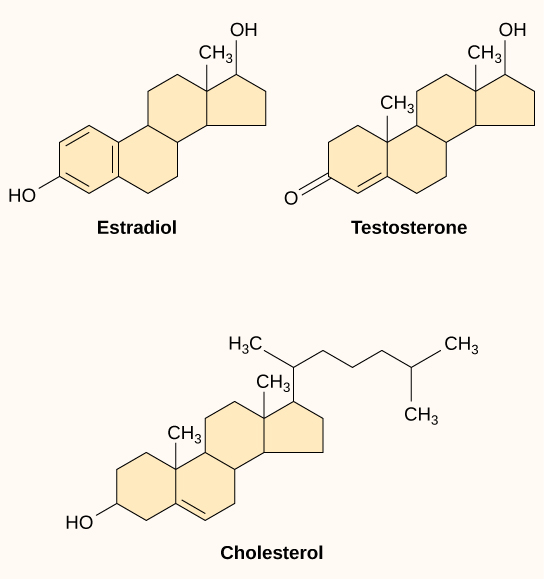
6 groups of functional groups
Hydroxyl
Carbonyl
Carboxyl
Amino
Phosphate
Methyl
Hydroxyl group
-OH → covalently bonded
Polar
Hydrophilic
Neutrally charged
Found in alcohols

Carbonyl group
C=O - covalently bonded
Polar (but less than OH)
Hydrophilic
Neutrally charged
Found in sugars

Carboxyl group
-COOH or OH-C=O - both covalently bonded
Polar
hydrophilic
acidic
neutrally or neg charged depending on what it is bonded to
Can release H+
found in amino acids and fatty acids

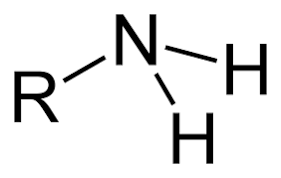
Amino group
NH2 -covalently bonded
Highly polar
hydrophilic
Basic
alone it is neutrally charged but in the environment, ph contributes to how it is charged
can accept H+
found in amino acids
Phosphate group
PO4 covalently bonded
Polar
hydrophilic
acidic
-3 charge
found in phospholipids, nucleic acids, ATP, etc.

Methyl group
CH3 covalently bonded
Nonpolar
hydrophobic
neutrally charged
found in dna methylation and play major role in gene expression
macromolecules
large molecules with 1000s of atoms
necessary for life
polymers
macromolecules made of chains of monomers
monomers
identical or similar repairing building blocks of a polymer
combine with each other using covalentt bonds
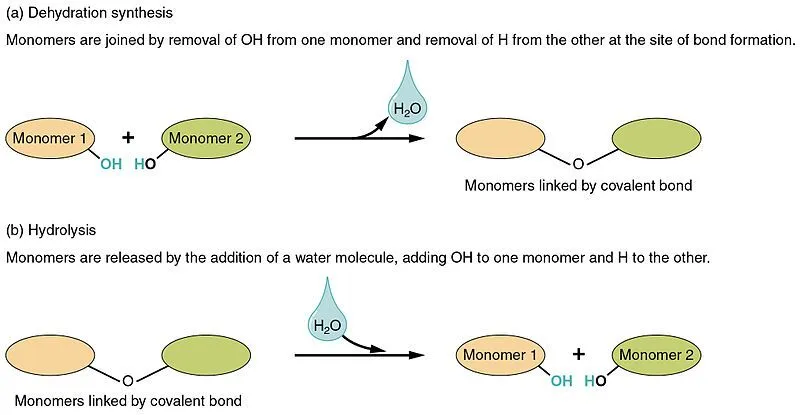
dehydration synthesis
reaction that building larger molecules
when monomers combine with covalent bonds, they release water molecules as byproducts
“to put together while losing water”

hydrolysis
reaction that breaks larger molecules (polymers) into smaller molecules (monomers) by interesting a water molecule to break covalent bonds
1 monomer will gain an h while one will gain an oh hence the breaking
4 classes of biological macromolecules
carbs, m lipids, proteins, nucleic acids
LIPIDS ARE NOT POLYMERS
Carbohydrates
polymers of sugar made of CH2O
Used for fuel and structure
short to medium term energy sources

monosaccarides
monomers of carbohydrates, usually 3-6 c
exp: glucose, fructose, galactose
polysaccarides
polymer of hundreds to thousands of monosaccharides
monomers are connected with glycosidic linkages
Two main functions:
storage: starch, glycogen
Structure: cellulose, chitin
Lipids
Diverse hydrophobic macromolecules, not polymers
hydrocarbons
not water soluble
used for storage, structure, and signaling
utilize ester bonds to build (dehydration rxn)
3 types:
fats,phospholipids,steroids

fats
glycerol + fatty acid tails (3)
most abundant lipid
used for long term energy storage
phospholipids
Glycerol+ fatty acids+ phosphate group (2 fa tails)
Amphipathic- has hydrophobic and hydrophilic regions
steroids
ring structure
3 6 c rings
1 5 c ring
used for membrane structure and signaling (steroid hormones)
proteins
polymers of amino acids
amino acids are the monomers
parts of amino acids- central c, h, carboxyl group, amino group, r group, side chain
20 amino acids in cellular life
connected vis peptide bonds which result in polypeptides 100+ aa
formed via dehydration
responsible for structure, signaling, communication, enzymes, defense, transport, everything but heredity
Levels of protein structure
primary- linear
secondary- local folding, amino acids are close tgther in sequence , short distances
hydrogen bonds between the backbone carbonyl oxygen
tertiary-three-dimensional shape of a single polypeptide chain, interactions between side chains
Hydrophobic interactions
Hydrogen bonds
Ionic bonds
quaternary- 2 or more polypeptide chains held together (hemoglobin)
any kind of interaction

denaturation
if protein is subject to changes in temp, ph, or exposure to chemicalcs, the protein structure may change, losing it shape w/o losing its protein sequence→ polypeptide chain is fine

nucleic acids
monomer- nucleotide
polymer- polynucleotide
found in dna and rna
store and transmit genetic info