Finance Chapter 1 (1.1-1.5) Midterm content
 Call Kai
 Learn
Learn Practice Test
 Spaced Repetition
 Match
Match Flashcards
 Knowt Play
1/21

There's no tags or description
Looks like no tags are added yet.
Name | Mastery | Learn | Test | Matching | Spaced | Call with Kai | Chat |
|---|
No analytics yet
Send a link to your students to track their progress
22 Terms
What is corporate finance?
How a business chooses to mange its money, funding, and investments to grow and make a profit. Should answer the following 3 questions
what long term investments or projects should a firm undertake
How should a firm raise money to pay these investments (debt, equity, or a mix)
How should the firm manage its day-to-day finances such as cash, inventory, and receivables

What is Capital Budgeting
The process of planning and managing a firms investments in. Long term assets
look into investment opportunities that are worth more to the firm than what they cost

What is working capital?
Planning and managing the firms current assets and current liabilities
deals with day to day activities
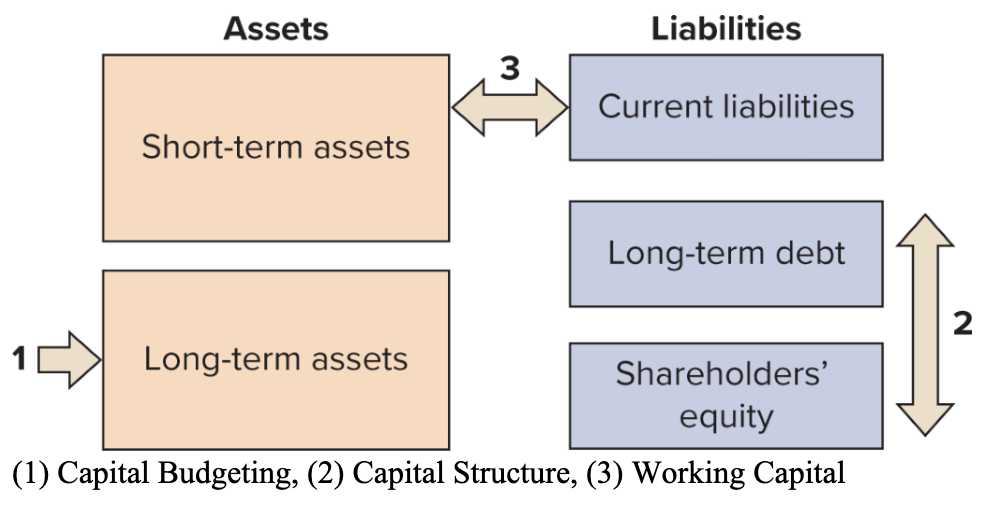
What is working capital?
Planning and managing the firms current assets and current liabilities
deals with day to day activities
Sole Proprietorship
A business owned by a single individual
easiest to start as its not heavily regulated
Owner keeps all the profits
Personal tax is applied
Unlimited liability
Not easy to transfer ownership or raise money
Ownership and management are not separated
Partnership
A business formed by two or more co-owners
easy to start as its is not heavily regulated
Unlimited liability (unless you’re a limited partner)
Not easy to transfer ownership or raise money
Personal tax
No separation from owner and management for general partners (unless you’re limited partner)
General Partnership
All partners share in gains or losses and all have unlimited liability for all partnerships debts
partnership terminates when GP wishes to sell or dies
Manage and own the business
Limited partnership
A limited partnership liability for business debts is limited to the amount contributed to the partnership
they do not actively manage/participate in the business
Their interest can be sold without dissolving partnership
Corporation
A business created as a distinct legal entity owned by one or more individuals
is not easy to start and thus is heavily regulated
Shareholders keep the profits
Double taxation (corporate tax + personal tax)
Limited liability
Easy to transfer ownership via shares
Easy to raise money
Ownership and management are separated
Co-operative (Co-op)
An enterprise that is equally owned by its members who share the benefits of a Co-op based on how much they use the services
Consumer Co-op
Provide product or services to its members (i.e. retail co-op, housing etc)
Producer Co-op
Markets the goods and services produced by its members, and supplies products and services necessary to the members professional activity (i.e. Farmers)
Worker Co-op
Provides employment for its members.
Multi-stakeholder Co-op
Serves the needs of many different stakeholder groups such as employees, clients, and other interested parties (ex. Health, home care etc)
The goals of Financial Management:
Maximize current share value
Maximize Firm value
Maximize Shareholders wealth
Overall financial managers are acting in the best interest of the shareholders.
Agency Relationship
A principal delegates decisions to an agent who acts on the principal’s behalf
common whenever we rely on someone else’s expertise
In a corporation: shareholders → managers
Agency Problem
A problem can arise within an agency relationship when different interests are mixed with imperfect monitoring
managers interests may differ from shareholders’ and they cannot perfectly observe/evaluate managerial decisions

Agency cost
The resulting cost in value to shareholders can’t be both
direct: perks, misuse of firm resources, monitoring costs
Indirect: value lost from distorted decisions or missed opportunities
Agency solutions
Align incentives
managers are given a greater job prospects when they perform successfully
Managers are given stock options
Monitor managers
Board of directors oversea management
Money Markets Vs. Capital Markets
Money Markets: financial markets where short term debt securities are bought and sold (i.e. chartered banks, investment dealers, treasury bills)
dealers market → dealers buy and sell things themselves at their own risk
Capital Markets: financial markets where long term debt and equity securities are bought and sold (i.e. Toronto stock exchange - TSX)
Primary Markets Vs. Secondary Markets
Primary Markets: refers to the original sale of securities by government and corporations
typically conducted by investment dealers
Financial institutions
Secondary Markets: trading conducted after the original sale - general public
The 2 kinds of secondary markets
Auction markets: directly matches those who wish to sell with those who wish to buy (ex. TSX). Broker dealers play a more limited role.
Dealer markets: in this market most of the buying and selling is done by dealers on behalf of clients (ex. Agency trading), or for their own account after transacting with clients themselves (ex. principal trading)