Unit 3 - Biological Bases of Behavior
 Call Kai
 Learn
Learn Practice Test
 Spaced Repetition
 Match
Match Flashcards
 Knowt Play
1/157

Earn XP
Description and Tags
AP Psychology
Name | Mastery | Learn | Test | Matching | Spaced | Call with Kai | Chat |
|---|
No analytics yet
Send a link to your students to track their progress
158 Terms
Neuron
a nerve cell; the basic building block of the nervous system
Axon
the neuron extension that passes messages through its branches to other neurons or to muscles and glands
Dendrite
a neuron’s bushy branching extensions that recieve messages and conduct impulses toward the cell body
What part of the neuron recieves the messages?
Dendrites
What part of the neuron sends the message?
Axon/Axon Terminal
Myelin Sheath
a fatty tissue layer segmentally encasing the axons of some neurons; enables vastly greater transmission speed as neural impulses hop from one sausage-like node to the next
Cell Body/Soma
contains the nucleus, the cell’s life support center
Node of Ranvier
Gaps in myelin sheath that impulses jump over
Schwann Cell
produces myelin sheath, supports protects and maintains it
Glial Cells
nervous system’s supporters; feed and nourish neurons, protect them; help us learn, think, and remember
Axon Terminal (Buttons)
ends of the axon, contains vesicles that store neurotransmitters

#1?
Dendrites

#2?
Cell Body
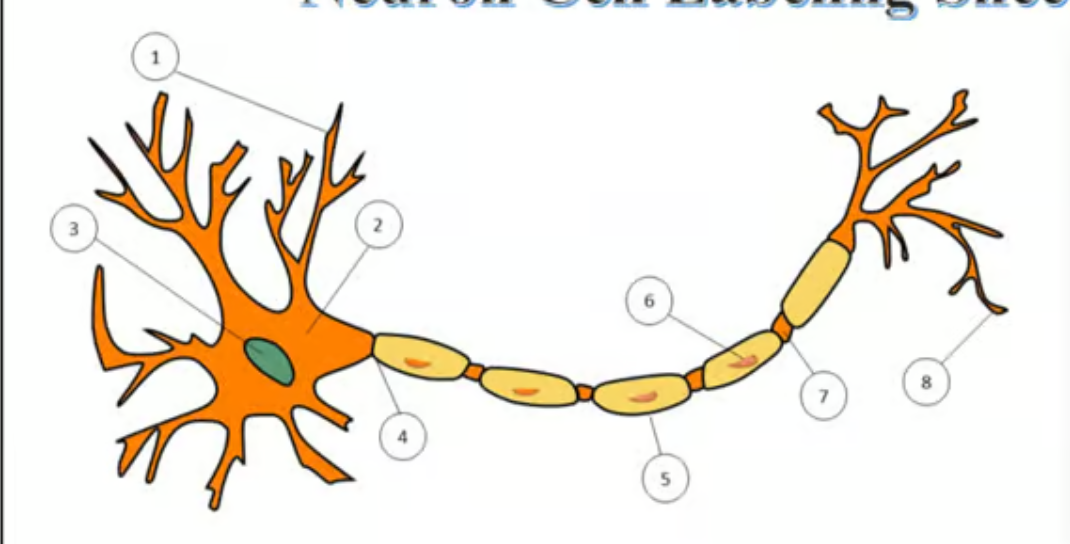
#3?
Nucleus

#4
Axon
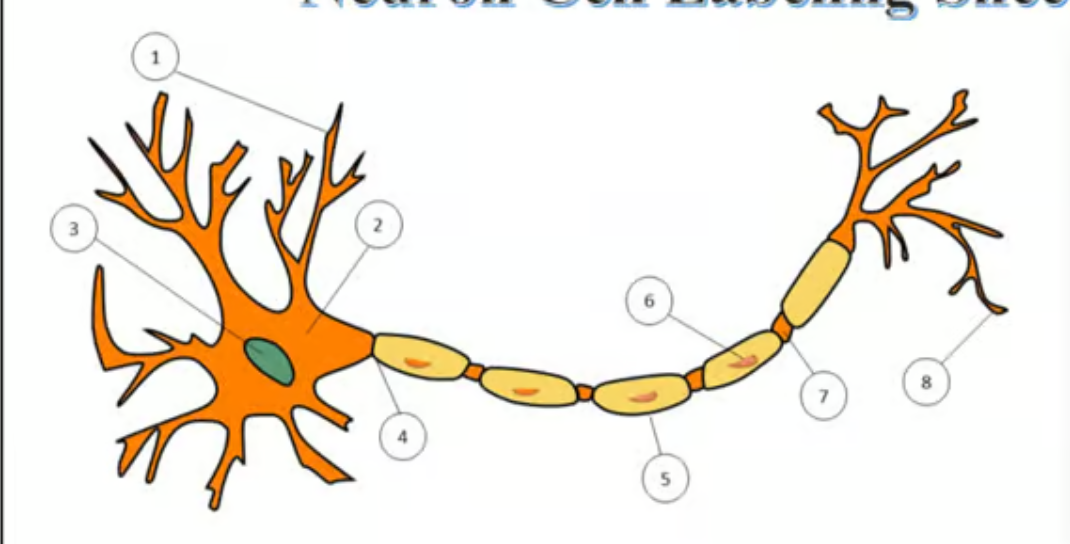
#5
Myelin Sheath

#6
Schwann Cell
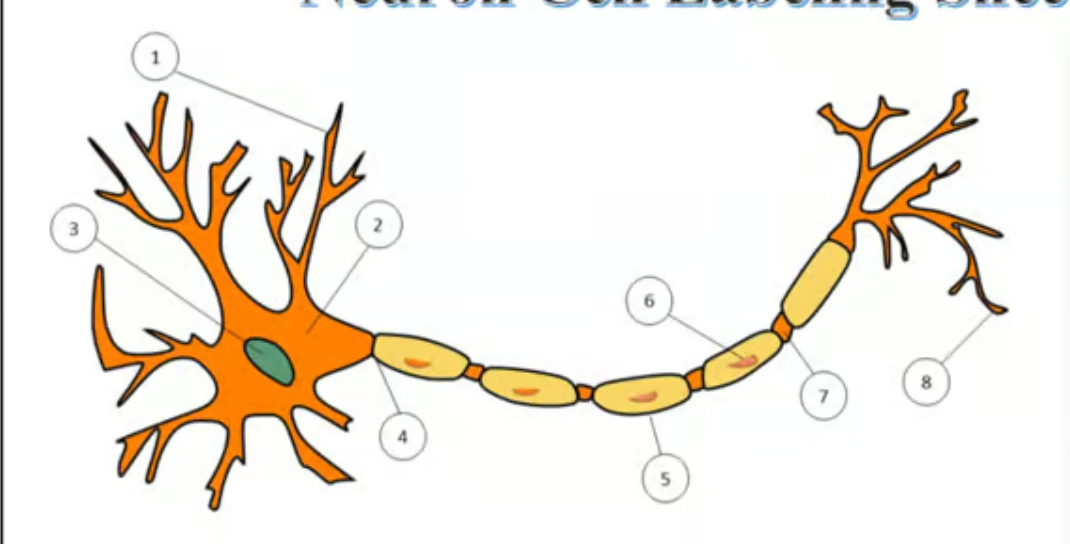
#7
Node of Ranvier

#8
Axon Terminal
How to pronounce words so you don’t sound like an idiot! —Myelin Sheath
mialin (kind of like violin, NOT myeh-lin)
How to pronounce words so you don’t sound like an idiot! — Node of Ranvier
Ran-vi-ay (NOT ran-veer)
Synaptic Vesicle
stores the neurotransmitters in the axon terminal
Action Potential
a neural impulse; a brief electrical charge that travels down the axon
Resting Potential
where the neurons start and end, banana in the ocean→ inside- negative protein ions, positive potassium ions, outside- positive sodium ions- axon surface is selectively permeable
Depolarization
positive sodium ions flood into channels (attracted to negative interior)
Are Potassium ions positive or negative? Sodium ions?
Positive; Positive
Is the inside of the axon positive or negative?
Negative
Repolarization
potassium ions flow out of the channel, resets to start again
Threshold
the level of stimulation required to trigger a neural impulse
All-Or-None Principle
a neuron’s reaction of either firing (with a full-strength response) or not firing; you can’t half-fire a gxn, you cant half pull a trigger either you fully pull it and it shoots or you dont pull it enough or at all and it doesn’t shoot, and even if you hesitate and another person is prepared and confident the bullet will still go with the same speed and intensity
Refractory Period
a period of inactivity after a neuron has fired ; like in pokemon shield when you have to send your pokemon to the clinic to regain health so you can fight with them again and you have to wait a couple seconds while it heals them
Synapse
the junction between the axon tip of the sending neuron and the dendrite or cell body of the receiving neuron. The tiny gap is called the synaptic gap or synaptic cleft
Neurotransmitter
chemical messengers that cross the synaptic gaps between neurons, when released by the sending neuron, neurotransmitters travel across the synapse and bind to receptor sites on the receiving neuron, thereby influencing whether that neuron will generate a neural impulse
Reuptake
a neurotransmitter’s reabsorption by the sending neuron
Acetylcholine/ ACh
enables muscle movement, learning, memory — too little=unable to contract (botox) — ACh-producing neurons deteriorate=alzheimers — neither excitatory nor inhibitory
Dopamine
influences movement, learning, attention, emotion — “pleasure hormone” — pleasure and reward — too much=schizophrenia, too little=parkinson’s/tremors — excitatory
Serotonin
mood , hunger, sleep, arousal — too little=depression — SSRIs are effective treatment — NOT happiness hormone → mood regulation — neither excitatory nor inhibitor
Nor-epinephrine/Epinephrine
adrenaline or non-adrenaline — fight or flight — energy, hypes up, focus, controls alertness and arousal — too little=depressed, too much=anxious — treatment: SNRI — extremely excitatory
GABA
major inhibitory neurotransmitter — too little= seizures, tremors, insomnia
Glutamate
major excitatory neurotransmitter — memory — too much=migraines or seizures due to overstimulation
Endorphins
“morphine within” - natural, opiate-like neurotransmitters linked to pain control and to pleasure
Substance p
associated with feelings of pain (p means pain) — released by sensory neurons in the peripheral and central nervous systems — increases blood vessel size and starts inflammation process — works together with glutamate — what sends blood to start the healing process
Multiple Sclerosis
immune system attacks neurons’ myelin sheath covering — slows down neurotransmission — weakness in limbs, muscle spasms, coordination/balance issues
Myasthenia Gravis
immune system attacks ACh receptors in neuromuscular junctions — muscles become easily fatigued or temporarily paralyzed — slurred speech and difficulty swallowing are among common symptoms
Agonist
a molecule that, by binding to a receptor site, stimulates a response
Antagonist
a molecule that, by binding to a receptor site, inhibits or blocks a response
Sensory Neuron
neurons that carry incoming information from the sensory receptors to the brain and spinal cord → incoming/afferent
Motor Neuron
neurons that carry outgoing messages from the brain and spinal cord to muscles and glands — efferent/outgoing
Interneuron
neurons within the brain and spinal cord that communicate internally and intervene between the sensory inputs and motor outputs
Nervous System
the body’s speedy, electrochemical communication network, consisting of all the nerve cells of the peripheral and central nervous systems
Central Nervous System
the brain and the spinal cord
Peripheral Nervous System
the sensory and motor neurons that connect the CNS to the rest of the body
Somatic Nervous System
the division of the peripheral nervous system that controls the body’s skeletal muscles → also known as the skeletal nervous system
Autonomic Nervous System
the part of the peripheral nervous system that controls the glands and the muscles of the internal organs (heart) — its sympathetic division arouses; its para-sympathetic division calms
Sympathetic Nervous System
the division of the autonomic nervous system that arouses the body, mobilizing its energy in stressful situations
Para-sympathetic Nervous System
the division of the autonomic nervous system that calms the body, conserving its energy
Reflex/Reflex Arc
a simple, automatic response to a sensory stimulus, such as the knee-jerk response
Endocrine System
the body’s “slow” chemical communication system; a set of glands that secrete hormones into the bloodstream
Pituitary Gland
the endocrine system’s most influential gland. Under the influence of the hypothalamus, the pituitary regulates growth and controls other endocrine glands
Hormone
chemical messengers that are manufactured by the endocrine glands; travel through the bloodstream and affect other tissues
Ocytocin
“bonding” “love” “cuddle” hormone, enables birth contractions, breast milk release, released during/after orgasm
Cortisol
stress hormone that increases blood sugar
Lesion
tissue destruction — a brain lesion is a naturally or experimentally caused destruction of brain tissue
Electro-Encephalo-graph (EEG)
an amplified recording of the waves of electrical activity sweeping across the Brain’s surface — waves are measured by electrodes placed on scalp
Computerized Tomography (CT Scan) or (CAT Scan)
a series of x-ray photographs taken from different angles and combined by computer into a composite representation of a slice of the brain’s structure
Positron Emission Tomography (PET Scan)
a visual display of brain activity that detects where a radioactive form of glucose goes while the brain preforms a given task
Magnetic Resonance Imagine (MRI)
a technique that uses magnetic fields and radio waves to produce computer-generated images of soft-tissue — shows brain anatomy
Functional Magnetic Resonance Imaging (fMRI)
a technique for revealing bloodflow and, therefore, brain activity by comparing successive MRI scans — fMRI scans show brain function as well as its structure
Contralateral hemispheric organization
sensory and motor functions from one side of the body are controlled by the opposite hemisphere of the brain
Brain Stem
the oldest part and central core of the brain, beginning where the spinal cord swells as it enters the skull; responsible for automatic survival functions
Medulla
the base of the brainstem; controls heartbeat and breathing
Pons
coordinates sleep and movement; keeps you in REM sleep
Reticular Activating System
a nerve network that travels through the brain stem and thalamus; controls arousal and attention; filters incoming stimuli; helps “multi-task” ; if severed, youll be in a coma
Thalamus
brain’s sensory control center, located on top of the brainstem; directs messages to the sensory receiving areas in the cortex and transmits replies to the cerebellum and medulla; all senses except smell; 911 dispatcher/mail person for senses
Cerebellum
the “little brain” at the rear of the brainstem; functions include processing sensory input, coordinating movement output and balance, and enabling nonverbal learning and memory
Limbic System
neural system located below the cerebral hemispheres; associated with emotions and drives
Hippocampus
processes and creates new memories and sends it away to be stored (DOES NOT STORE IT IN ITSELF)
Amygdala
generates emotions, mainly aggression and fear, as well as other strong emotional experiences
Hypothalamus
a neural structure lying below the thalamus; directs several maintenance activities (such as eating, drinking, body temperature) helps govern the endocrine system via the pituitary gland, and is linked to emotion (pleasure) and reward (remember the 4 Fs→ fight, flight, food, and sex/f*ck)
3 parts of the Limbic System:
Amygdala, Hippocampus, Hypothalamus
3 parts of the Brain Stem:
Medulla, Pons, Reticular Formation
Cerebral Cortex
“newest” part of the brain, intricate fabric of interconnected neural cells covering the cerebral hemispheres; the body’s ultimate control and information-processing center
Frontal Lobes
portion of the cerebral cortex lying just behind the forehead; involved in speaking and muscle movements and in making plans and judgements
Motor Cortex
an area at the rear of the frontal lobes that controls voluntary movements
Parietal Lobes
portion of the cerebral cortex lying at the top of the head and toward the rear; receives sensory input for touch and body position
Somatosensory Cortex
area at the front of the parietal lobes that registers and processes body touch and movement sensations
Occipital Lobes
portion of the cerebral cortex lying at the back of the head; includes areas that receive information from the visual fields
Visual Cortex
receives information from visual fields
Temporal Lobes
portion of the cerebral cortex lying roughly above the ears; includes the auditory areas, each receiving information primarily from the opposite ear
Association Cortex
areas of the cerebral cortex that are not involved in primary motor or sensory functions; rather, they are involved in higher mental functions such as learning, thinking, remembering, and speaking
Corpus Callosum
the large bundle of neural fibers connecting the two brain hemispheres and carrying messages between them
Prefrontal Cortex
forward part of the frontal lobes enables judgment, planning, and processing
Executive Functioning Skills
front of the frontal lobe; not developed until ~25; helps with time management, planning, memory, self-regulation/monitoring, cognitive flexibility, goal-setting, emotion and impulse control etc etc
Aphasia
disorder affecting language
Broca’s Area
controls motor movement associated with speech, located in frontal lobe near motor cortex; muscle movement to talk - brocas aphasia=broken speech; understand everything and knows what to say but cant physically say it or doesnt know how to produce the sounds to say it
Wernicke’s Area
controls language comprehension, located in temporal/parietal lobe, wernicke’s aphasia - “wacky speech”, doesnt understand what others are saying nor what they themselves are saying and cant read
Angular Gyrus
translates visual written information to speech, talks to wernickes area to comprehend language
language is on what side of the brain
LEFT
Plasticity
the brain’s ability to change, especially during childhood, by reorganizing after damage or by building new pathways based on experience
Neurogenesis
the formation of new neurons; reorganizes after damage, and builds new pathways based on experience