General Senses & Spinal Cord 1 - PHYL 301
 Call Kai
 Learn
 Practice Test
 Spaced Repetition
 Match
 Flashcards
 Knowt Play
1/45

There's no tags or description
Looks like no tags are added yet.
46 Terms
Receptors
Detect environmental changes (stimuli)
Sensory Receptors
Cells, often nurons
Detects stimulus
Cellular Receptors (Receptor Protein)
Proteins on cells
Protein on or inside the cell and responds to a signal
General Senses
Can be sensed in multiple locations
proprioception
pain
temperature
pressure
vibration
touch (fine, crude, light)
Special Senses
Located in specialized organs
vision (sight)
audition (hearing)
gustation (taste)
olfaction (smell)
quilibrioception (balance)
Nociceptors
Painful Stimuli
Thermoreceptor
Temperature (cold or hot)
chemoreceptors
chemical concentrations (e.g., pH, O2 , CO2 )
osmoreceptors
osmotic pressure
mechanoreceptors
stretch & distortion
tactile receptors
touch
baroreceptors
pressure
proprioceptors
body position
What is nociception?
Nociception is the nervous system’s detection and transmission of signals about potential or actual tissue damage
Nociceptors can respond to extreme heat or cold, strong mechanical forces such as a pinprick, or irritating chemicals
Pain is the conscious experience that can result from that signaling
Stimulus
Change detectable by the body
Afferent neurons
Have sensory receptors at peripheral endings
Respond to stimuli from external world and internal environment
Sensory neurons that cary information towards nervous system
Receptor potentials
Local, graded change in voltage caused by a stimulus
Can lead to action potentials and senesory transduction (stimulus into signal to send toward CNS)
What happens when stimulus alters receptor membrane permeability?
Graded Receptor Potenital
Summation of receptor potenails lead to action potenials
Receptor potentials may also open nearby voltage-gated Na+ channels
Tonic Receptors
Slowly adapt to stimuli
“tone” = montone = long
Tonic Receptors Examples
Merkel’s discs (light sustained touch)
Ruffini corpuscles (stretch, sustained pressure)
Phasic Receptors
Quickly adapt to stimuli
“phase" = just a phase, short and quick
Phasic Receptors Examples
Hair plexuses
Pacinian corpuscles (vibration & deep pressure)
Meissner’s corpuscles (light touch)
Which category of sensory receptors rapidly adapts to a constant simtulus, decreasing their response over time (adapting over time)?
Phasic Receptors
Tactile Receptors
Related to touch
Hair receptor (root hair plexus)
Merkel’s disc ~ Tonic/sustained
Pacinian corpuscle
Ruffini endings (corpuscle) ~Tonic/sustained
Meissner’s corpuscle

Free Nerve Endings
Stimulated by
Touch
Temperature
Pain
Found in dermis and deeper layers of epidermis
How you sense things naked

Root Hair Plexuses
Mechanoreceptor neurons (stretch & distortion)
Wrap around hair follicles
Detect hair movement
Structure: sensory nerve endings wrapped around hair follicles
if you feel the wind blowing through your hair

Tactile Discs (Merkel cells)
Oval-shaped discs
Reach into stratum basale (epidermis)
Stimulated by
pressure
position where you’re being touched
(deep) touch pressing more than light touch
“erked” = annoying and deep
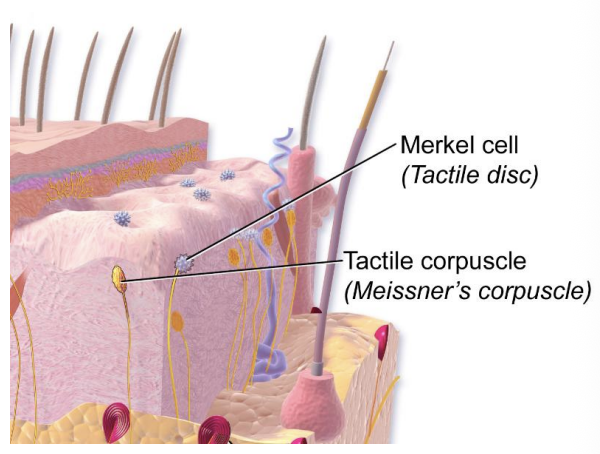
Tactile (Meissner’s) Corpuscles
Nerve endings surrounded by connective tissue capsule
Located in papillae of the dermis (Papillary layer under epidermis, ret underneath )
Stimulated by
Light, fine touch
Vibration
“meiSS"“ = super smooth = light
mice is nice

Lamellated (Pacinian) Corpuscles
Encapsulated nerve endings
Dozens of connective tissue layers (like an onion)
Gelatinous fluid between layers
Located in deep dermis
Stimulated by
Pressure
Vibration
Mechanism of adaptation in Pacinian corpuscle
Receptor ending consisting of concentric layers of connective tissue wrapped around the peripheral terminal of an afferent neuron

Bulbous (Ruffini) Corpuscles
Nerve endings weaving through collagen bundles surrounded by a capsule
Located in dermis
Stimulated by
Stretch
Joint position
“bulb & ruff” = bubble weaves through collagen
Visceral afferents
Carries subconscious input
Internal
Sensory afferents
Carries conscious input
Outer bodily sensations
What does a labeled somatosensory pathway tell the brain, and what do first-, second-, and third-order mean?
The label tells the brain what you felt (modality) and where you felt it (location), like light touch on your left index finger.
First-, second-, and third-order tell you the order of the neurons that relay the signal toward the sensory cortex.
What is Acuity?
“Accuracy”
Influenced by receptive field size and lateral inhibition
Smaller = more precise
Fingertips have higher acuity; two points may feel like one on back

Receptive field
Region of the skin surface surrounding the somesthetic sensory neuron

Lateral inhibition
Each activated signal pathway inhibits the pathways next to it
Strongest signal at contact point, but smaller weaker signals nearby
Perception
conscious awareness of surroundings
Derived from interpretation of sensory input
Exteroreceptors - General Sense Receptor
Detect external stimuli
Interoreceptors - General Sense Receptor
Detect internal stimuli
Proprioception
General sense of body position and movement
Uses proprioceptor neurons & mechanoreceptor nerve endings
muscle spindles - changes in muscle length (stretch)
Golgi tendon organs - tension in tendon (muscle to bone)
joint receptors - joint movement
How your body knows where it is with you eyes closed

Nociceptors Stimulation
pain perception, motivational & emotional responses
Brings awareness of current or impending cell/tissue/body damage
Stores memories of pain to avoid reoccuring
Subcategories:
mechanical, thermal, chemical, and polymodal
A-Delta Fibers
myelinated, small
“fast” pain (e.g., pricking by sharp points)
Axon of Nociceptors
“A” = first = fast
C Fibers
unmyelinated, small
“slow” pain (e.g., dull achey, long lasting)
“C"“= see long = slow
What do cell receptor proteins do for sensory receptor cells?
Cell receptor proteins detect stimuli for sensory receptor cells
Different types of ion channels
Stimulus → Cell Receptor → Sensory Cells
Stimulus → Cell Receptor → Sensory Cells
Thermoreceptors
Chemoreceptors
Mechanoreceptors
Stimulus → Cell Receptor → Sensory Receptor (Cell)
Temperature → Tempertature-gated ion channels → thermoreceptors
Chemicals → ligand-gated ion channels → chemoreceptors
Stretch, distortion, or pressure → mechanically-gated ion channles → mechanoreceptors
Analgesic System
Analgesia: blocking or relief from pain
Suppresses pain pathways as they enter spinal cord
Endorphins released during exercise
Reduces substance P relief
Stress-induced analgesia
Acupuncture analgesia