Perio II, Lecture 6 - Soft Tissue Resective Surgery (Dr. Karimbux)
 Call Kai
 Learn
 Practice Test
 Spaced Repetition
 Match
 Flashcards
 Knowt Play
1/45

There's no tags or description
Looks like no tags are added yet.
46 Terms
When do we perform perio surgery? (4)
- After initial phase therapy SRP
- Followed by re-eval
- Pocket depths remaining in the 4-6mm range
- Or by prescription
Define the following:
Section of gingiva and/or mucosa surgically separated from the underlying tissues to provide visibility of and access to bone and the root surface:
Periodontal flap surgery

What are the 4 classifications of flaps?
- Full thickness
- Partial thickness
- Repositioned
- Unrepositioned
Full thickness and Partial Thickness flap have what type of bevel?
Internal bevel

What type of bevel does a gingivectomy have?
External bevel

What layer is present in a full thickness flap that is NOT present in a partial thickness flap?
Periosteum

Which 2 tissues are elevated during an internal bevel incision with flap reflection?
Gingiva
Periosteum

Which tissues are removed during an external bevel gingivectomy?
Gingiva only (periosteum remains intact)


ID the type of bevel:
Internal bevel

ID the type of bevel:
External bevel
What type of incisions are used for the following?
- Internal bevel incision
- Reverse or INTERNAL bevel incision
- External Bevel
- Crevicular (sulcular) incision
Horizontal

What type of horizontal incision starts at a distance from the gingival margin and is aimed at the bone crest?
Internal bevel
External bevel incisions are primarily used for what?
Gingivectomy

What type of horizontal incision starts at the bottom of the pocket and is directed to the bone margin?
Crevicular/Sulcular incision

ID the type of incision:
Marginal incision
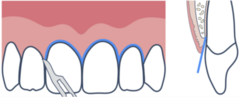
ID the type of incision:
Sulcular incision

ID the type of incision:
Sub marginal incision
Flap design depends on all of the following EXCEPT:
A) Gross anatomy (Tori, nerves, blood supply, foramen)
B) Local anatomy (Amount of keratinized tissue, tooth position, edentulous spaces)
C) Degree of access to the underlying bone
D) Degree of Access to the root surfaces
E) Initial positioning of the flap
E - FINAL positioning of the flap (coronal, apical, lateral)

The following are goals for what?
- Access for Sc/Rp
- Access for removing local etiology (Ex: overhangs)
- Access for restorative procedures (subgingival decay, soft tissue crown lengthening)
Non-osseous surgery
A full thickness flap includes all of the following EXCEPT:
A) Gingival epithelium
B) Gingival connective tissue
C) Cortical plates of bone
D) Periosteum
C) Cortical plates of bone
In a gingivectomy one uses a(n):
A) Internal bevel incision
B) External bevel incision
C) Vertical incision
D) Horizontal incision
B) External bevel incision
What has the following goals?
- Eliminate pockets
- Remove inflamed tissues
- Get access to roots to SC/RP
- Not done when there are infra-boney pockets
- Useful in esthetic areas
Curretage/ ENAP/ Modified widman
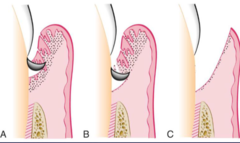
ID the procedure:
- Use of a curette to scrape away the inflammation and calculus
Curettage
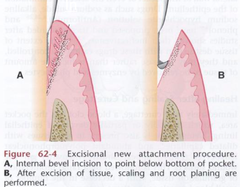
ID the procedure:
- Use of a blade to remove the inflamed tissue (internal bevel incision), then scraping the rest away
ENAP (excisional new attachment procedure)

ID the procedure:
1) Primary incision to crest of bone, reflect 2-3mm
2) Secondary incision releasing collar of tissue
3) Third incision to remove the band of tissue
Modified Widman Flap
ID the procedure:
- Called "open flap curretage technique"
- No osseous recontouring
- Repositioning flap to original location
Modified Widman Flap
T/F: The Original Widman Flap technique included Apical displacement of flap and osseous recontouring
True
The 1st incision in the Modified Widman Flap:
Incision is ___-___ mm from the gingival margin and parallel to the long axis of the tooth
0.5-1 mm

The 2nd incision in the Modified Widman Flap:
After flap elevation, a _____ incision is made to the alveolar crest to separate the tissue collar from the root
Crevicular incision

The 3rd incision in the Modified Widman Flap:
Incision is made ________ to the root surface as close as possible to the bone crest to separate the tissue collar from the bone crest
Perpendicular

T/F: After proper debridement & currettage of angular bone defect flaps are repositioned & sutures. Close adaptation of flaps to tooth surface should be done
True

All of the following are advantages of Modified Widman Flap EXCEPT:
A) Close adaptation of soft tissues to root surfaces.
B) Significant trauma to bone and connective tissue.
C) Less exposure of root surfaces, which is an esthetic advantage in the treatment of anterior teeth
B - MINIMAL trauma to bone and connective tissue
Define the following:
Surgical removal of excess gingival tissue
Gingivectomy

Define the following:
Surgical reshaping or recontouring of gingival tissue to improve its shape and appearance
Gingivioplasty

All of the following are indications for a gingivectomy procedure except:
A) Gingival enlargement/overgrowth (drug-related, hormonal, leukemia, idiopathic fibrosis)
B) Minor corrective procedures for esthetics/orthodontics
C) Subgingival restorative procedures
D) Lack of black triangles
D) Lack of black triangles
What are the three different drugs that can cause gingival overgrowth?
- Cyclosporine
- Calcium Channel Blockers - Nifedipine/Amplodipine
- Phenytoin (dilantin - anticonvulsant)

ID the tool:
Kirkland knife

ID the tool:
Orban knife
What tool is used to make the initial incisions during a gingivectomy?
Kirkland knife
What two characteristics affect the angle of incision in a gingivectomy?
- Tissue thickness
- Mucogingival junction (MGJ)
All of the following are contraindications for gingivectomy/ gingivoplasty EXCEPT:
A) Narrow/absent attached gingiva
B) Infrabony pockets
C) Thinning of alveolar bone
C - THICKENING of alveolar bone

All of the following are the advantages of gingivectomy/ gingivoplasty EXCEPT:
A) Technically simple
B) Complete pocket elimination
C) Unpredictable morphological result
C -PREDICTABLE morphological result

All of the following are disadvantages of gingivectomy/ gingivoplasty EXCEPT:
A) Very limited indication
B) Gross wound, post-operative pain
C) Healing by secondary intention
D) Danger of exposing bone
E) Sacrifice of attached gingiva
F) Exposes cervical area of tooth
G) Esthetics in the posterior
G - Esthetics in the ANTERIOR
T/F: Gingivectomy technique is indicated when osseous surgery is necessary
False
What is the primary goal of periodontal soft tissue
resective surgery?
A) To reduce tooth mobility
B) To regenerate lost alveolar bone
C) To reduce pocket depth by removing diseased gingival tissue
D) To expose furcation
C) To reduce pocket depth by removing diseased gingival tissue
Which of the following is commonly performed during soft tissue resective surgery when there is limited
keratinized tissue?
A) Bone graft placement
B) Membrane placement
C) Apically repositioned flap
D) Coronally repositioned flap
C) Apically repositioned flap